
Fasting Before a Blood Test: What UK Men Need to Know
Some blood tests need an empty stomach and many do not. If you need to fast, it usually means nothing but plain water for a set number of hours, and the clinic that booked your test sets that number. The safest route is simple: check your booking letter or text, follow it exactly, and ask the person who requested the test if anything is unclear.
This guide explains which tests may need fasting, how the hours vary, what you can and cannot have on the morning, what to do if you slip up, and how a finger-prick test differs from a blood draw from the arm. There is no pressure here. A missed instruction is a small, fixable thing.
TL;DR
- Fasting usually means only plain water for a set number of hours. The person who requested your test tells you whether you need to do it and for how long.
- Hours differ by test and by laboratory. NHS trusts list anything from 8 to 14 hours, so follow your own instructions rather than a general rule.
- Cholesterol testing has moved on. Most people no longer need to fast for a routine cholesterol check, but your doctor may still ask you to for some situations.
- If you eat or drink something by mistake, tell the staff on the day. The test may simply be rearranged.
- Take any questions about medicines, including weight-loss treatment, to your own GP or prescriber before the day.
Table of Contents
- Why some blood tests ask you to fast
- Which tests may need fasting
- How long is a fast, and what counts as breaking it
- Do you still need to fast for cholesterol?
- If you ate or drank by mistake
- Finger-prick or arm: what is the difference?
- Blood tests men commonly ask about
- A simple plan for the day before
- A longer test: the glucose tolerance test
- Free support alongside your tests
- FAQ
- Sources
Why some blood tests ask you to fast
Food and drink put fats, sugars, vitamins, minerals and proteins into your blood. One NHS hospital trust leaflet explains that these can cloud some test results, so certain tests give a more useful reading when you have not eaten. The same leaflet says your doctor decides whether you should fast and for how long.
The NHS blood tests page says the GP, nurse or specialist should tell you if you need to prepare, for example by not eating or drinking anything except water for a short time before some tests. It also mentions that some people need to stop certain medicines, such as anticoagulants, beforehand. That decision belongs to whoever prescribes them.
So the first step is easy: read what you were sent. If nothing mentions fasting, you most likely do not need to.
Which tests may need fasting
The example list below comes from NHS hospital trust guidance. Trusts do not all use the same hours, so treat it as a guide to what is typical and not as your instruction.
| Test | Fasting time in one NHS trust leaflet | Fasting time in another NHS trust's instructions |
|---|---|---|
| Fasting glucose | 8 hours | 14 hours (non-diabetic), 10 hours (insulin-treated diabetes) |
| Lipids (cholesterol and triglycerides) | 12 to 14 hours | 14 hours (non-diabetic and tablet-treated diabetes), 10 hours (insulin-treated diabetes) |
| Homocysteine | 8 hours | 12 hours, Monday to Thursday only |
| Testosterone | 8 hours | Not listed |
| Glucose tolerance test | 8 to 14 hours | 12 hours, then a glucose drink and a two-hour wait |
Sources: East Kent Hospitals NHS leaflet, October 2021 and East Sussex Healthcare NHS Trust phlebotomy page.
The gaps between the two columns are the point. Local laboratories set their own rules, which is why your own letter beats any table, including this one.
How long is a fast, and what counts as breaking it
Most fasts in the table sit between 8 and 14 hours. In practice that often means an early evening meal, nothing after it except water, and a morning appointment. Many men find a first-thing slot easiest because you sleep through most of the fast.
The East Kent leaflet is clear about the morning itself:
- Water only.
- No breakfast.
- No tea, coffee or fizzy drinks.
- No chewing gum.
- No smoking, which includes vaping and nicotine patches.
The East Sussex instructions say the same thing from another angle: nothing to eat and only plain, unflavoured water. Squash, flavoured water and "just a splash of milk" all count as breaking the fast.
Water is allowed, and can help
Plain water is fine. East Sussex Healthcare NHS Trust even advises drinking more plain water in the hours before your appointment, especially if you are known to be difficult to take blood from, because it can make the blood draw easier. Stay hydrated, and do not treat fasting as a reason to go thirsty.
Medicines and fasting
The East Kent leaflet says not to change your medication unless your doctor tells you to. It also says to speak to your doctor if a medicine needs to be taken with food, or if you have diabetes. Fasting can affect blood sugar in people on diabetes treatment, which is why the East Sussex hours are shorter for those on insulin.
If you take weight-loss medication, blood pressure tablets or anything else regularly, ring your GP surgery or prescriber a few days beforehand and ask what to do on the morning. Individual treatment decisions sit with them, not with a general article like this one.
Do you still need to fast for cholesterol?
Often not. This is the biggest change in UK practice, and it is why friends and relatives may tell you different things.
The NHS cholesterol testing page, last reviewed on 13 March 2026, says that for a blood test taken from the arm you might be asked to fast for up to 12 hours, but most people do not need to. Results go to a laboratory and usually come back within a few days.
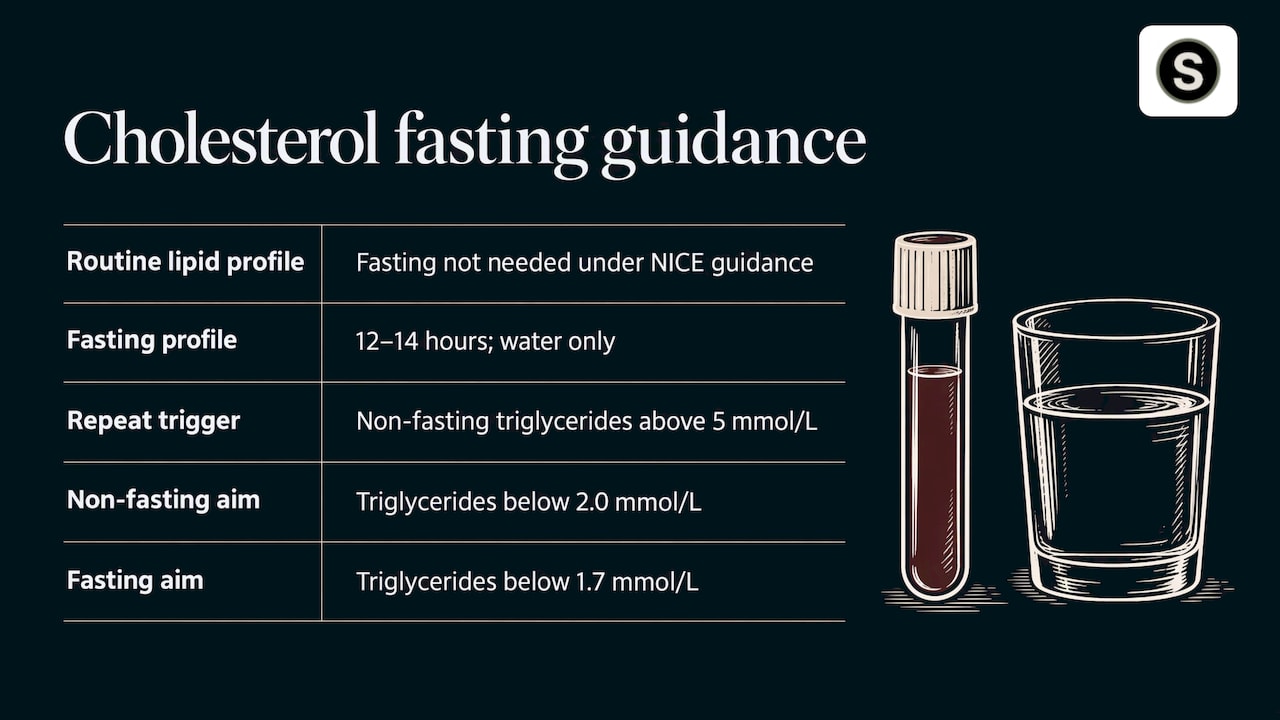
A pathology service page for a lipid profile says that NICE guidance, now NICE NG238, no longer asks people to fast for routine lipid profiles. The same page notes that a fasting profile, when requested, needs 12 to 14 hours on water only, and that a fasting repeat is recommended if a non-fasting triglyceride result is above 5 mmol/L.
HEART UK, the cholesterol charity, says on its triglycerides page (updated 3 March 2025) that national UK guidelines no longer recommend a fasting test for triglycerides. It gives a non-fasting aim of below 2.0 mmol/L, and below 1.7 mmol/L if a doctor does ask you to fast, usually for 10 to 14 hours. Triglycerides are a type of fat in the blood.
A joint statement from HEART UK and the Association for Laboratory Medicine adds that a fasting sample can still be useful where high triglycerides matter. It also says UK laboratories should offer both options and record which one was used. It points out that non-fasting tests are more convenient and avoid unnecessary fasting for people at risk, such as those on certain diabetes medicines.
What this means for you: if your cholesterol test comes with no fasting instruction, that is normal now. If it does come with one, follow it. Either way, the person reading your result needs to know whether you had eaten, so mention it on the day.
If you ate or drank by mistake
It happens, especially on a busy morning. A cup of tea on autopilot does not mean you have wasted anyone's time.
The Gateshead Health guidance for its glucose tolerance test says to tell staff that morning if you have eaten, drunk or smoked, because the appointment may need to be rearranged. That guidance was written for a pregnancy test, but the logic carries over: an honest answer lets the team decide whether the result will still be useful.
A quick way to handle it:
- Say what you had and roughly when, at the desk or to the person taking your blood.
- Let them decide whether to go ahead, change the test or rebook.
- Do not try to "make up for it" with extra fasting. Follow the new instructions you are given.
Finger-prick or arm: what is the difference?
Both give a sample, but they are used differently.
The NHS blood tests page explains that blood is usually taken from the inside of the elbow with a needle, and sometimes from the wrist or finger in a finger-prick test. A venous (arm) test takes about 10 minutes. A soft strap goes round your upper arm to make the vein easier to find, you feel a scratch as the needle goes in, and the blood fills a small tube that goes to a laboratory. Afterwards you get cotton wool or a plaster, and you may see some bruising or swelling that fades over a few days.
For cholesterol, the NHS describes the finger-prick option on its cholesterol testing page. It is available during an NHS Health Check if you are over 40, and at some pharmacies. A drop of blood goes on a paper strip, a machine reads it, and you get a result in a few minutes. The arm test, by contrast, is the one sent to a lab and returned in a few days.
Why does that matter for fasting? The instruction depends on the test being done, not on how the blood is collected. A fasting glucose still needs the fast whether the sample comes from a finger or an arm. Check the instruction for the test, not the method.
If you would like to see what an arm collection involves, what to expect at a blood test walks through the appointment. Our own explainer on upper-arm home collection covers the same method in more detail.
Blood tests men commonly ask about
Many men book tests for a reason: weight, energy, blood pressure, sleep or mood. Here is how fasting tends to come up for the usual ones.
Weight and metabolic checks
Blood sugar and lipids are the two checks where fasting most often appears, which is why they are in the table above. Our guide to weight loss blood tests for UK men explains six common checks in plain English, and what common blood tests actually check is a good starting point if the names on your form mean nothing to you.
Testosterone
The East Kent leaflet lists testosterone at 8 hours of fasting as an example. Timing matters for this test too, so see our pages on testosterone blood test timing and testosterone blood tests: preparation and results. Your own doctor or the service that ordered the test will confirm the exact instructions for you.
Liver, kidney and iron
These are covered in separate guides on liver and kidney blood tests and iron, ferritin and full blood count. Again, whether you fast depends on what was requested, so read the instructions you were given.
Home sample kits
If you are posting a sample, timing and fasting get an extra layer of planning. Our guide on preparing a sample: fasting, timing, medicines and posting goes through it step by step.
A simple plan for the day before
Here is a routine that fits around work and family, whatever the fasting hours are.
- Read the instruction. Look at your letter, text or app message and note the fasting hours and the appointment time.
- Count back. If you have to fast for 12 hours and your appointment is at 8am, your last meal needs to finish by about 8pm the evening before. Put a reminder in your phone.
- Plan the last meal. Something you enjoy and that keeps you full, such as a normal dinner. No need for anything special.
- Sort medicines. Ring your GP surgery or prescriber if you are unsure whether to take a tablet or injection on the morning.
- Pack for afterwards. Take a snack and a drink for once the sample is taken, and wear a top with loose sleeves. Gateshead Health suggests both for its longer glucose tolerance test, and they help for any fasting test.
- Drink water. Plain water is allowed, and drinking a little more in the hours beforehand can help the blood draw go smoothly.
A breakfast you can grab straight after the test makes the morning feel less rough. Our garlic egg potato breakfast hash with mushrooms can be made ahead and reheated, and the paprika turkey potato breakfast hash is another option.
A longer test: the glucose tolerance test
The oral glucose tolerance test is the longest fasting test you are likely to meet. Gateshead Health describes it as taking about 2.5 hours. You give a fasting sample on arrival, drink a glucose drink within five minutes, then stay put for two hours, with no walking around, eating or smoking, and only sips of water. A second sample is taken, after which you can eat and drink. If you vomit, the test is abandoned and a repeat or alternative is offered. That page is written for pregnancy, so your own trust's leaflet is the one to follow, but it shows what to expect: bring something to keep you occupied.
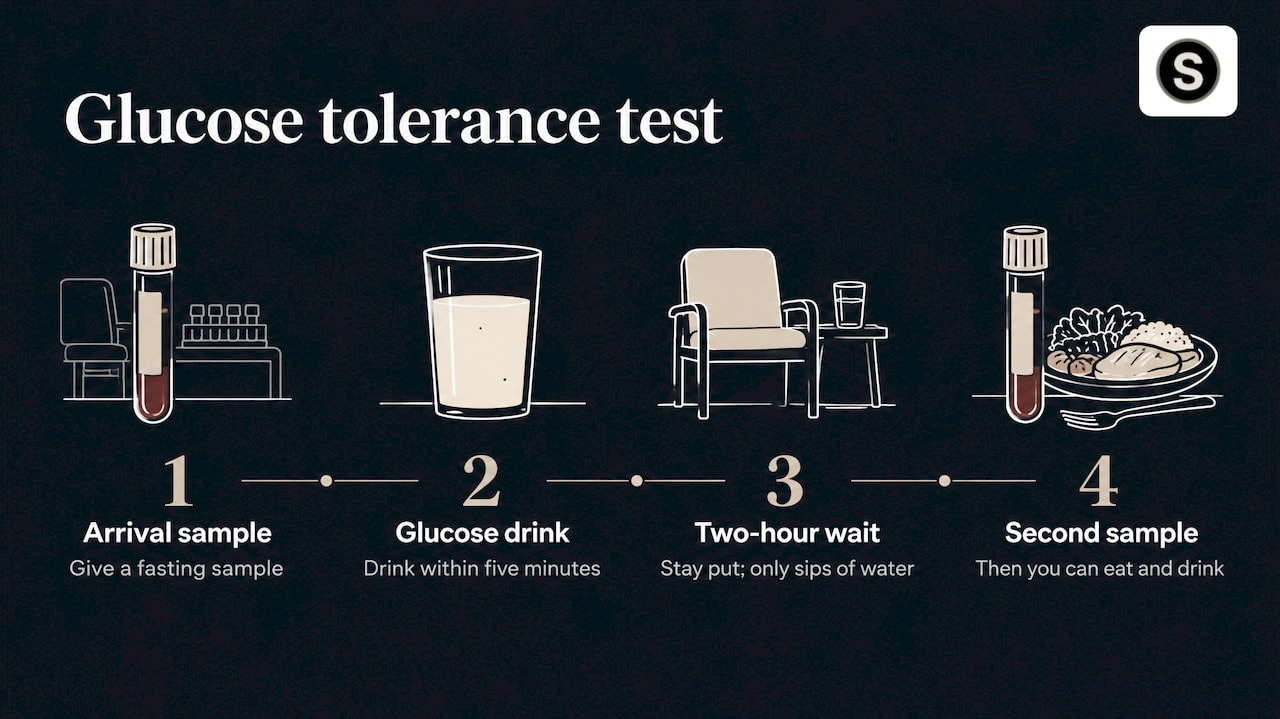
East Sussex Healthcare NHS Trust lists its version as 12 hours of fasting, a glucose drink and then two hours of inactivity before the second sample.
Free support alongside your tests
Blood test results are only useful if you know what to do with them. Our understanding blood-test results and follow-up page helps you prepare questions, and the Men's Health MOT guide gives you a wider checklist to talk through with your GP.
Shift Some Timber offers My Timber, free practical support for food, movement, check-ins and progress. You can use it alongside your own clinic or prescriber, after treatment ends, or without any treatment, and you do not need a prescription transfer or a purchase. Individual treatment decisions stay with your own prescriber. You can start from the Shift Some Timber home page, or browse the Men's Health Knowledge Hub for plain-English health information.
FAQ
Can I drink water before a fasting blood test?
Yes. Plain water is allowed and is part of the standard fasting instruction in the NHS trust guidance above. East Sussex Healthcare NHS Trust even suggests drinking more of it beforehand. Avoid flavoured water, squash, tea, coffee and fizzy drinks.
Do I need to fast for every blood test?
No. Only some tests need it, and your GP, nurse or specialist should tell you when preparation is required. For cholesterol, the NHS says most people do not need to fast, though you might be asked to for up to 12 hours in some cases.
What if I take regular medicines or have diabetes?
Do not stop or change anything on your own. The East Kent leaflet says to follow your doctor's advice on medication and to speak to them if a medicine needs food or if you have diabetes. Contact your GP surgery or prescriber before the day.
Is a finger-prick test the same as a blood test from the arm?
Both collect blood, but they are used differently. A finger-prick gives a drop for a quick machine reading, such as a cholesterol check at an NHS Health Check or pharmacy. An arm test fills a tube that goes to a lab and comes back in a few days. Fasting depends on the test requested, not the method.
Can I smoke or vape while fasting?
The East Kent leaflet says no smoking, including vaping and nicotine patches, during the fast. If you use nicotine replacement, ask your GP or pharmacist what to do on the morning.
Sources
- Blood tests, NHS
- High cholesterol: getting tested, NHS
- Fasting for your blood test, East Kent Hospitals NHS
- Phlebotomy (blood tests), East Sussex Healthcare NHS Trust
- Having an Oral Glucose Tolerance Test (OGTT) in pregnancy, Gateshead Health NHS
- Lipid profile, Sussex NHS pathology
- What are triglycerides, HEART UK
- Standardising lipid testing and reporting in the United Kingdom, HEART UK and the Association for Laboratory Medicine
Recommended
- Preparing a sample: fasting, timing, medicines and posting
- Testosterone blood tests: preparation and results explained
- Liver and kidney blood tests: what they can and cannot show
- Understanding blood-test results and follow-up
SHIFT provides general UK health information and practical support. Speak to your GP or your own prescriber about symptoms, test results or medicines. My Timber is free to use alongside your own clinic, after treatment ends or without treatment.
Last updated .