
16–20 Weeks: Wegovy Side Effects Timeline, Dose Steps and Red Flags
Most men notice Wegovy side effects within the first few days of that initial injection, or in the days after each dose step-up. Nausea and stomach upset usually settle within a few days to a few weeks. Constipation tends to hang around longer. Stop the injection and get urgent medical help straight away for severe abdominal pain, sudden changes to your vision, serious dehydration, or any sign of a severe allergic reaction.
TL;DR:
- Most side effects, including nausea and vomiting, peak within the first week of each dose increase and typically improve as the body adjusts.
- Constipation often lasts longer and may require ongoing fiber and hydration strategies for relief, even during the maintenance phase.
- Severe symptoms such as persistent abdominal pain, inability to keep fluids down, rapid vision loss, or signs of allergic reactions require immediate medical attention and discontinuation of Wegovy.
- Dose escalation from 0.25mg to 2.4mg usually spans 16 to 20 weeks, with delays or pauses in increasing doses common to improve tolerability.
- A six-month review assesses weight loss progress and side effects, with ongoing support and symptom management critical for completion and safety.
Table of Contents
- [Wegovy side effects timeline: what "normal" actually looks like](#wegovy-side-effects-timeline-what-normal-actually-looks-like)
- [Side effect frequency and the dose escalation schedule](#side-effect-frequency-and-the-dose-escalation-schedule)
- [Weeks 1 to 4 on 0.25mg: the first month and how to get through it](#weeks-1-to-4-on-025mg-the-first-month-and-how-to-get-through-it)
- [Weeks 5 to 8 on 0.5mg: reflux and constipation start to bite](#weeks-5-to-8-on-05mg-reflux-and-constipation-start-to-bite)
- [Weeks 9 to 12 on 1.0mg: appetite drops, but pacing matters more than speed](#weeks-9-to-12-on-10mg-appetite-drops-but-pacing-matters-more-than-speed)
- [Weeks 13 to 20 and beyond: what lingers and what's rare but serious](#weeks-13-to-20-and-beyond-what-lingers-and-whats-rare-but-serious)
- [When to stop Wegovy and get urgent help](#when-to-stop-wegovy-and-get-urgent-help)
- [Practical self-care that actually prevents complications](#practical-self-care-that-actually-prevents-complications)
- [The six-month review and life after stopping](#the-six-month-review-and-life-after-stopping)
- [How ongoing support can help you through dose escalation](#how-ongoing-support-can-help-you-through-dose-escalation)
- [Where this information comes from](#where-this-information-comes-from)
- [Sources](#sources)
- [FAQ](#faq)
Wegovy side effects timeline: what "normal" actually looks like
Nausea is the side effect most men mention first, and it's also the most common one flagged in the Wegovy summary of product characteristics (SmPC). Vomiting, diarrhoea, constipation, headache and fatigue round out the list of things you're likely to notice, particularly in that first stretch of treatment.
Here's the reassuring part: most of these reactions are mild to moderate, and they cluster around two specific moments, starting the drug and stepping up the dose. That pattern is worth remembering, because it means the worst of it usually has a clear beginning and, for most men, a clear end too.
- Nausea, often the first thing you'll feel, typically within days of your first jab
- Vomiting, less common than nausea but still frequent during escalation
- Diarrhoea, usually intermittent rather than constant
- Constipation, slower to appear but often slower to leave too
- Headache and fatigue, generally mild and short-lived
Statistic Callout: In pooled phase 3 trial data behind the Wegovy SmPC, nausea affected roughly 38.9 to 43.9% of patients and vomiting affected around 22.1 to 24.5%. Diarrhoea and constipation were also common enough to be listed among the most frequently reported reactions.
Side effect frequency and the dose escalation schedule
Wegovy follows a fixed escalation path: 0.25mg, then 0.5mg, 1.0mg, 1.7mg, and finally the 2.4mg maintenance dose. Each step normally sits at four weeks, meaning the full climb to maintenance takes about 16 to 20 weeks. That escalation window is where the Gov says side effects are most likely to strike, both at the very start and after every increase.
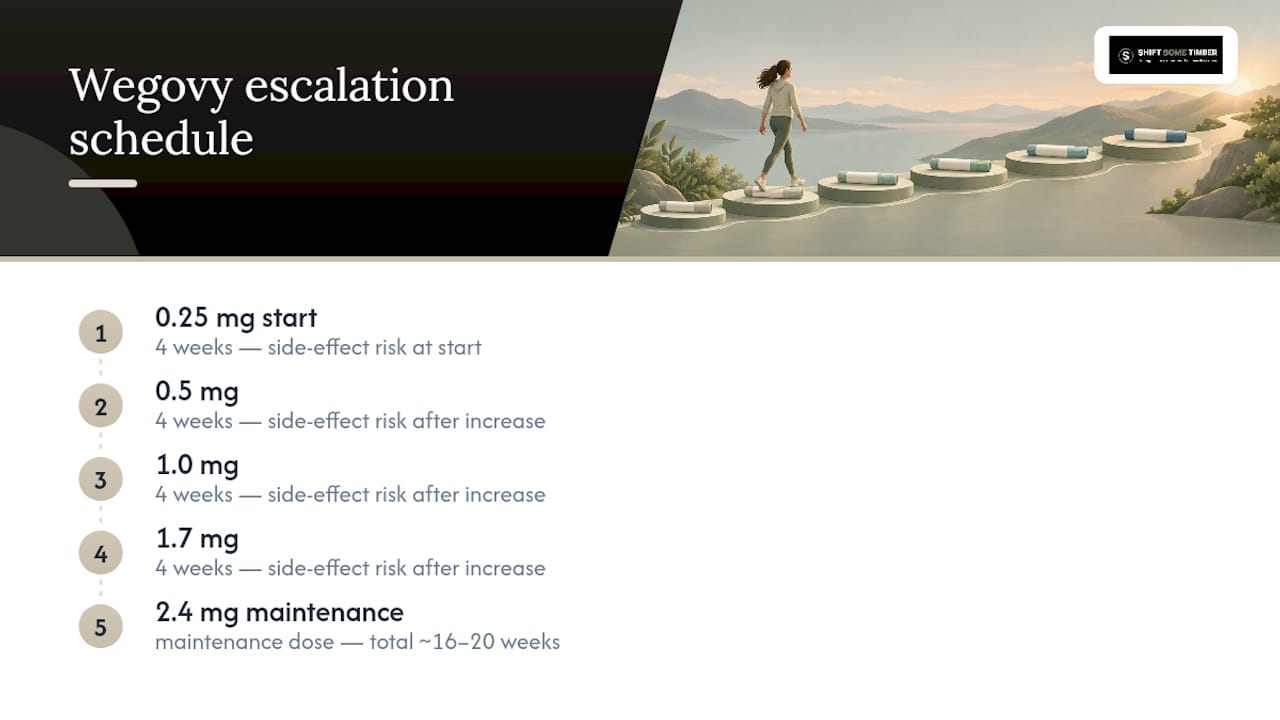
The percentages below come from pooled phase 3 trial data reported in the SmPC. They describe what happened across large trial populations, not what will definitely happen to you, so treat them as a guide to likelihood rather than a promise.
Individual experiences vary widely. Some men breeze through escalation with barely a twinge; others feel every step. Neither response tells you much about how well the drug is working for weight loss.
Weeks 1 to 4 on 0.25mg: the first month and how to get through it
This is usually the roughest patch, if there's going to be a rough patch at all. Nausea tends to arrive within the first few days of that opening injection and peaks somewhere in week one, easing as your body adjusts to the drug slowing gastric emptying.
A few practical moves make a real difference here:
- Eat smaller meals more often, rather than three big ones
- Sip fluids steadily through the day instead of gulping large amounts
- Skip fatty, greasy or heavily fried food for now, it tends to sit badly
- Ask your pharmacist about antiemetic options if nausea is persistent rather than passing
- Rest when you need to; fatigue in week one is common and usually short-lived
Pro Tip: Keep a bottle of water or squash within arm's reach on injection day and the day after. Men who wait until they feel thirsty to drink are usually already a step behind on hydration, and that's when nausea turns into something worse.
Call your prescriber or pharmacist if vomiting won't stop, or if you notice signs of dehydration such as a dry mouth, dizziness on standing, or dark urine. That's not a symptom to push through alone.
Weeks 5 to 8 on 0.5mg: reflux and constipation start to bite
The first dose increase, from 0.25mg to 0.5mg, often brings a short flare of symptoms lasting a few days as your gut recalibrates. Reflux and heartburn tend to show up more here than they did in month one, and constipation often starts building rather than resolving on its own.
Simple, pharmacy-shelf strategies usually get on top of this:
- Increase fibre gradually rather than all at once, sudden fibre spikes can worsen bloating
- Keep fluid intake up, fibre without enough water tends to make constipation worse, not better
- Try a gentle osmotic laxative if things haven't moved in a few days
- Take reflux medication after meals rather than on an empty stomach if your pharmacist recommends one
If constipation comes with vomiting, or your abdomen feels noticeably swollen and tender, that's not a "wait and see" situation, get medical advice promptly.
Weeks 9 to 12 on 1.0mg: appetite drops, but pacing matters more than speed
By this stage, most men notice a genuine shift in appetite. Food noise, that constant background chatter about what to eat next, quietens down considerably for many. Some still get a wave of mild nausea around injection day itself, even without a dose change, which is a normal part of how the drug behaves at this level.
- Track how you feel for two or three days after each injection, not just the day itself
- If tolerability is genuinely poor, ask your prescriber about delaying the next step rather than pushing through on schedule
- Report anything unusual to your clinic rather than assuming it will simply pass
- Keep an eye on whether appetite suppression is affecting your ability to eat enough overall, not just too much
Dose escalation isn't a race. Delaying a step-up by a couple of weeks to let your gut settle is a completely normal clinical decision, not a failure.
Weeks 13 to 20 and beyond: what lingers and what's rare but serious
Constipation is usually the last symptom standing. Nausea and vomiting tend to fade as your body adapts to each dose, but sluggish bowels can persist well into the maintenance phase, and it's worth staying proactive about fibre and fluids rather than waiting for it to resolve alone.
- Hair thinning has been reported in some men on longer-term treatment, usually linked to rapid weight loss rather than the drug itself
- Gallstones can develop over months, particularly with faster weight loss
- Sudden vision changes, including a rare condition called NAION (non-arteritic anterior ischaemic optic neuropathy), need urgent same-day assessment whenever they occur, not just early in treatment
- Signs of pancreatitis, severe and persistent abdominal pain, warrant stopping treatment and seeking care immediately
Statistic Callout: Trial data behind the Wegovy SmPC put acute pancreatitis at roughly 0.2% of patients, a small but real risk that's why persistent severe abdominal pain is never something to sit with.
When to stop Wegovy and get urgent help
A handful of symptoms mean you stop the injection and get seen straight away, not next week, not "if it doesn't improve." These matter regardless of how far into treatment you are.
- Severe, persistent abdominal pain, especially if it spreads to your back. This may signal pancreatitis, and the Wegovy patient information leaflet is explicit that this warrants urgent medical attention.
- Vomiting or diarrhoea you can't keep fluids down from. Left unaddressed, this risks dehydration and, in severe cases, damage to your kidneys.
- Sudden or rapidly worsening vision loss. This needs urgent ophthalmology assessment, and treatment should stop while it's investigated.
- Signs of a severe allergic reaction or anaphylaxis, such as swelling of the face or throat, difficulty breathing, or a widespread rash with dizziness. Call emergency services immediately.
None of these are "wait until Monday" situations. They're stop the drug, get seen now.
Practical self-care that actually prevents complications
Most of the damage from GI side effects comes not from the nausea or diarrhoea itself, but from what happens if you don't replace fluids. Dehydration during a bad vomiting or diarrhoea spell can genuinely put your kidneys at risk if it runs on too long without correction.
- Aim to sip fluids consistently through the day rather than large amounts infrequently, particularly during a flare
- Favour small, low-fat meals with bland, carbohydrate-rich snacks (toast, plain crackers, rice) when your stomach is unsettled
- Time meals around your injection rather than eating heavily right before or after
- Ask your pharmacist about oral rehydration sachets if diarrhoea or vomiting last more than a day
Pro Tip: Plain water isn't always enough during a bad flare, it replaces fluid but not the electrolytes you're losing. An oral rehydration sachet from the pharmacy is cheap, quick, and does the job properly.
If symptoms don't ease with these steps within a day or two, that's the point to escalate to your prescriber rather than continuing to manage it yourself.
The six-month review and life after stopping
NICE guidance (TA875) points to a formal review at around six months, weighing up how much weight you've lost against how much the side effects have cost you day to day. That review is also when ongoing risks like gallstones, eye changes and hydration issues should get a proper check.
- Expect your clinic to assess percentage weight loss against a set threshold at this six-month mark
- Flag any persistent symptoms before the review, not just on the day
- If you and your clinician decide to stop treatment, plan ahead for what typically happens after stopping GLP-1 medication, including appetite and food noise returning for many men
- Lifestyle support doesn't need to end just because the injections do
How ongoing support can help you through dose escalation
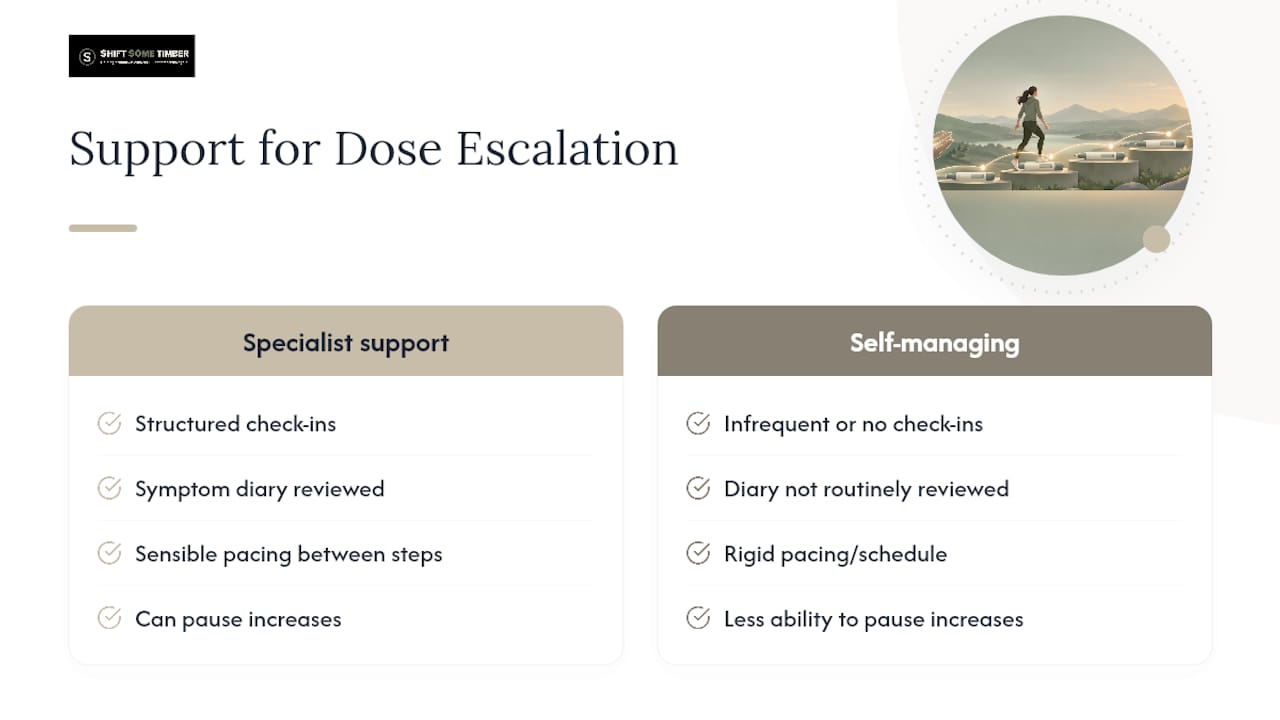
Escalation weeks are where most men either push through or quietly give up. Structured check-ins, sensible pacing between dose steps, and someone actually looking at your symptom diary rather than a rigid schedule, that combination is what keeps men on track without white-knuckling through weeks of nausea.
Practical support matters more than clinical jargon here: nutrition advice that actually fits your week, hydration checks when you're having a rough patch, and the option to pause an increase rather than forcing it. If you're weighing up whether supervised specialist support suits you better than managing dose changes alone, that structure is exactly where it earns its keep. Structured pacing and support built into a programme can help men get through escalation with the fewest bad weeks possible, which is half the battle.
Where this information comes from
The figures and warnings above draw on the Wegovy SmPC and patient information leaflet, the MHRA safety update on GLP-1 receptor agonists, NHS patient guidance on semaglutide, and NICE guidance TA875. Report any side effect to your GP, pharmacist, or via the Yellow Card scheme, and get advice through NHS 111 for anything that doesn't feel urgent but doesn't feel right either.
This article is general information, not a substitute for advice from a qualified doctor. Consult a qualified healthcare professional about your own circumstances before acting on anything here.
Sources
- Wegovy 2.4 mg, FlexTouch solution for injection in pre-filled pen - SmPC (emc)
- Gov
- NICE final appraisal document (TA875)
FAQ
How long after taking Wegovy do you feel side effects?
Most men feel something, usually nausea, within the first few days of their initial injection. The same pattern repeats after each dose increase, with symptoms typically peaking in the first week and easing over the following one to two weeks.
What's the worst day on Wegovy?
For most men, the roughest stretch is the first few days after the very first injection or immediately following a dose increase, when nausea and fatigue tend to peak. It's rarely a single day so much as a short window that fades as your body adjusts.
What is the number one side effect of Wegovy?
Nausea is the most commonly reported side effect, affecting roughly 39 to 44% of patients in pooled trial data. It's usually mild to moderate and settles within days to a few weeks.
What is the average weight loss on Wegovy after one month?
Weight loss in the first month is typically modest, since you're still on the lowest starting dose of 0.25mg, and the priority at this stage is tolerability rather than rapid results. Meaningful weight loss tends to build as you move through the escalation schedule towards the 2.4mg maintenance dose.
How long do Wegovy side effects last overall?
Most gastrointestinal side effects, nausea, vomiting and diarrhoea, resolve within days to a few weeks of each dose stage. Constipation is the exception and can persist for longer, often needing ongoing fibre and fluid management well into the maintenance phase.