
Weight Loss Medication Eligibility in the UK: Who Qualifies
To get weight loss medication in the UK, your BMI and your health both count. The licensed starting point is a BMI of 30 or above, or 27 to 30 with a weight-related health condition. The NHS is much stricter than the licence, because access is being rolled out in phases to the highest-need groups first. Private prescribing follows the licence, but only after a proper clinical check.
This guide focuses on medicine licences and private clinical assessment. NHS funding and access are separate questions with different routes for different medicines. For a current explanation of NHS specialist and phased primary-care eligibility, see our NHS medication-access guide. The information is written for men, but the clinical rules apply across eligible adult populations.
TL;DR
- The licence for medicines such as Wegovy and Mounjaro covers a BMI of 30 or above, or 27 to 30 with at least one weight-related condition.
- NHS eligibility is not one BMI rule. For tirzepatide, NICE specialist-service guidance includes BMI of at least 35 with a weight-related condition; the current NHS England primary-care phase is more restricted, generally requiring BMI of at least 35 and four of five specified conditions (with relevant ethnicity adjustments). See our NHS medication-access guide for the different routes.
- Meeting the criteria does not guarantee a prescription. A clinician has to confirm the medicine is right and safe for you.
- There is a stop rule: if you haven't lost at least 5% of your starting weight after 6 months on the highest tolerated dose, the medicine is normally reviewed.
- If you do not qualify for a particular medicine or NHS route, other forms of support are available. Alternative medicines each have their own licensing and clinical eligibility rules.
Table of Contents
- The short version: licence versus NHS rules
- What your BMI needs to be
- Who is likely to qualify: a quick check
- Why meeting the criteria isn't a guarantee
- Other medicines if GLP-1s aren't right for you
- The stop rule and what happens after
- Safety points to know before you apply
- Our view
- Where SHIFT fits in
- FAQ
- Sources
The short version: licence versus NHS rules
Two different sets of rules get mixed up online, and that is where most of the confusion comes from.
The licence is what the regulator, the MHRA, has approved a medicine for. It sets the outer limit of who can be prescribed it. When the MHRA approved the first semaglutide tablet for weight loss on 11 June 2026, it was for adults with obesity (BMI of 30 or above) or overweight adults (BMI 27 to 30) with at least one weight-related condition. That tablet is not yet available on the NHS and still faces a NICE evaluation.
NHS funding rules are set by NICE and NHS England. They are narrower, because the NHS has to prioritise limited budgets and specialist capacity. You can be eligible under the licence and still not be eligible for an NHS prescription.
| Licence (MHRA) | NHS funding (NICE / NHS England) | |
|---|---|---|
| BMI | For the named injectable medicines, usually 30 or above, or 27 to under 30 with a weight-related condition | No single NHS threshold: NICE specialist recommendations and the phased England primary-care cohorts differ by medicine, service and qualifying conditions |
| Ethnicity adjustment | Clinician judgement | Threshold usually 2.5 lower for specified backgrounds |
| Access | Via a registered prescriber, NHS or private | Phased, often via specialist weight management services |
| Time limits | Set by the prescriber | Semaglutide on the NHS is capped at two years |
What your BMI needs to be
BMI is your weight in kilograms divided by your height in metres, squared. The NHS has a free BMI calculator if you want a quick check. BMI is a blunt tool, especially for men who carry a lot of muscle, so clinicians also look at waist size and your overall health. But it is still the number the eligibility rules are written around.
NHS specialist guidance versus current England primary-care access
NICE's tirzepatide recommendation includes adults with an initial BMI of at least 35 and at least one weight-related condition, subject to clinical assessment and specified ethnicity adjustments. That describes the broader NICE recommendation and specialist-access context; it does not mean that a GP practice can currently prescribe tirzepatide for obesity to everyone with BMI 35 and one condition.
NHS England's phased primary-care commissioning guidance sets a narrower priority cohort for 2026/27: generally BMI of at least 35 with four of five specified conditions (hypertension, dyslipidaemia, obstructive sleep apnoea, cardiovascular disease and type 2 diabetes), subject to their clinical definitions and the usual 2.5 BMI adjustment for specified ethnic backgrounds. Specialist services and other UK nations have their own access pathways.
For the current phase, which services take referrals and what to ask next, use our NHS medication-access guide. A clinician or commissioned service determines individual eligibility; a BMI calculation alone cannot.
Wegovy and the two-year cap
For semaglutide (Wegovy), NICE's recommendation allows it as an option alongside a reduced-calorie diet and more physical activity, but only for a maximum of two years and within a specialist weight management service. We unpack the numbers in our guide to Wegovy eligibility for UK men.
The private threshold
Private prescribers work to the licence rather than the NHS funding rules. For injections, that is typically a BMI of 30 or above, or 27 to 30 with a weight-related condition. A BMI under 27 is outside the licence, and a responsible prescriber will say no. These medicines are not intended for cosmetic weight loss. The MHRA has been clear that GLP-1 medicines are serious treatments to be used under medical supervision, and only prescribed by a registered healthcare professional.
Who is likely to qualify: a quick check
Use this as a rough guide, not a decision. Only a clinician who has your full history can confirm it.
- Work out your BMI. Use your current weight, not the one you're aiming for.
- Note any weight-related conditions. High blood pressure, high cholesterol, sleep apnoea, type 2 diabetes and heart disease all matter. Take a note of any diagnoses and medicines you take.
- Check your ethnic background. If it falls in the groups with a lower threshold, your BMI cut-offs drop by 2.5.
- Think about your history. Pancreatitis, certain thyroid conditions, eating disorders and other medicines can rule a medicine out or change the choice. Be upfront about all of it.
- Be honest about what else you've tried. Prescribers expect the medicine to sit alongside diet and activity changes, not replace them.
Worked examples
These are illustrations, not real patients.
- A 44-year-old with BMI 36 and high blood pressure alone. This does not meet the current NHS England primary-care tirzepatide priority cohort, which generally requires four of five specified conditions alongside the applicable BMI threshold. He can ask about specialist assessment and other support; neither a referral nor a prescription is guaranteed.
- A 38-year-old with a BMI of 31 and no health conditions. He is under the NHS threshold, but within the licence. Private prescribing may be an option after a clinical assessment.
- A 50-year-old with a BMI of 28 and sleep apnoea. He is outside the NHS criteria but inside the licensed range of 27 to 30 with a related condition. A prescriber would weigh up the benefits and risks.
- A 35-year-old with a BMI of 26. Outside the licence. Other support is the right route.
Why meeting the criteria isn't a guarantee
This is the part that frustrates people most. NICE's own implementation toolkit makes clear that NHS access often runs through specialist Tier 3 or Tier 4 weight management services, and that waiting lists and supply issues vary by area. So you can tick every clinical box and still wait.
Our guide to NHS weight loss drugs and why it depends on your postcode goes through how that plays out.
Even on the private route, a prescriber can say no. They might spot a condition, a medicine interaction or a history that makes treatment unsuitable. That is the system working properly.
Other medicines if GLP-1s aren't right for you
GLP-1 injections get the headlines, but they aren't the only option.
Orlistat is the long-standing alternative. According to a NHS formulary entry, it can be prescribed for adults with a BMI of 30 or above, or 28 or above with associated risk factors, as part of an overall plan that includes diet and behaviour change. A lower-dose 60mg version is also available from community pharmacies.
The new tablet (oral semaglutide) is licensed but, as of the MHRA announcement, not yet NHS-funded. Our piece on oral semaglutide for weight loss in the UK explains what the trial results do and don't tell you.
Comparing injections. If you are weighing up different injectable medicines, our Wegovy vs Saxenda comparison sets out the differences. For an overview of what's involved, our GLP-1 guide for UK men is the place to start.
The stop rule and what happens after
Eligibility isn't a one-off test. NICE's prescribing guide describes a stop rule: if you haven't lost at least 5% of your starting weight after 6 months on the highest tolerated dose, a specialist is advised to reassess or stop. For a man starting at 120kg, that is 6kg.
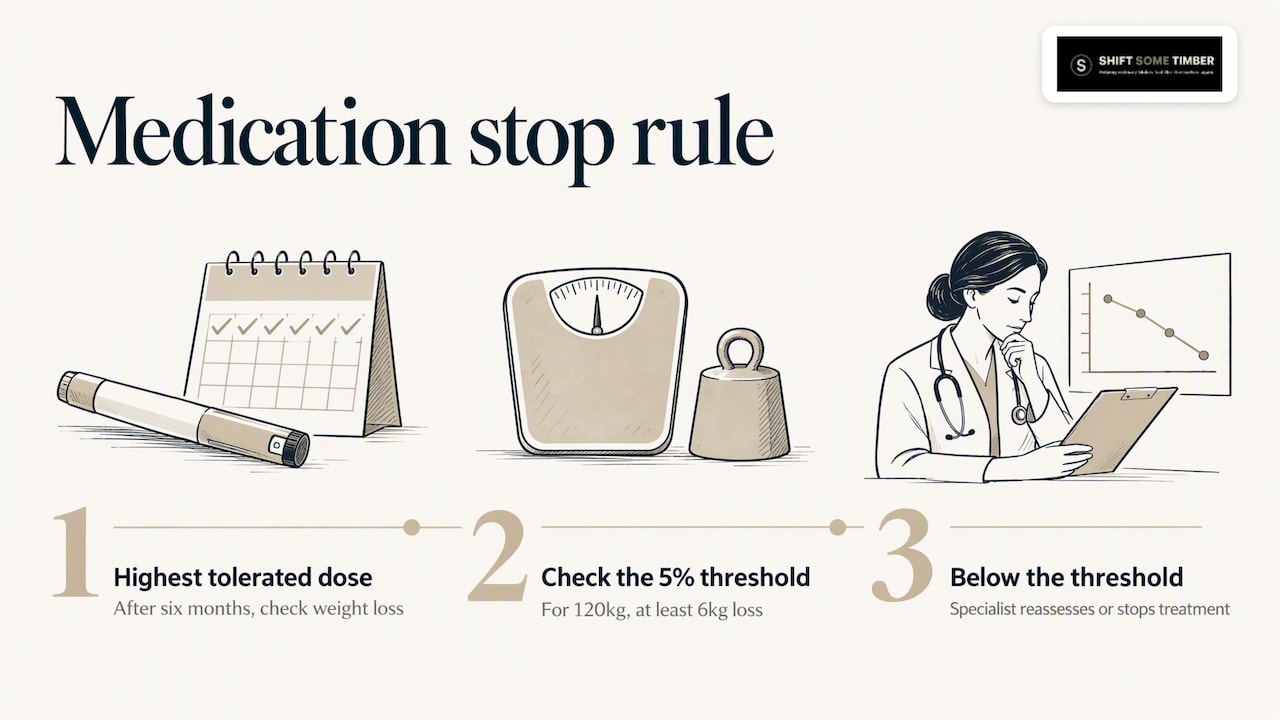
The same guidance is clear that there is no automatic maintenance prescription once you stop, and that without continued changes to food and activity, weight regain is likely. That is why we think the question "can I get it?" should always be followed by "what happens next?".
Safety points to know before you apply
The MHRA says gastrointestinal side effects such as nausea, vomiting and diarrhoea are very common with these medicines, affecting more than 1 in 10 people, and can lead to dehydration if not managed. Our guides on dosing in four-week steps and GLP-1 constipation cover practical ways to handle this.
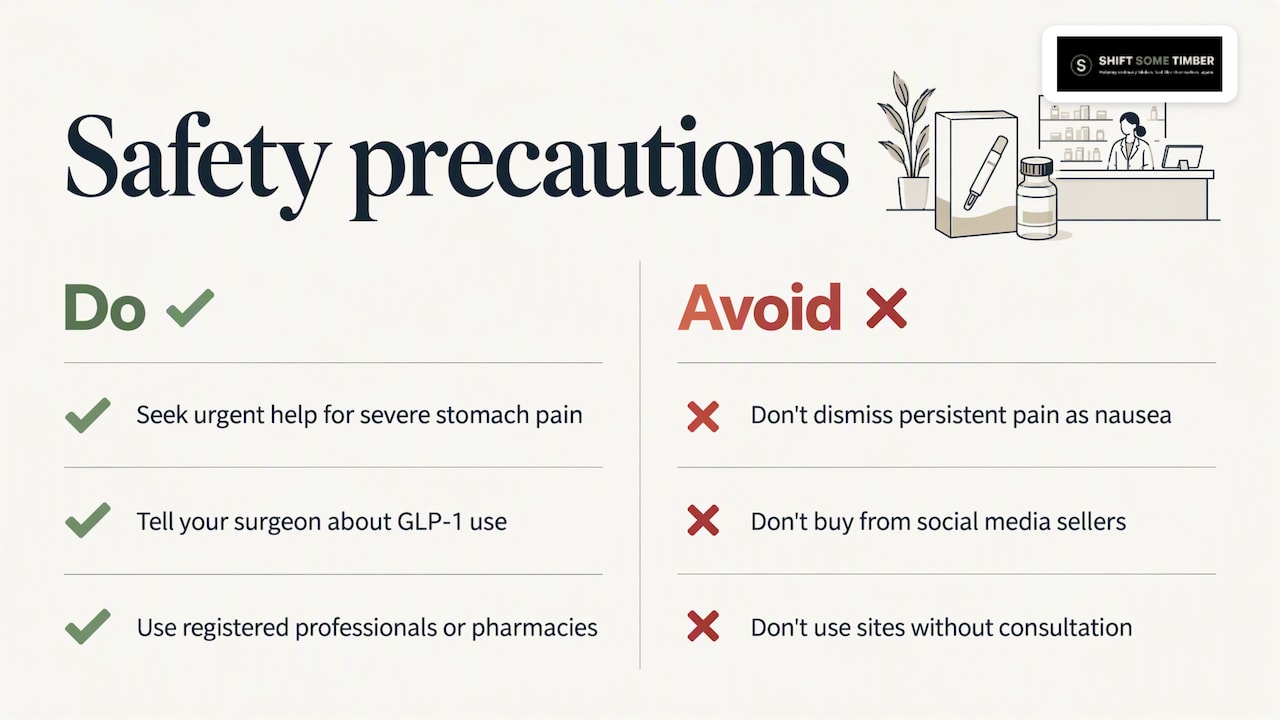
One symptom needs more than patience. If you get severe, persistent stomach pain that spreads to your back, don't put it down to the usual nausea. The MHRA's guidance on GLP-1 medicines warns about pancreatitis, so contact your prescriber, NHS 111 or a GP urgently, or call 999 if you are very unwell.
Tell any surgeon or anaesthetist you're taking a GLP-1 medicine before an operation.
Be careful where you buy. The MHRA has warned that falsified products have entered the supply chain and that genuine medicine should come only through a registered healthcare professional or pharmacy. Don't buy from social media sellers or sites that skip a consultation.
Our view
We started SHIFT because ordinary men told us the same thing: the information was either too clinical or too pushy, and nobody talked about the bit after the prescription. Eligibility is only the front door.
Here is how we see it:
- The BMI number is a starting point, not a verdict. It decides what's possible. It doesn't decide whether you are worth helping.
- Being turned down isn't the end. Plenty of men don't meet the NHS rules or the licence. They still deserve food, movement and mindset support that works around a job and a family.
- Medication works best with habits behind it. The guidance says so, and so do the men we talk to. We built The Programme (Grub, Fit, Life Back and My Timber) around that.
- You are welcome wherever you are. Before, during or after treatment, including if you started elsewhere or have stopped.
We don't prescribe ourselves. Clinical assessment, prescribing and dispensing are handled by appropriately regulated partners, and we keep the support around it honest and plain.
— Matt O’Brien
Where SHIFT fits in
If you want to see where you stand, start with Weight-Management Medication, which explains the options and the eligibility checks and clinical verification involved. If you're not sure about medication at all, Weight Loss for Men UK covers getting started with or without it. The Programme gives you the practical food, movement and tracking support either way.
FAQ
What BMI do you need for weight loss medication in the UK?
The named injectable medicines are generally licensed for BMI 30 or above, or 27 to under 30 with a weight-related condition. NHS funding depends on the particular medicine and pathway: NICE specialist recommendations and NHS England primary-care phased access are different. In the 2026/27 England tirzepatide primary-care cohort, BMI 35 or above usually needs four of five specified conditions, subject to ethnicity adjustments and clinician assessment. See our NHS medication-access guide.
Can I get Wegovy on the NHS?
Possibly, but access is limited. NICE recommends semaglutide within a specialist weight management service for up to two years. Waiting lists and local rules vary a lot. Ask your GP what is available in your area.
Can I get weight loss medication privately if I don't meet NHS criteria?
Often yes, if you fall within the licence, which means a BMI of 30 or above or 27 to 30 with a related condition. You will still need an assessment by a registered prescriber, who may decline if the medicine isn't safe or suitable for you.
Is there a weight loss tablet I can get in the UK?
Orlistat is available on prescription and in a lower-dose form from pharmacies. A semaglutide tablet for weight loss was approved by the MHRA in June 2026, but it is not yet available on the NHS.
What happens if I don't lose enough weight on the medication?
Under NICE's stop rule, if you haven't lost at least 5% of your starting weight after 6 months on the highest tolerated dose, your prescriber will normally review or stop treatment. Talk to them early rather than waiting for that point.
Sources
- First GLP-1 tablet for weight loss approved in the UK (GOV.UK)
- NICE TA1026: tirzepatide recommendations
- NHS England interim commissioning guidance for tirzepatide
- NICE TA875: semaglutide recommendations
- MHRA Drug Safety Update on GLP-1 receptor agonists
- NICE implementation toolkit: access to tirzepatide
- Formulary entry on orlistat
- NICE guide for prescribing medicines to manage overweight and obesity
- GOV.UK: GLP-1 medicines for weight loss and diabetes
Recommended
- 3 NHS weight loss drugs: who qualifies, why it depends on your postcode
- Wegovy eligibility for UK men: NHS BMI rules and the two year cap
- NHS vs Private Weight-Loss Medication
- Lifestyle Alone vs Weight-Loss Medication
Related: NHS weight-loss medication: access routes and eligibility in 2026 | SHIFT.
Last updated .