
What Happens at a Male Fertility Appointment in the UK

A male fertility appointment is usually a conversation, a brief physical check and a semen sample. In the UK, the first step is normally your GP. They ask about your health and sex life, may examine you, and arrange a semen analysis. The result goes back to the clinician who requested it. It does not usually come straight to you.
None of it is painful, and none of it is a judgement. This guide walks through each stage in plain English, tells you what to bring, and ends with a short list of questions to take along. We are the SHIFT Team. We are not your clinician, and decisions about your own care sit with your GP or specialist.
TL;DR
- Expect three parts: questions about your health and lifestyle, a general examination that may include your testicles, and a semen analysis. Some people are also offered blood tests.
- The semen sample usually needs a short break from ejaculating beforehand, a clean sterile pot and no lubricant. Your lab's own leaflet overrides any general advice, so follow that.
- Results usually go to the GP or requesting clinician, often within about one to two weeks. A repeat test is common and does not mean something is wrong.
- Bring a list of medicines, supplements and past surgery or infections. Write down your questions beforehand.
- Next step: write your medicines list and three questions tonight. That is enough to start.
Table of Contents
- Who this appointment is for
- Step 1: The GP conversation
- Step 2: The physical examination
- Step 3: The semen analysis
- Step 4: Blood tests and other investigations
- Step 5: Getting your results
- What to bring
- A question checklist for your appointment
- Everyday things that sit alongside the appointment
- Where SHIFT fits in
- FAQ
- Sources
Who this appointment is for
The NHS advises that fertility tests can take time, so it is sensible to make an appointment early rather than wait. That applies to men as much as women. If you and your partner have been trying for a baby without success, or you have a specific worry, such as a past testicular injury or surgery, your GP is the place to start.
If you are earlier in the thinking stage, our guide to where to start and when to ask for help with male fertility covers the "should I go?" question. This article assumes you have decided to go and want to know what happens.
Step 1: The GP conversation
Most men start with a routine GP appointment. It is a normal consultation, usually ten minutes or so, and you can ask for a longer slot if you think you will need it.
The NHS says the GP will ask about your medical and sexual history. That includes whether you have had children with previous partners, any medical conditions including sexually transmitted infections, and any medicines, including herbal remedies and supplements.
The British Association of Urological Surgeons (BAUS) lists the kind of questions a GP may ask:
- Your job and work pressures, and any exposure to excess heat
- Whether you have fathered children before
- How often you have unprotected sex
- Any erection or ejaculation concerns
- Previous testicular or scrotal surgery, injury or infection
- Smoking, alcohol and drug use, including anabolic steroids
Some of these feel personal. GPs ask them because each one can point towards a possible cause or rule one out. Honest answers save time.
If you have used steroids or testosterone
Tell the GP. Anabolic steroids and testosterone treatment can affect sperm production, and clinicians need to know. Our guides explain the conversation: past anabolic steroid use and fertility and TRT and fertility. If you take prescribed medicines of any kind, including weight loss treatment, your own prescriber is the person to discuss how they relate to your fertility plans.
Step 2: The physical examination
BAUS says a general examination is done with particular attention to the genital region, meaning the testicles and the tissue around them. The NHS adds that the GP may check your testicles for lumps or deformities and look at the penis for shape, structure and anything obvious.
In practice:
- You will be asked to undress from the waist down, usually behind a curtain, with a sheet or paper cover.
- The check takes a few minutes and should not hurt. Tell the clinician if anything is uncomfortable.
- You can ask for a chaperone, and you can ask for a male or female clinician where the practice can arrange it.
Some private clinics package a general check and a semen test together as a male fertility health check. On the NHS, the examination is part of the GP appointment, and the semen test is booked separately.
Step 3: The semen analysis
The NHS describes a semen analysis as the main test to check for a low sperm count. A lab looks at the sample under a microscope. An NHS fertility centre leaflet explains that the test measures volume, thickness, sperm movement, concentration and shape. It is described there as the gold standard test for male fertility potential.
If you want to understand what those words mean before you go, read semen analysis explained: concentration, movement and shape.
Getting the pot
In some areas you need your GP to request the test first. For example, one NHS service in Devon says you must see a GP to request the test and collect a sample pot with a barcode or signed request form. Others book you directly with the lab once the GP refers you. Your GP surgery will tell you which route applies locally.
Preparing: what the leaflets agree on
Labs differ on exact timings, so treat your own leaflet as the rule. These examples show the pattern:
| Lab or trust | Abstinence beforehand | Time to deliver sample |
|---|---|---|
| Homerton Fertility Centre | Two days | By appointment time |
| Leicester Fertility Centre | More than 2 full days, under 7 | Within 1 hour |
| Wrightington Hospital | At least 48 hours, no more than 7 days | Within 50 minutes |
| Cambridge IVF | 2 days up to 5 days, avoid over 7 | Per user guide |
The point of the gap is practical. A very short break can mean a lower count, and a very long one can affect how well the sperm move. Sticking to your lab's window gives the result the best chance of being representative.
Other points the leaflets share:
- Wash and dry your hands and genitals first.
- Collect the whole sample by masturbation into the sterile pot provided.
- Label it with your name and date of birth.
- Do not use lubricant. NHS guidance says shop-bought and natural lubricants, including water and saliva, can harm sperm and make results misleading.
- Do not use ordinary condoms. The same Devon page says withdrawal during sex is not recommended, because you may miss part of the sample and vaginal contamination can affect results. Special sample condoms exist; Homerton's leaflet says they are available by prior arrangement for a charge.
- Keep the sample warm if you are bringing it in. One lab asks for it to be kept at body temperature and delivered within an hour. Wrightington suggests an inside pocket.
Producing the sample on site or at home
Most clinics have a private room. Devon's service says you can book a sample on-site appointment. Cambridge's referral process says patients living more than 30 minutes away produce the sample on site, while others collect at home and deliver within 40 minutes. If travel time worries you, ask which option you can have when you book.
A sample that is unlabelled, too old or missing a referral form can be rejected, as Leicester's leaflet sets out. Check the label and form before you leave the house.
What about home sperm tests?
A home kit can give a rough idea of concentration but is not the same as a lab analysis, and a normal-looking kit result is not a full answer. We explain the limits in can a home sperm test tell me whether I am fertile?. If you are worried, the route through your GP is the one that leads to proper follow-up.
Step 4: Blood tests and other investigations
Not everyone needs more than a semen analysis. When more is needed, it is usually because the first result was unusual or your history points to something.
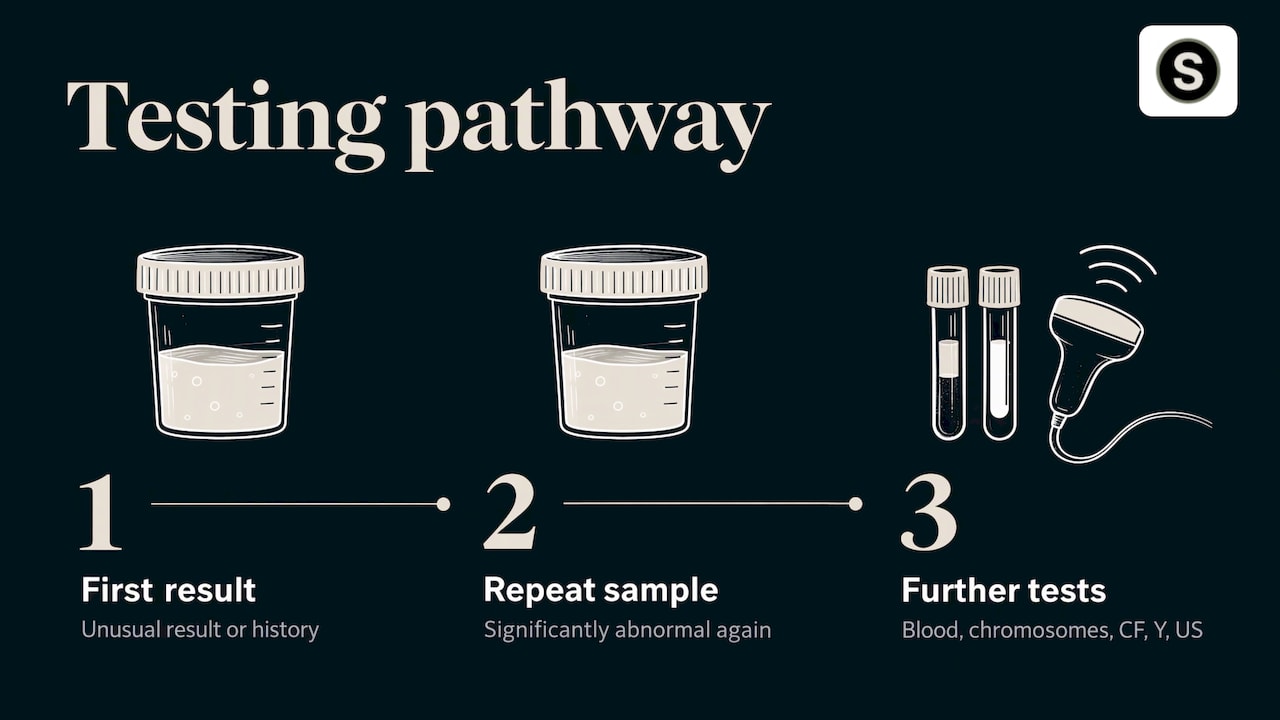
An NHS trust patient leaflet explains that male hormone levels are only checked if the semen analysis is abnormal. If a repeat sample is also significantly abnormal, further investigations may include a blood hormone profile, chromosome analysis, cystic fibrosis carrier status, Y chromosome checks and a testicular ultrasound scan. The NHS makes a similar point: if a second test also finds a problem, you may be referred to a specialist for more tests, such as blood tests or an ultrasound.
Imperial College Healthcare's guidance for referrers mentions morning, fasted hormone levels including FSH, LH, prolactin, testosterone and SHBG, plus a full blood count. These are the hormones involved in sperm production.
Timing a testosterone blood test
BAUS says that for an accurate testosterone reading, blood should be taken first thing in the morning, with nothing to eat or drink since midnight. Your GP will tell you the exact slot. For the background, see our page on testosterone blood tests: preparation and results.
Sometimes a specialist team may recommend a procedure to find the cause or collect sperm. Imperial notes that micro-surgery can occasionally restore fertility. Whether any of this is relevant to you is a decision for your specialist, not something to guess at in advance.
Step 5: Getting your results
This is the part that surprises people. The lab usually does not hand you the result.
- Homerton says results go to your referring clinician within 10 working days and cannot be given over the phone.
- Leicester says results are sent electronically to the referring doctor, usually in 7 to 10 working days.
- Wrightington says results normally reach the GP within one week.
So plan for roughly one to two weeks, and book your follow-up with your GP after that window. Cambridge's user guide advises allowing for reporting time when you book appointments, and booking straight after referral to avoid delays.
Why a repeat test is common
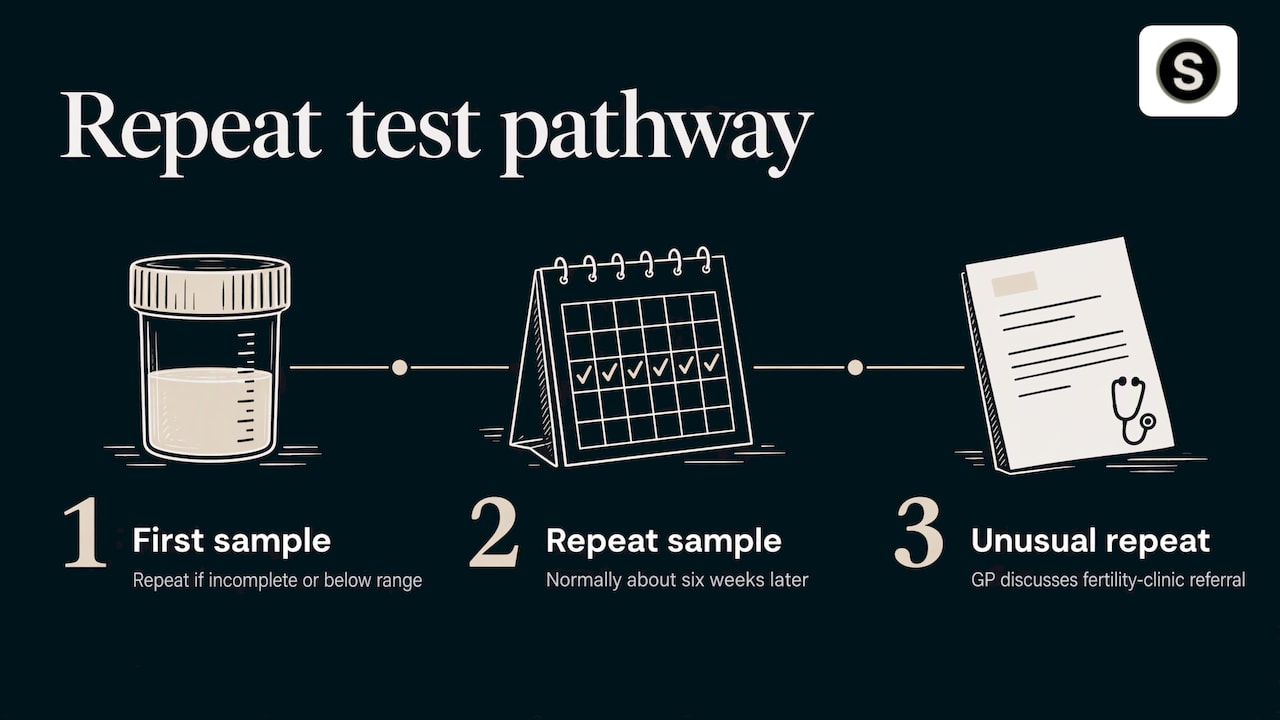
A repeat sample may be suggested if the first was incomplete or something fell below the lab's reference range. Homerton's leaflet says exactly that, using the World Health Organization 2021 standards. Wrightington says a repeat is normally about six weeks after the first. Sperm counts vary from day to day, so one result is rarely the whole story.
If the repeat also looks unusual, Devon's service says the GP will discuss referral to a fertility clinic as a couple. We do not interpret individual numbers here. What a result means for you is for your GP or specialist to explain.
What to bring
A small folder or a note on your phone is plenty.
- A medicines list. Prescription, over the counter, supplements, herbal products and anything you have used in the past. Our guide on what to tell your GP or specialist about medicines helps you build it.
- Key history. Testicular surgery, injury, infection, undescended testicle, any STI, any previous children.
- Lifestyle facts. Smoking, alcohol, recreational drugs, steroid use, hot work environments, long hours.
- Referral paperwork. The request form or barcoded pot if your lab needs it.
- Your partner's details if relevant. Many services look at both partners together.
- Your questions. Written down, because it is easy to forget them in the room.
If you feel anxious about the conversation itself, our page on what the GP will ask is a calm run-through of how GP appointments about sensitive topics tend to go.
A question checklist for your appointment
Tick off the ones that matter to you.
- Which tests do you recommend first, and why?
- Where will I produce the sample, and how long should I abstain beforehand?
- Who will contact me with the result, and roughly when?
- If the result is unusual, what happens next and who decides?
- Are any of my medicines or supplements relevant?
- Should my partner be tested at the same time?
- Is there anything about my work, sleep, weight or lifestyle worth looking at?
- Is a referral to a specialist or fertility clinic likely to be needed?
Everyday things that sit alongside the appointment
The appointment answers a specific question. Day to day, general health still matters, and these are things you can work on without waiting for results:
- Food. Regular, realistic meals are easier to keep up than a strict plan. Our SHIFT Health fertility page sets out the education side.
- Sleep, stress and mood. Waiting for results can be stressful. Talking to your GP about low mood or anxiety is a perfectly reasonable thing to do in the same appointment.
- Blood pressure, bloods and the wider MOT. A Health MOT can help you see the bigger picture before you see a clinician. It does not replace one.
None of these are promises about fertility. They are sensible background habits, and your GP can tell you what applies to you.
Where SHIFT fits in
SHIFT does not currently offer clinical assessment, prescribing or dispensing, and we do not arrange fertility tests. What we do offer is free practical support through My Timber: check-ins, progress tracking, food and recipes through SHIFT Grub, walking and strength through SHIFT Fit, and Life Back for the things that matter beyond the scales. You can use it alongside your own clinic or prescriber, after treatment ends, or without treatment, and you do not need a prescription transfer or a purchase. You can start at the Shift Some Timber homepage with one small step.
FAQ
Do I need a referral to get a semen analysis on the NHS?
Usually, yes. In many areas your GP requests the test and gives you a pot or form, or refers you to the lab, as the Devon service describes. Arrangements differ by area, so ask your surgery how it works locally.
Will the examination hurt?
It should not. The GP checks the testicles and penis for lumps or anything unusual, as the NHS describes. Tell the clinician straight away if anything is uncomfortable, and you can ask for a chaperone.
Can I get my result straight away?
Normally not. Labs such as Homerton send results to the referring clinician and do not give them over the phone. Allow roughly one to two weeks, and book your GP follow-up for after that.
What if my result is unusual?
A repeat test is often the next step, because results can vary between samples. If it is still unusual, your GP can discuss referral to a specialist. Do not rely on an internet search to interpret your own figures. Ask your GP or specialist what they mean for you.
Does the test mean I have a fertility problem if I am on medication or have used steroids?
The test only describes one sample. Tell your GP about every medicine, supplement and past steroid use so they can interpret it properly. Your own prescriber decides anything to do with your treatment.
Sources
- Diagnosis of infertility, NHS
- Low sperm count, NHS
- Fertility problems, British Association of Urological Surgeons
- Diagnostic semen analysis leaflet, Homerton Fertility Centre
- Andrology patient information leaflet, Leicester Fertility Centre
- A user guide to andrology services, Cambridge IVF
- Cambridge IVF referral process chart
- Diagnostic semen analysis for subfertility, MyHealth Devon
- Semen analysis leaflet, Wrightington Hospital
- You and your fertility journey, Worcestershire Acute Hospitals NHS Trust
- Male fertility, Imperial College Healthcare NHS Trust
- Male fertility healthcheck
Recommended
- Male fertility: where to start and when to ask for help
- Fertility and medicines: what to tell your GP or specialist
- Male fertility: tests, understanding and next steps
- Can a home sperm test tell me whether I am fertile?
SHIFT provides general UK health information and practical support. Speak to your GP or your own prescriber about symptoms, test results or medicines. My Timber is free to use alongside your own clinic, after treatment ends or without treatment.
Last updated .