
Blood Tests for Men: What They Check and When
For most UK men, the sensible route to a blood test is your GP, because the NHS decides which tests suit your symptoms, conditions and medicines. The NHS says blood tests can check different things depending on those factors. Common ones include a full blood count, blood glucose, kidney function, cholesterol (lipids) and thyroid function. Private packages can add extra markers, but more markers do not always mean more useful answers.
This guide explains the main tests, who they are for, how to prepare, and what to do with the results. It is general information. Your own GP or prescriber handles individual decisions about tests and treatment. If you want free practical support with food, movement and tracking while you sort your tests out, we cover that further down.
TL;DR
- There is no single "men's blood test". The right tests depend on your age, symptoms, family history and any medicines you take.
- Common NHS tests cover blood count, glucose, kidney function, cholesterol and thyroid. Ask your GP which suit you.
- Testosterone testing needs a morning sample and usually a repeat. A single result can mislead.
- Routine PSA screening is not offered on the NHS for men without symptoms or a specific genetic risk. You can discuss it with your GP.
- Write down your results and dates. Trends over time say more than one number.
Table of Contents
- What blood tests can tell you
- Is there a routine set every man should have?
- Blood tests linked to weight and metabolic health
- Testosterone and hormone tests
- PSA tests and the prostate
- NHS or private: what to know before you pay
- How to prepare for a blood test
- Making sense of the results
- What you can do between tests
- Get started with free support
- One next step this week
- FAQ
- Sources
What blood tests can tell you
A blood test is a snapshot. It shows what is circulating in your blood on the day, which helps your GP spot problems early or check whether something is under control.
The NHS lists several routine checks that may be used depending on your situation:
- Full blood count (FBC): looks at red cells, white cells and platelets. It can point towards anaemia or infection.
- Blood glucose: shows how your body handles sugar, which matters for type 2 diabetes risk.
- Urea and electrolytes (kidney panel): checks how well your kidneys are working.
- Lipid profile: measures cholesterol and related fats, which feed into heart and circulation risk.
- Thyroid (TSH): checks the hormone that tells your thyroid how hard to work.
None of these is specific to men. What changes for men is the context: heart disease risk, type 2 diabetes, testosterone questions and prostate concerns tend to come up more often in conversations with a GP.
If you want the numbers explained in more depth, our guide to what common blood tests actually check goes through each one in plain English.
Is there a routine set every man should have?
Not as one fixed list. In England, the NHS Health Check is the nearest thing. It is offered to adults aged 40 to 74 and, according to NHS Health Check material from Public Health England, it includes a check of blood pressure and cholesterol as part of assessing your risk of heart disease, type 2 diabetes, kidney disease and stroke. Arrangements can differ across England, Scotland, Wales and Northern Ireland, so ask your GP surgery what is offered where you live.
If you are under 40, you do not have a standard invitation. That does not mean you cannot ask. If you have symptoms, a strong family history, or you are concerned about weight, tiredness or blood pressure, book a GP appointment and say what is worrying you.
A simple example
Tom is 46, works shifts and has put on weight over a few years. He is tired a lot and his dad had type 2 diabetes. Rather than buying a long list of tests, he checks whether he has had an NHS Health Check invitation, books a GP appointment, mentions his family history and tiredness, and lets the GP decide which tests fit. He writes the date and results in a note on his phone afterwards.
That is a realistic first step. It needs no special preparation and no judgement about how you got here.
Blood tests linked to weight and metabolic health
If weight loss is your goal, a few results are especially useful for context: glucose or HbA1c (a longer-term sugar measure), cholesterol and kidney function. They help you and your prescriber or GP see where you are starting from and how things change over time.
For men already diagnosed with type 2 diabetes, checks are more structured. One NHS integrated care board page says that at diagnosis, and at least yearly after, people with type 2 diabetes should have an HbA1c test, blood pressure and weight checks, a cholesterol test and blood and urine kidney tests, alongside eye screening and a foot check. If that is you, your diabetes team will arrange these.
Our article on weight loss blood tests for UK men explains six common checks and what the results might mean. If you are on weight loss medication, your own prescriber decides which tests you need and when.
Testosterone and hormone tests
This is the area most men search for, and where tests are most often misunderstood.
Testosterone is the main male sex hormone. Low levels can be linked to tiredness, low mood, reduced sex drive and other symptoms, but those symptoms are common and have many causes, including poor sleep, stress, weight and alcohol. That is why a test is only one part of the picture.
Why timing matters
Testosterone rises and falls through the day. A 2023 laboratory medicine review explains that serum total testosterone is the most widely accepted marker for diagnosing low testosterone (hypogonadism). It says samples should be taken between 7:00 and 11:00 am, and that a low or borderline result should be repeated on at least two occasions, ideally four weeks apart, with SHBG and albumin checked. SHBG is a protein that carries testosterone around the blood.
A UK primary care guide from 2020 adds that testosterone and SHBG should be measured in the morning after an overnight fast, and that routine screening in men with no symptoms is not recommended.
What the numbers can mean
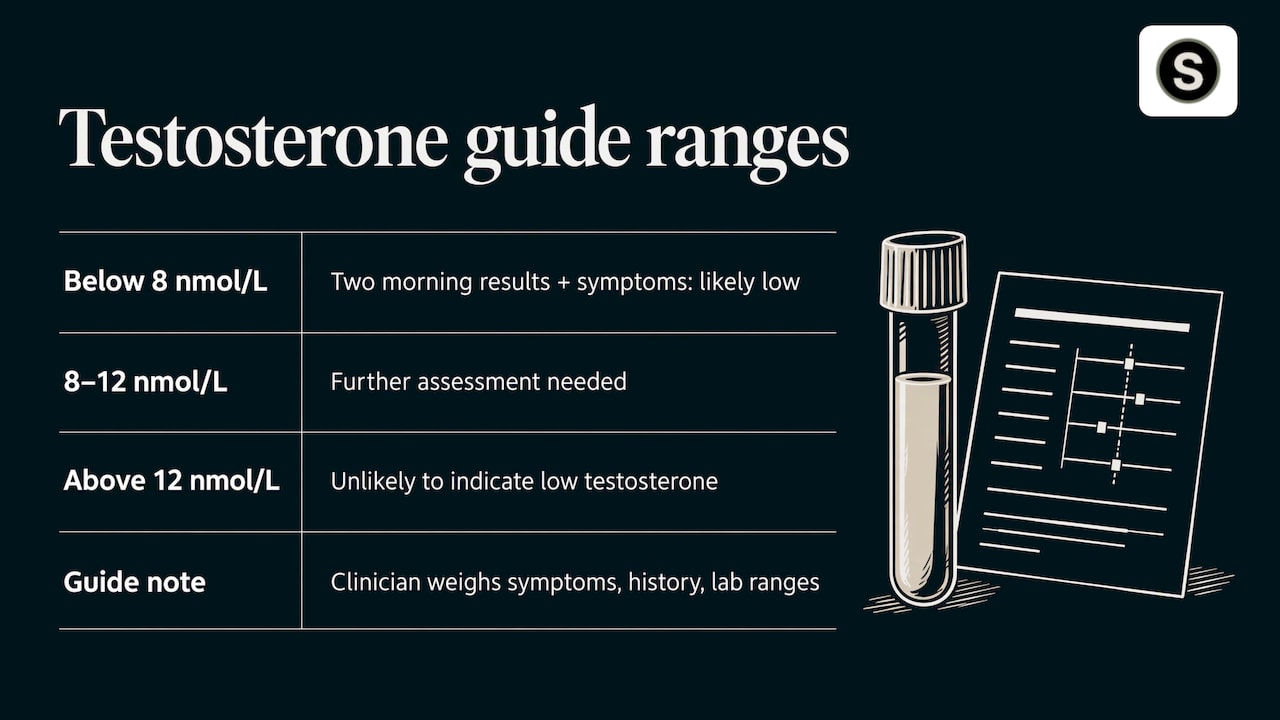
The same 2023 review says two consecutive morning levels below 8 nmol/L, together with suggestive symptoms, are likely to indicate low testosterone. Levels above 12 nmol/L are unlikely to, and results between 8 and 12 nmol/L call for further assessment. Those are guide ranges. Laboratories use their own reference ranges, and only a clinician can interpret a result alongside your symptoms and history.
If the level is low, the next step in the 2020 guide is to measure LH and FSH, two pituitary hormones, to help work out the cause.
We have separate pages that cover testosterone blood tests and how to prepare and what happens next. For a wider view of morning sampling, repeat testing and how results feed into assessment, testosterone testing and repeat results is also worth reading.
Fertility
Blood hormones are only part of a fertility work-up. If you and your partner have been trying for a baby without success, your GP is the starting point and will explain which tests apply.
PSA tests and the prostate
PSA is a protein made by the prostate. A PSA blood test can be raised for several reasons, not only cancer.
The NHS PSA test page states that routine PSA testing is not currently offered on the NHS unless genetic tests show a faulty BRCA2 gene. A test may be offered if your doctor thinks symptoms could be prostate cancer, and you can ask a GP about PSA testing. The NHS also explains that results usually take 1 to 2 weeks, a raised result may lead to a repeat test, and if it is still high your GP may discuss referral for further tests such as an MRI scan or biopsy. It also warns that PSA results may not be accurate and can lead to tests or treatment that were not needed.
That is why it is a conversation to have with a GP rather than a box to tick. If you notice changes when you pass urine, or have a family history of prostate cancer, say so at your appointment.
Our plain-English page on PSA tests, benefits, limits and next steps helps you prepare questions, and there is an explainer on the NHS Prostate Progress research invitation.
NHS or private: what to know before you pay
Private blood tests are easy to find, and some men like the convenience. Before you buy, it helps to know what the system says about commercial screening.
The UK National Screening Committee explains that commercial screening ranges from simple blood tests to full body scans, and that some offers are test-only, not evidence-based and often have no quality assurance. It also notes that when a private test is only a test, it is left to you to seek advice or further investigation, and abnormal results often need repeating by the NHS.
A few practical questions are worth asking yourself:
- Do I have symptoms? If yes, start with your GP.
- Who will explain the result? A number without context can worry you or falsely reassure you.
- What happens if it is abnormal? Your GP will usually need to repeat it.
- Am I already on treatment? Your prescriber should know about any tests you do.
If you do pay for a test, take the results to your GP and let them decide what to do next.
How to prepare for a blood test
The NHS says a blood test is usually done at a GP surgery or hospital, takes about 10 minutes and blood is taken from the inside of the elbow, sometimes the wrist or finger. Results usually come back in a few days to a few weeks. If you have heard nothing after a few weeks, contact the surgery or specialist.
A simple routine:
- Ask what the test needs. Some tests need fasting, some do not. Your surgery will tell you.
- Book the right time. For testosterone, a morning appointment is needed.
- Drink water unless told otherwise. It can make blood easier to take.
- Tell them your medicines, including anything bought over the counter.
- Write down the date and results when they arrive.
If needles make you uneasy, tell the person taking the sample. It is common, and they can help.
Making sense of the results
A result outside a reference range is not a diagnosis. Reference ranges describe what is typical for a lab's population, and your own normal may differ. A good GP looks at your symptoms, your history and the trend.
Two habits help:
- Keep a record. One result is a dot, several results make a line. Our guide on keeping track of health results over time shows a simple way to do this.
- Ask three questions. What does this number mean for me? Do we need to repeat it? What should I change, if anything, before the next one?
You can read more in our guides to blood test results, ranges and context and understanding blood-test results and follow-up. If winter is making you feel flat, there is also a page on whether a vitamin D test is worth considering.
What you can do between tests
Blood tests tell you where you are. Daily habits are what you can work on. None of this replaces advice from your GP or prescriber, and results vary from person to person.
- Food: realistic, budget-friendly meals make it easier to stay consistent. Our recipes include simple breakfasts such as a paprika turkey potato hash.
- Movement: walking and some strength work are a manageable place to start. See our exercise guide on walking, strength and mobility.
- Sleep and mood: poor sleep can affect energy and how you feel, which can look a lot like the symptoms people want tested. Our page on sleep trackers and their limits explains what wearables can and cannot show.
- Blood pressure: this is a simple check that does not need a blood sample. Ask your pharmacy or GP surgery.
If you feel low, anxious or stuck, speak to your GP. Support is available and asking for it is a normal first step.
Get started with free support
If you want a starting point that fits around work and family, our free My Timber support brings together check-ins, progress tracking, food ideas, walking and strength guides, and non-clinical help through Ask Timber. You can use it alongside your own clinic or prescriber, after treatment ends, or without treatment. You do not need a prescription transfer or a purchase.
Treatment decisions stay with your own prescriber. Our free weight-loss support for men page shows what is included, and the SHIFT Health MOT is a gentle way to see which health areas to talk about with your GP. The Men's Health MOT guide explains how it works.
One next step this week
Pick one:
- Check whether you are due an NHS Health Check (age 40 to 74 in England) and ask your surgery.
- Book a GP appointment and write down your three biggest worries beforehand.
- Start a note on your phone with the date and result of every test you have had.
Any of these counts. You do not need to do all three.
FAQ
Do Boots or other high street shops do a testosterone test?
Some high street and online providers sell testosterone tests, and you would need to check the provider's own page for what is offered. Whichever route you take, remember that testosterone needs a morning sample and is usually repeated before anyone draws conclusions. Take any result to your GP.
What is the best comprehensive blood test for men?
There is no single best test, because the right set depends on your age, symptoms and history. The NHS says tests vary with symptoms, conditions and medicines. Your GP can advise which checks make sense for you.
How do I check my hormone levels as a man in the UK?
Start with a GP appointment and describe your symptoms. Testosterone is measured with a morning blood sample, and a low or borderline result is normally repeated at least once, ideally four weeks later, according to the 2023 laboratory review. Your GP may then check other hormones such as LH and FSH.
Can I get a PSA test on the NHS?
Routine PSA testing is not currently offered on the NHS, except where genetic tests show a faulty BRCA2 gene. A GP may offer one if symptoms could be prostate cancer, and you can ask about it. The NHS notes that PSA results can be inaccurate, so it is best discussed with your doctor.
Sources
- Blood tests, NHS
- PSA test, NHS
- NHS Health Check leaflet, Public Health England
- Living with diabetes, Black Country ICB
- NHS and commercial health screening tests: important considerations, UK National Screening Committee, GOV.UK
- Adult Male Hypogonadism: A Laboratory Medicine Perspective, 2023
- How to manage low testosterone level in men: a guide for primary care, 2020
Recommended
- Testosterone blood tests: preparation and results explained
- What do common blood tests actually check?
- Blood test results explained: numbers, ranges and context
- Liver and kidney blood tests: what they can and cannot show
SHIFT provides general UK health information and practical support. Speak to your GP or your own prescriber about symptoms, test results or medicines. My Timber is free to use alongside your own clinic, after treatment ends or without treatment.
Last updated .