
Keeping Track of Your Health Results Over Time: A UK Guide for Men

The simplest way to keep track of your health results is one notebook or one folder, a few measures you can repeat the same way each time, and a date on everything. Weigh and measure on a schedule, write down blood test results with their units and the lab's reference range, and note a line or two on how you felt. Then look at the pattern, not the single number. Your GP or prescriber makes the call on what the numbers mean for you.
This guide shows you what to record, how often, how to keep it tidy and when to pick up the phone. No apps needed, no guilt, no perfect streaks.
TL;DR
- Pick three to five measures you can repeat in the same way: weight, waist, home blood pressure if your GP has asked for it, a simple food and activity note, and how your energy and sleep felt.
- Record the date, the result and the units every time. For blood tests, also copy the lab's reference range from the report.
- One reading tells you little. NHS England guidance describes measurement as a way to track progress and inform decisions, with follow-ups at one month, six months or a year to see whether changes hold.
- Take your notes to appointments. Your own GP or prescriber handles individual treatment decisions.
- Free practical support from SHIFT, My Timber, works alongside your own clinic or prescriber, after treatment ends, or without treatment.
Table of Contents
- Why track results at all?
- Keep it small enough to actually do
- What to measure, and how to do it the same way each time
- A privacy-friendly system for blood test results
- Telling a trend from a wobble
- Turning your records into small changes
- When to speak to a GP
- Free practical support to keep it going
- Your one next step
- FAQ
- Sources
Why track results at all?
Most of us guess. We think we eat less than we do and move more than we do. Nesta's guide on tracking change notes that people often underestimate or overestimate their own behaviour, and that seeing change over time helps you understand your own patterns and get support at the right time.
There is a second reason. Health is rarely a single number. A peer-reviewed overview by Holmes, Stanescu and Bishop explains that long-term conditions fluctuate, so ongoing monitoring helps people know their condition better and engage more with their health. It also points out that test results alone can be poorly linked to how someone feels and functions, so notes on symptoms and wellbeing add a fuller picture.
And a third: motivation. The Patients Association advises keeping a diary so you can see how far you have come, build on what worked and spot what to avoid. It also says to be ready for setbacks. A bad week is data, not a verdict.
Keep it small enough to actually do
Nesta's guidance is blunt about this: tracking only works when it is low effort. If entering data becomes a chore, it becomes a reason to stop.
So start with less than you think you need:
- One body measure you repeat weekly, such as weight or waist.
- One habit note a day, such as "walked 20 minutes" or "cooked at home".
- One feeling note a week: energy, sleep, mood, out of 10.
- One folder for anything official: blood test reports, clinic letters, blood pressure readings.
That is enough. You can add more later if you want to.
A quick word if tracking has ever gone wrong for you
NICE says weekly weighing, waist awareness and noting food and activity can help people keep an eye on their weight, and it also asks professionals to take care with anyone who has or might develop disordered eating. If counting numbers makes you anxious, or you find yourself obsessing, drop the scales and track habits and how you feel instead. Talk to your GP if food or weighing is taking over your thinking.
What to measure, and how to do it the same way each time
Consistency matters more than the equipment. Here is the routine for each measure.
Weight
The NHS England leaflet on recording your weight suggests:
- weigh at the same time of day, preferably in the morning
- use the same scales, in the same spot, on a firm level floor
- wear little or no clothing
- wait until the number stops moving, then write it down
- do it at regular intervals, from weekly to monthly
NICE recommends weighing once a week as one way of keeping an eye on your weight. Daily weight swings with water, salt and what you ate last night, so the weekly figure, or the average of a few weeks, is the one to watch.
Waist and waist-to-height ratio
Waist often tells you more than the scales, especially if you are building strength while losing fat. For men with a BMI below 35 kg/m², NICE says to use waist-to-height ratio as well as BMI. To measure it:
- Find the bottom of your ribs and the top of your hips.
- Wrap a tape measure midway between them, just above the belly button.
- Breathe out normally and read the number.
- Divide your waist by your height, both in the same units. NICE's own example is 96.5 cm ÷ 170 cm = 0.57.
If the result suggests increased health risk, NICE says to seek advice from a healthcare professional. Our waist size guide for men and the waist-to-height ratio calculator do the sums for you, and body composition tracking explains why weight and waist together show trends better than either alone.
Blood pressure
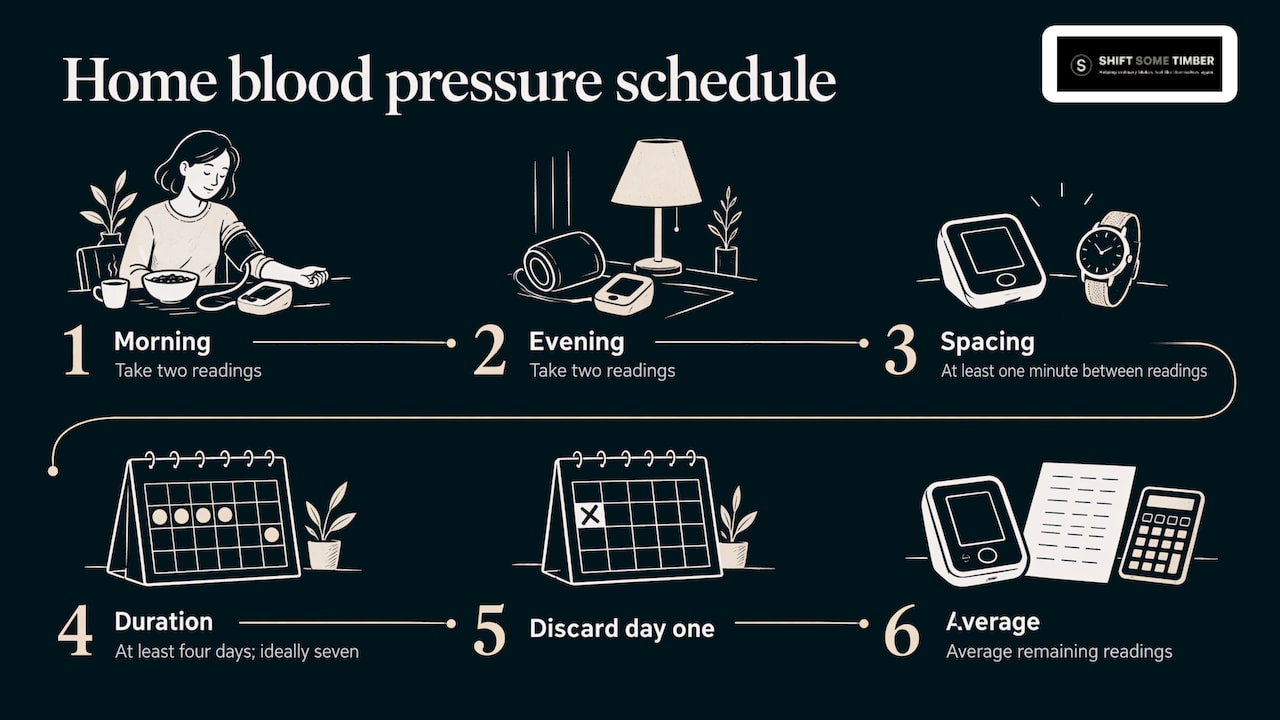
Only track this at home if your GP or practice nurse has asked you to, and use the method they give you. As an example of how the NHS does it, an NHS integrated care board hypertension flowchart based on NICE guidance describes home monitoring as two readings at least a minute apart, morning and evening, for at least four days and ideally seven, with the first day discarded and the rest averaged. A diagnosis is not made from one reading. Our home blood pressure reading checklist walks through the setup.
Food, activity and sleep
NHS food diary guidance from East Lancashire suggests three days, ideally seven, including a weekend day, before an appointment. It says to record as you go, use household measures such as "3 tablespoons of cereal" or "1 large mug of milky tea", and note hunger, mood and why you were eating. The aim is to spot triggers and habits you had not noticed, not to grade yourself.
For everyday meals that are easy to log, browse our recipes, such as a simple breakfast hash, and our walking, strength and mobility guide for movement you can note down as minutes or steps.
For sleep, a line is enough: bedtime, wake time, how rested you felt out of five. Cambridge University Hospitals uses exactly this kind of activity and sleep diary before reviews.
A privacy-friendly system for blood test results
Blood tests are where tracking often falls apart. Results arrive as a page of abbreviations, you glance at it, and a year later you cannot remember what the number was. You do not need an app or an online account to fix that. Paper works, and it stays with you.
SHIFT's My Timber does not receive or clinically monitor your lab results. Keep these yourself, and share them only with your GP or prescriber.
An illustrative paper checklist
Copy this onto a sheet or into a notebook, one row per test:
| Date of test | Test name | My result | Units | Lab reference range | Fasting or time of day | Questions for my GP |
|---|---|---|---|---|---|---|
| 12 Mar | (as written on the report) | (number) | (e.g. mmol/L) | (copied from the report) | Morning, no breakfast | "Is this a change from last time?" |
The example row is illustrative only. Fill in your own from the report.
A few habits make this work:
- Write the units every time. The same test can be reported in different units, and a number without them is easy to misread.
- Copy the reference range from that report. Do not rely on a range you remember or one you found online.
- Note the circumstances. Time of day, whether you were fasting, whether you were ill, drinking more than usual or had just started a new routine.
- Keep a "questions" column. Write the question when it occurs to you, then take the sheet to the appointment.
- Store it somewhere private. A folder at home, or a photo in a password-protected place on your phone, is plenty.
Why reference ranges and timing can differ
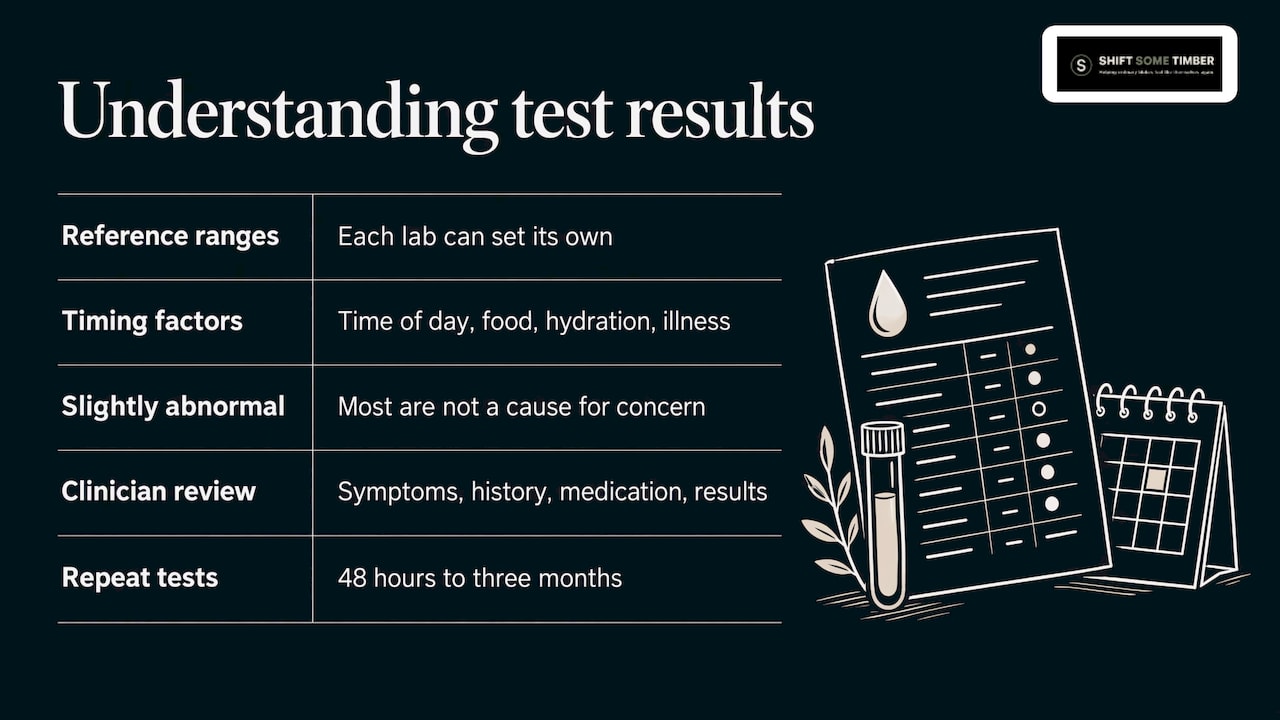
A reference range is the span of results usually seen in a group of healthy people, and labs can set their own, so a range on one report may not match another. Some tests also vary with the time of day, recent food, hydration or illness, and your surgery will tell you if you need to fast or book a morning slot. That is why you copy the range from each report and note when you were tested, rather than compare numbers from different labs by eye.
It also explains why a slightly out-of-range result is not automatically a problem. A GP surgery patient leaflet explains that a clinician reviews each result, most slightly abnormal results are not a cause for concern, and results are read alongside your symptoms, history, medication and previous results. Repeat tests can be booked anywhere from 48 hours to three months later, depending on the clinician's comment.
For plain-English background on bloods, heart health, testosterone, fertility and sleep, our SHIFT Health hub explains what each test is for and what questions to ask.
Telling a trend from a wobble
Most readings bounce around. What you want is direction over weeks and months.
- Weight: compare weekly figures or a four-week average, not today against yesterday.
- Waist: measure every two to four weeks; it moves more slowly.
- Blood pressure: use averages from the structured home routine your GP gave you, not a single reading.
- Blood tests: look at how the same test has moved between reports. Kidney Care UK, writing about kidney tests, says the overall trend is often more important than the exact numbers, and that is a good general habit to bring to any long-term record.
NHS England's guidance suggests checking in again after one month, six months or a year to see whether changes are maintained. A simple rhythm: weekly for weight, monthly for a look back, every six months for a proper review with your notes in hand.
Turning your records into small changes
A log is only useful if it nudges you to do something. Read it for patterns, then pick one change.
NICE lists common things that undermine weight efforts, including sugary or alcoholic drinks, underestimating food eaten, overestimating activity, treats as reward or comfort, and struggling to keep plans going at weekends, on holiday or after illness. Look through your diary and see which of those show up.
A worked example. Dave, a 46-year-old delivery driver (an illustrative example, not a real person), logs a week and sees:
- weight steady on weekdays, up on Mondays
- most steps on days he parks further from the depot
- two late-night takeaways on Saturdays
- sleep under six hours on three nights
His one change is not "be perfect". It is to cook a batch meal on Friday so Saturday has a ready option, and to look at his bedtime. A month later he checks whether Mondays have settled.
NICE says even small, gradual improvements in activity and diet are likely to be helpful, and no single food or activity will do it alone. Small changes are the realistic kind.
If you are on, or coming off, weight-management treatment
NICE quality standard QS212 says people who stop weight-management medicines or finish a behavioural programme should get feedback and monitoring at regular intervals for at least a year, plus "if-then" plans for when they slip, changes to their surroundings, social support and routines that support the new behaviour. Your own records make those conversations concrete: weight trend, waist, how food and energy have felt, and where things slip.
Decisions about starting, changing or stopping any treatment belong to your own prescriber. Take your notes and questions to them. Our weight-management review questions give you a list to take along.
When to speak to a GP
Tracking is not a substitute for medical advice. Book a GP appointment if your readings or symptoms worry you. NHS guidance from GP at Hand lists pain lasting more than a few days, chronic fatigue, a cough lasting more than three weeks and unexplained weight loss among the reasons, with NHS 111 when you are unsure and 999 for emergencies such as chest pain, severe breathing difficulty or a suspected stroke.
Specific things worth taking to your GP or prescriber:
- a home blood pressure average that is persistently high, or any reading that comes with chest pain or severe headache (call 999 or 111 as appropriate)
- a blood test result that has moved in the same direction across several reports
- weight dropping without trying
- ongoing tiredness, low mood or poor sleep that your notes show is not improving
- anything that changes after a new medicine
NICE also asks professionals to ask permission before discussing weight or measuring, and to avoid putting every symptom down to weight. You can say so if a symptom, such as hip pain, is what you came about. Writing it at the top of your sheet helps. For ideas on getting the most from the conversation, see this piece on preparing for your appointment.
Free practical support to keep it going
We built My Timber to make this part easier. It is free, and you do not need a prescription transfer or a purchase to use it. It brings together Today and Journey check-ins, progress tracking, SHIFT Grub for realistic food, SHIFT Fit for walking and strength, Life Back for the things that matter beyond the scales, and Ask Timber for non-clinical support.
You can use it alongside your own clinic or prescriber, after treatment ends, or with no treatment at all. SHIFT is not currently offering clinical assessment, prescribing or dispensing, so individual treatment questions stay with your own prescriber.
For a starting point, see our weight loss support for men page. If you want a snapshot of where you are now, the Health MOT guide explains how to take stock.
Your one next step
Take a sheet of paper today. Write today's date, your weight or waist, and one line on how you feel. Put it in a folder. Next week, do it again. That is the whole system, and it is enough to start.
FAQ
How often should I weigh myself?
Once a week is a sensible rhythm, and NICE lists weekly weighing as one way of keeping an eye on your weight. Use the same scales, at the same time, ideally in the morning with little clothing on. If weighing makes you anxious, track waist or habits instead.
What should I write down from a blood test?
Note the date, the test name, your result, the units and the lab's reference range copied from the report. Add whether you fasted and the time of day. Then write your questions for your GP beside it.
Why does my blood test range look different from last time?
Labs can set their own reference ranges, and some results vary with timing, food, hydration or illness. That is why you copy the range from each report. Ask your GP or practice if you are unsure whether a change matters.
Do I need an app to keep track?
No. A notebook, a folder and a reminder on your phone work well, and paper keeps your health data private. Use whichever you will actually stick with, because easy tracking is the kind that lasts.
Does My Timber record my lab results?
No. My Timber is free practical support for food, movement, check-ins and progress. It does not receive or clinically monitor lab results, so keep those yourself and share them with your own GP or prescriber.
Sources
- Measuring supported self-management, NHS England
- Reimagining Help Guide: Tracking change, Nesta
- The Use of Measurement Systems to Support Patient Self-Management, PMC
- Self-management and long-term conditions, The Patients Association
- Preventing overweight, obesity and central adiposity, NICE NG246
- Identifying and assessing overweight, obesity and central adiposity, NICE NG246
- How to Record Your Weight, NHS England
- Hypertension in adults flowchart, NHS Shropshire, Telford and Wrekin ICB
- Food diary, East Lancashire Hospitals NHS Trust
- Activity diary guidance, Cambridge University Hospitals
- Understanding Your Blood Test Results, Camelford Medical Centre
- Understanding your CKD blood and urine test results, Kidney Care UK
- Overweight and obesity management, NICE QS212
- When is the right time to see your NHS GP?, GP at Hand
- Preparing for your appointment
Recommended
- Home Blood Pressure Reading Checklist for UK Men
- Weight Loss Blood Tests for UK Men: 6 Checks, Results Explained
- Metabolic Health Markers: 5 Numbers and UK Thresholds for Men
- Understanding blood-test results and follow-up
SHIFT provides general UK health information and practical support. Speak to your GP or your own prescriber about symptoms, test results or medicines. My Timber is free to use alongside your own clinic, after treatment ends or without treatment.
Last updated .