
Home Blood Pressure Reading Checklist for UK Men

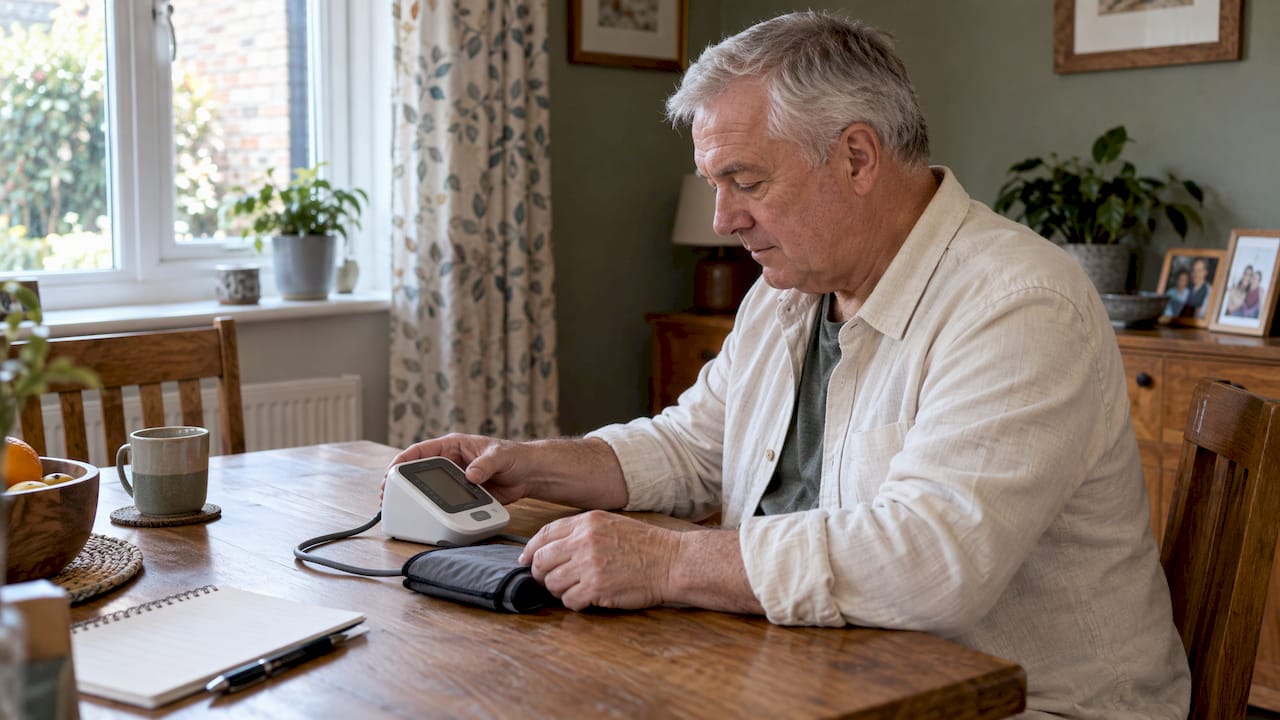
To get useful home blood pressure readings, use a validated upper-arm monitor with a cuff that fits. Sit quietly for five minutes with your back supported and your arm resting at heart level. Take two readings a minute or two apart, morning and evening, for a week. Write every number down exactly as the screen shows it, then take the diary to your GP. Your GP or nurse decides what the numbers mean for you.
This checklist walks you through it in order. Tick it off, print it or save it to your phone. None of it needs special kit beyond the monitor itself.
TL;DR
- Buy or borrow an upper-arm monitor that is validated for accuracy, with a cuff that fits your arm.
- Rest for five minutes first, sit with your back supported, feet flat and arm at heart level, and stay quiet while it inflates.
- Take at least two readings a minute or two apart, morning and evening, ideally for seven days. Write down every number without rounding.
- Take the diary to your GP or practice nurse. Diagnosis and any treatment decisions stay with them.
- Call 999 if you think you are having a heart attack or stroke.
Table of Contents
- Step 1: Get the right monitor
- Step 2: Check why you are measuring
- Step 3: Get ready before each reading
- Step 4: Sit and set up the cuff
- Step 5: Take the readings
- Step 6: Repeat for a week
- Step 7: Fill in the diary
- Step 8: Work out your average
- What the numbers mean and when to get help
- Step 9: Bring it to your GP
- Common mistakes that skew home readings
- Everyday habits that sit alongside monitoring
- Free practical support from SHIFT
- One next step
- FAQ
- Sources
Step 1: Get the right monitor
The monitor matters as much as your technique. A cheap or badly fitting one can give you numbers that look precise but mislead you.
Monitor checklist
- It has an upper-arm cuff, not a wrist or finger device. An NHS BP@Home leaflet advises buying a monitor with an upper arm cuff that is the right size.
- It is UK approved and listed as validated by the British and Irish Hypertension Society (BIHS). The same leaflet says this.
- The cuff fits. If it is too small or too large, your readings can be off. Check the sizing range in the instructions against your upper arm.
- It is not old. The BP@Home leaflet suggests ideally using a monitor less than five years old and checking it is working properly at least every two years. The BIHS says home monitors should be replaced after a maximum of four years of use, or sooner if the cuff is damaged or you doubt its accuracy.
- You have read the instruction booklet. Blood Pressure UK and the NHS leaflets all start with this: follow the maker's instructions.
We have a short page on what to look for in a validated blood pressure monitor if you want to go through the buying side in more detail.
Some GP practices lend monitors to patients. If yours does, the practice leaflet from Box Surgery asks that the diary, and the monitor if borrowed, go back to the practice afterwards. Ask your own surgery what it offers.
Step 2: Check why you are measuring
A quick question before you start: who asked you to do this, and for how long?
- Your GP or nurse asked you to. Ask how many days, and whether they want a diary or a phone message. The NHS says you usually take readings twice a day, morning and evening, for as many days as your doctor or nurse tells you.
- You are curious or worried. That is fine. Follow the checklist below for a week and book an appointment if the numbers stay high.
- You already take blood pressure medication. Your prescriber decides about any change. Do not change your treatment because of a number at home.
It is also worth knowing that monitoring plans can be personal. A 2022 BJGP article argues that daily readings forever are unnecessarily burdensome. It suggests some people may only need to send results once a year, or contact the GP only if readings are above their target. Ask your practice what suits you.
Step 3: Get ready before each reading
Blood pressure moves around with food, caffeine, stress and effort. This checklist gives you a calm baseline.
In the 30 minutes beforehand
- No eating, smoking, caffeinated drinks or exercise. Blood Pressure UK advises leaving half an hour after any of these.
- Use the toilet first.
- Wear something with short sleeves, or roll your sleeve up loosely, so the cuff goes on bare skin. The NHS advises short sleeves so the cuff does not go over clothes.
- Put the monitor and diary where you will sit, so you are not rushing about.
Medication timing
Write down when you took any blood pressure tablets. Blood Pressure UK asks you to note the time you took them. Some leaflets give a specific order: the Oxford University Hospitals leaflet says to measure after your medications, whereas another practice-style leaflet asks for morning readings before medication. Different services want different things, so ask your own surgery which they prefer, and do the same every time.
Step 4: Sit and set up the cuff
Two minutes of setup makes the numbers more reliable.
- Sit on an upright chair with a back. Do not use a sofa.
- Put your feet flat on the floor and do not cross your legs.
- Rest your arm on a table or cushion so the cuff sits level with your heart. The NHS advises resting your arm on a table and relaxing your hand and arm.
- Place the cuff on your upper arm, about 2 cm above the elbow, as Blood Pressure UK describes.
- Sit quietly for five minutes. The BIHS home diary instructions say to sit for 5 minutes, with the arm supported at heart level and without talking.
- Breathe normally. Do not talk, chew, laugh or fidget while the cuff inflates.
Phone down, TV off. It is five minutes, and it is also a fair break from the day.
Step 5: Take the readings
Press start and stay still. When the result shows:
- Write it down exactly as it appears, with both numbers (top and bottom). Do not round.
- Wait one to two minutes, still seated.
- Take a second reading and write it down.
- If the first reading is much higher than the second, Blood Pressure UK says to ignore it and take an extra reading. Several leaflets say to take two or three further readings if the first two are very different.
That is the shape of the whole thing. Two readings, a minute apart, written down.
Step 6: Repeat for a week
NICE guidance for confirming a diagnosis of high blood pressure is the clearest pattern. The NICE hypertension guideline NG136 says to take two consecutive measurements at least one minute apart, with the person seated, twice daily (ideally morning and evening). Recording should continue for at least four days, ideally seven. The first day's measurements are discarded and the average of the rest is used.
Putting that together as a routine:
| When | What to do |
|---|---|
| Morning | Rest 5 minutes, then 2 readings, 1 to 2 minutes apart |
| Evening | Rest 5 minutes, then 2 readings, 1 to 2 minutes apart |
| Days | Ideally 7 in a row, at least 4 |
| First day | Record it, but leave it out of your average |
| Same times | Keep to similar times each day |
The BP@Home leaflet gives an example of morning and afternoon slots, usually around 9am and 4pm, for four to seven days. Pick times you can keep up. A kitchen table before work and the same chair after tea is plenty.
Step 7: Fill in the diary
A good diary is simple. For each reading, note:
- Date and time
- Top number (systolic) and bottom number (diastolic)
- Pulse, if your monitor shows it
- The time you took any blood pressure medication
- Anything that might have affected it: a bad night, a rushed morning, pain, a stressful phone call
Blood Pressure UK asks for all readings, without rounding, along with these notes. Many practices and charities have printable diaries. The BIHS has diaries you can download, and a notes app works if your GP accepts it. Ask first.
Example week (made up for illustration, not a real person)
| Day | Time | Reading 1 | Reading 2 | Note |
|---|---|---|---|---|
| Mon | AM | 148/94 | 142/90 | First day, left out of average |
| Mon | PM | 145/92 | 141/89 | First day, left out of average |
| Tue | AM | 139/88 | 137/87 | Slept badly |
| Tue | PM | 136/86 | 134/85 | |
| Wed | AM | 138/88 | 135/86 |
The numbers are only there to show the layout. They are not a guide to what yours should be.
Step 8: Work out your average
You do not have to do this yourself, because your GP practice will usually do it. But it helps to know how.
- Leave out the first day.
- Add up all the top numbers from the remaining readings and divide by how many there are.
- Do the same for the bottom numbers.
- If you ignored an extra-high first reading on a given occasion, leave that one out too, as Blood Pressure UK describes.
Keep the highest and lowest readings visible as well. The BJGP article notes that focusing only on the average risks missing very low readings, which can matter if someone is being treated. Your GP can then see the whole picture, not just one number.
What the numbers mean and when to get help
This is the part where we hand over to your GP. We can tell you what the official guidance says. We cannot interpret your own readings.
Reference points
- The NHS says high blood pressure is 140/90 mmHg or higher at a clinic, or 135/85 mmHg or higher when checked at home.
- NICE says a diagnosis of hypertension is confirmed when clinic blood pressure is 140/90 or higher and the home average is 135/85 or higher. A diagnosis is made by a clinician looking at your whole picture.
- For adults already diagnosed, NICE gives a home target of below 135/85 for people under 80 and below 145/85 for those aged 80 and over. Your own target is for your prescriber to set.
A single high reading
Blood Pressure UK says a one-off high reading is usually nothing to worry about. Rest for five minutes and take it again. If it stays high for around two or three weeks, see your doctor or nurse.
Very high readings
The BP@Home leaflet says that if your average over four readings, or any single reading in a paper diary, is 170/115 mmHg or above, contact your GP surgery or NHS 111 before the end of the day. Local NHS plans vary a little on thresholds, so if your practice gave you its own advice, follow that.
Symptoms
The NHS advises calling NHS 111 if you often have headaches or blurred vision, have chest pain that comes and goes, or have other symptoms you are worried could be caused by high blood pressure. Call 999 for symptoms of a heart attack, such as sudden chest pain that does not go away, pain spreading to the arm, neck, jaw, stomach or back, or feeling sweaty, sick, light-headed or short of breath. Call 999 too if you think you are having a stroke.
The NHS also says that if you are 40 or over and have not had your blood pressure checked for more than five years, you should get it checked at a pharmacy or GP surgery.
Step 9: Bring it to your GP
A short list helps you get the most from the appointment.
Take with you
- Your completed diary, or a printout or clear photo of it
- The monitor, if the surgery wants to check it against theirs
- A list of your medicines and when you take them
- Notes on anything that worries you, such as headaches, snoring, poor sleep, or a family history of heart disease
Questions you might ask
- Do my readings need further checking?
- What target is right for me?
- How often should I measure from now on, and who do I tell if it is high?
- Is my cuff size right?
- Should I have any blood tests?
NICE says clinicians should give training and advice on using home monitors, and information about what to do if you are not reaching your target. If nobody has shown you how, ask.
If blood tests come up, our explainer on understanding blood test results and follow-up can help you ask better questions. If you are also wondering what a blood test wellness check usually involves, reading up before you book makes the conversation easier.
Common mistakes that skew home readings
These are easy to fix once you spot them.
- Measuring straight after the stairs, a coffee or a cigarette. Leave half an hour.
- Talking or scrolling. Stay quiet and still.
- Cuff over a sleeve. Bare arm, or thin sleeve rolled loosely.
- Legs crossed or no back support. Feet flat, back against the chair.
- Arm hanging down. Rest it on a table at heart level.
- Rounding numbers. Write exactly what you see.
- Taking one reading only. Take at least two.
- Chasing a bad number. Taking ten readings in a row when you are worried tends to wind you up. Stick to the plan.
Everyday habits that sit alongside monitoring
Monitoring tells you what is happening. It does not change it. If you want to read more on how weight and blood pressure relate in men, see our page on weight and high blood pressure in men. For a wider view of numbers worth knowing, our metabolic health markers guide covers five of them with UK thresholds, and our Health MOT is a place to start if you are not sure where to look first.
A few small, practical steps many men find manageable:
- Food: build a few simple meals you can repeat. Our recipes include breakfasts you can cook from ordinary UK supermarket ingredients.
- Movement: a walk after tea counts. Start with what you can do and build from there.
- Sleep: poor sleep and snoring are worth mentioning to your GP, especially alongside high readings.
- Mood and stress: a bad week can show in your readings. Note it in your diary and do not beat yourself up.
Your own GP or prescriber handles any individual treatment decisions. Nothing here changes that.
Free practical support from SHIFT
My Timber is our free practical support: check-ins, progress tracking, food and recipes, walking and strength guidance, and non-clinical help. You can use it alongside your own clinic or prescriber, after treatment ends, or without treatment. You do not need a prescription transfer or any purchase. Clinical assessment, prescribing and dispensing through SHIFT are currently closed, so any treatment question goes to your own prescriber.
If you want a practical next step, take a look at Shift Some Timber and pick one thing: a recipe, a walk or a check-in.
One next step
Pick a week. Put the monitor on the table where you will use it, and write "AM" and "PM" on a sheet of paper for seven days. That is the whole job. Whatever the numbers turn out to be, you will have something solid to show your GP, and no judgement from us either way.
FAQ
How many readings should I take at home?
Take at least two readings, one to two minutes apart, each morning and evening. NICE says to continue for at least four days, ideally seven, and leave out the first day when working out the average. Blood Pressure UK suggests a third reading if the first two are far apart.
Should I measure before or after taking my tablets?
That depends on what your practice asks, because leaflets differ. Always note when you took your medication. Ask your GP, nurse or pharmacist which they prefer, then keep to the same routine each time.
Is 135/85 at home the same as 140/90 at the doctor's?
The NHS describes high blood pressure as 140/90 or higher when checked by a professional, or 135/85 or higher at home. Home readings are usually compared with the lower threshold. Your GP looks at the average and your wider health, so they decide what it means for you.
Can I use a wrist monitor?
The NHS BP@Home leaflet advises an upper-arm cuff monitor, listed as validated by the BIHS. A wrist or finger device is not what the guidance recommends, so choose an upper-arm one.
How often should I replace my monitor?
The BIHS says home monitors should be replaced after a maximum of four years, sooner if the cuff is damaged or you doubt it. The BP@Home leaflet suggests checking it works properly at least every two years. Your GP surgery may be able to check it against theirs.
Sources
- Blood Pressure UK: how to measure your blood pressure at home
- NHS: Check your blood pressure reading
- NHS: Blood pressure test
- NHS: High blood pressure
- NICE NG136: Hypertension in adults, diagnosis and management
- Blood Pressure at Home (BP@Home) leaflet
- Box Surgery home blood pressure monitoring leaflet
- British & Irish Hypertension Society: blood pressure diaries
- British & Irish Hypertension Society: validated BP monitors
- BJGP: Realising the potential of home blood pressure monitoring
Recommended
- Validated blood pressure monitor
- Weight and High Blood Pressure in Men
- Which health check should a man get first?
SHIFT provides general UK health information and practical support. Speak to your GP or your own prescriber about symptoms, test results or medicines. My Timber is free to use alongside your own clinic, after treatment ends or without treatment.
Last updated .