Emotional Eating in Men: Why It Happens and What Helps
Emotional eating is eating because of how you feel, not because you are hungry. For plenty of men it looks like a takeaway after a rough day, a packet of biscuits at the desk, or a few cans and a bag of crisps once the kids are in bed. It is common, it is not a character flaw, and it can be changed without crash diets or willpower battles.
This guide explains why it happens, how it tends to show up in men, what the research says, and what you can do this week. It also covers when it is worth talking to your GP.
TL;DR
- Emotional eating means eating in response to feelings such as stress, boredom, anger or loneliness. The comfort is short-lived and guilt often follows.
- In men it is often tied to coping quietly and staying in control, so it can go unnoticed or get dismissed as "just a bad habit".
- Strict food rules and cutting calories hard can make the cycle worse. Spotting your triggers, sleeping better and building routine usually helps more.
- If eating feels out of control or leaves you ashamed and distressed, speak to your GP. You do not need to be a certain weight to ask for help.
- Support that covers the head as well as the plate works best, whether or not medication is part of your plan.
Table of Contents
- What emotional eating actually is
- Why men often eat their feelings
- Two patterns: grazing versus big hits
- How to tell if it is emotional hunger
- What helps: practical steps for the week ahead
- Realistic goals and staying motivated
- When it is more than a habit: getting help
- Emotional eating, weight loss treatment and medication
- Our view: the plate is rarely the whole story
- Support that fits around your life
- FAQ
- Sources
What emotional eating actually is
The NHS describes emotional eating as eating because of a feeling rather than because your body needs fuel. The feeling can be negative, like sadness, fear or anger, or positive, like excitement. University Hospitals Sussex NHS Foundation Trust lays out the cycle clearly:
- You feel something uncomfortable.
- You eat.
- You get a short period of comfort.
- Guilt or shame follows.
- The bad feeling sends you back to food.
Notice that food is not the root of the problem in that loop. The feeling is. That is why a stricter diet on its own rarely fixes it.
Emotional eating is not the same as binge eating disorder
They overlap but they are not identical. Emotional eating is a pattern many people have at times. Binge eating disorder is a recognised eating disorder, where someone repeatedly eats large amounts, feels out of control while doing it, and is distressed afterwards. If that sounds like you, skip ahead to the section on getting help. You are not exaggerating and you are not alone.
Research on men specifically suggests the two can run on different tracks. A study of binge eating among men found that difficulty managing emotions and the urge to restrict food were each independent predictors of binge eating. In plain terms: trying to "just cut calories" harder can feed the very cycle you want to break.
Why men often eat their feelings
Nobody is born reaching for the biscuit tin. It is learned, and for men it often gets learned in a particular setting.
Stress, pressure and the "just get on with it" habit
A study of men aged 23 to 61 in the UK and abroad, published through City, University of London, linked emotional eating to what the authors call negotiating masculinity. Many men used food to manage emotions in ways that fit what they felt was expected of them: not talking about it, and keeping some control when life feels chaotic. It was less about "comfort eating" and more about coping without having to say anything out loud.
That will ring true for a lot of men. If you were never taught to name stress, food is quick, private and socially acceptable. Nobody asks why you are having a sandwich.
We cover the stress side in more detail in Stress, Eating and Weight Gain in Men.
Boredom is a bigger trigger than you might think
When researchers asked people with obesity which emotions most strongly triggered an urge to eat, boredom came top across every treatment group, with no significant difference between men and women. So it is not only about big, dramatic feelings. Flat evenings, long drives, scrolling and waiting around all count.
Sleep, routine and the quiet drivers
Poor sleep makes irritability and negative thinking worse, and that can push you towards food. NHS mental health guidance on lifestyle and mental health points to sleep, routine and movement as foundations for emotional stability. A steady daily rhythm, such as getting up, getting dressed and eating at set times, gives you something solid when everything else feels loose. Shift workers, new dads and men who work from home often lose exactly that structure.
Two patterns: grazing versus big hits
Not everyone eats emotionally in the same way. Analysis of the UK National Diet and Nutrition Survey, in a paper on emotional and external eating and eating architecture, found that emotional eating was linked with more frequent snacking across the day. External eating, which is eating in response to food cues like smells or seeing food, was linked with larger, more calorie-dense snacks.
That gives you a useful question to ask yourself:
| Pattern | What it looks like | What tends to help |
|---|---|---|
| Emotional | Frequent small snacks, often when stressed, bored or low | Naming the feeling, a pause, a non-food reset, regular meals |
| External | Eating because food is in sight or smells good | Changing what is in the house and on the desk, planning snacks |
| Both | Grazing when stressed and over-eating around visible food | Start with the trigger log below, then adjust the environment |
Most men are a mix. The point is to build a plan around what you actually do, not around what a generic diet sheet assumes.
How to tell if it is emotional hunger
Physical hunger builds gradually and is satisfied by most foods. Emotional hunger tends to arrive suddenly, want something specific, and not switch off when you are full. Some quick checks:
- Did it come on fast, right after something happened?
- Are you craving one particular food, usually salty, sweet or fatty?
- Are you eating on autopilot, in front of a screen or in the car?
- Do you feel guilty or low afterwards?
Two or more yes answers suggest a feeling is driving it. That is useful information, not a verdict.
What helps: practical steps for the week ahead
The NHS advice on managing emotional eating starts with identifying your personal triggers and the thoughts and feelings that link them to eating. Here is how to do that without turning it into a project.
1. Keep a food and mood diary for two weeks
The British Dietetic Association weight loss fact sheet notes that people who keep a food diary tend to lose more weight, because it keeps them aware and helps them deal with problems like emotional eating. Do not just log calories. Add three things to each entry: the time, what you were doing, and how you felt. After a fortnight, patterns usually jump out. Tuesday afternoons. Sunday nights. After a call with a particular person.
2. Plan for your high-risk moments
The same guidance recommends planning ahead for risky situations such as being very busy. If 4pm at your desk is the danger zone, decide in advance what happens. Have a proper lunch, keep a piece of fruit or yoghurt to hand, and get up and walk for five minutes before you decide anything. The aim is a gap between the feeling and the food.
3. Try the ten-minute pause
When the urge hits, set a timer for ten minutes. Drink a glass of water, step outside, text a mate, or do some press-ups. If you still want to eat afterwards, eat, without the guilt. Often the urge has faded. Even when it has not, you have shown yourself you can pause.
4. Eat regularly and do not under-eat
Skipping meals or going very low on calories sets you up for a late-night raid on the cupboards. Given the research on restriction and binge eating mentioned earlier, steady meals with protein and some fibre are a safer bet than severe cuts.
5. Protect your sleep and build a routine
Aim for a regular bedtime, daylight in the morning and set mealtimes. It is not glamorous, but it removes a lot of the background irritability that drives snacking. Our Fit approach to movement is built on the same idea: achievable and regular beats heroic and brief.
6. Reward yourself with something that is not food
BDA guidance suggests rewarding milestones with non-food treats to break the link between reward and eating. A round of golf, new trainers, a night at the football, a day out with the kids. Pick something you actually want.
7. Talk to someone
This is the hard one for plenty of blokes, and it is often the most effective. A mate, a partner, a GP, a counsellor. Saying "I have been eating when I am stressed" out loud takes some of the power out of it.
Realistic goals and staying motivated
Men often start with a big target and an all-or-nothing plan, then quit after the first slip. Realistic goals look different:
- Aim for habits, not just a number. "Three evenings a week I take a 20-minute walk after tea" is something you can do and check.
- Track other wins, such as energy, sleep, how your clothes fit, and how you feel at work and at home.
- Expect slips. One bad evening is a data point, not a failure. Look at what the trigger was and move on.
- Avoid quick fixes. The NHS and BDA guidance is clear that sustainable weight management means moving away from the quick fix mindset.
Motivation comes and goes. Routine and support are what carry you through the weeks when it has gone.
When it is more than a habit: getting help
If you are eating in secret, feel out of control, feel disgusted with yourself afterwards, or it is affecting your mood, work or relationships, treat it as a health issue and get support.
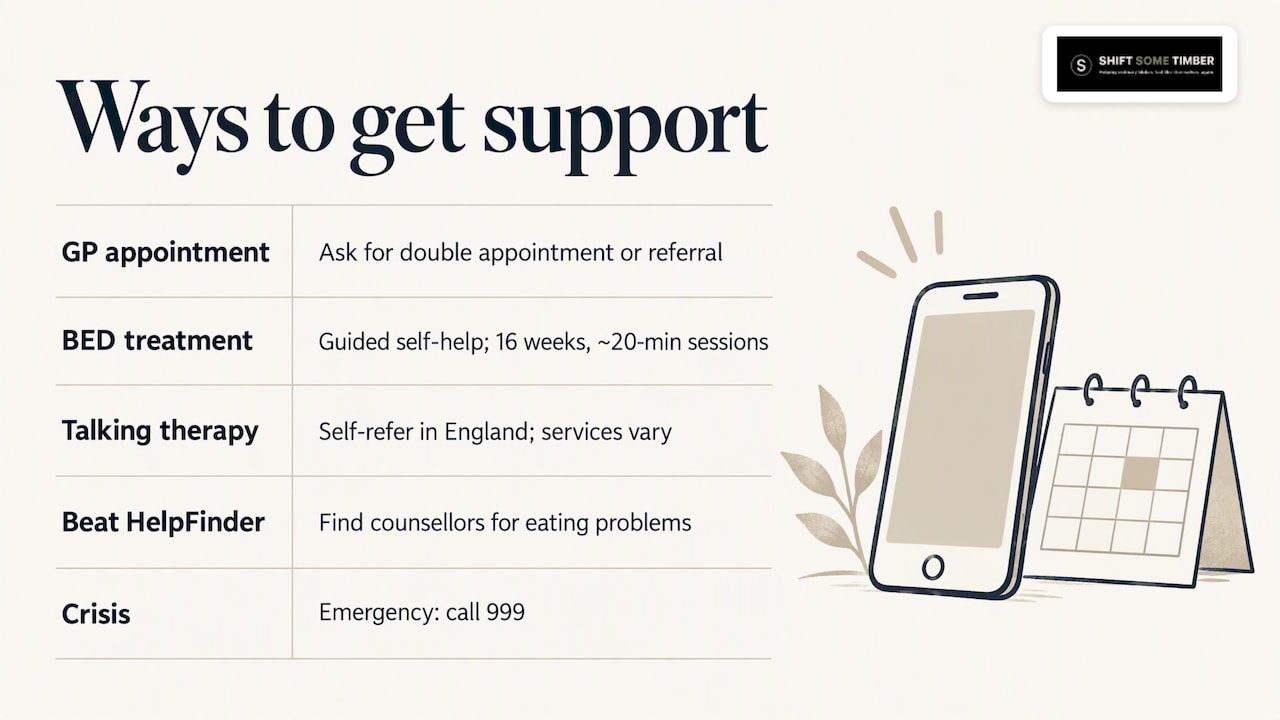
See your GP. You can ask for a longer appointment to talk about your mental health. Guidance reproduced by Cumbria County Council from Beat says eating disorders are mental illnesses and you do not need to be a certain weight to deserve help. It also says you can ask for a double appointment and request a specialist referral. Our pages on booking a GP appointment for mental health and what the GP will ask walk you through what to say.
Know what treatment looks like. For binge eating disorder, NICE quality standard QS175 says the first-line psychological treatment is a guided self-help programme. That is a cognitive behavioural self-help programme with brief support sessions, around 20 minutes each, spread over 16 weeks. It is not a lecture and it does not mean lying on a couch. If you want to see how clinicians approach choosing between treatment options more generally, this clinical guide to choosing a treatment is a useful read, though it is in Portuguese.
Try talking therapies. In England you can often refer yourself to NHS talking therapies for stress, low mood and anxiety without seeing a GP first, though services vary by area. See our guide to NHS Talking Therapies.
Use specialist charities. Beat, the UK eating disorder charity, runs a HelpFinder for counsellors who support people with eating problems, and a support group for people dealing with emotional overeating, according to NHS material from Doncaster and Bassetlaw.
If you are in crisis or thinking about harming yourself, do not wait for an appointment. Our mental health crisis plan explains the immediate steps, and in an emergency call 999.
Emotional eating, weight loss treatment and medication
Some men find that weight-loss medicines quieten what people call food noise, the constant mental chatter about eating. That can be a real help, but medication does not teach you what to do with stress, boredom or a bad week. If binge eating is part of your picture, the treatment questions need to be kept separate and discussed with a clinician. We explain this in Binge eating and weight-loss medicines. If you are weighing up where to start, our comparison of GP care versus a specialist weight-management service can help, and our page on mental health and weight loss covers the link in more depth.
Our view: the plate is rarely the whole story
SHIFT was built on lived experience, and the thing we hear most is not "I do not know what to eat". It is "I know what to eat, and I do it anyway when things get tough". That is not laziness. It is a coping habit that has been doing a job for years.
We think the answer is not more rules or more shame. It is plain-English information, practical food ideas, movement you can actually fit around work and family, and a bit of honest reflection on what is going on underneath. That is why our support covers life before, during and after treatment, and why it is open to men who started elsewhere, who have stopped medication, or who want help without it.
If you recognise yourself in this article, you do not need to fix it all at once. Start with the diary. Notice the pattern. Tell one person.
— Matt O’Brien
Support that fits around your life
If you want structured help rather than going it alone, The Shift Programme brings together Grub for practical food ideas, Fit for achievable movement, Life Back for personal goals and My Timber for check-ins and progress tracking. If you are not sure where to begin, Weight Loss for Men UK explains getting started and what support looks like. Clinical assessment, prescribing and dispensing, where relevant, are handled by appropriately regulated partners.
FAQ
What are the psychological reasons behind comfort eating?
Food can quickly dampen uncomfortable feelings like stress, boredom, loneliness or anger, so the brain learns to repeat it. For many men it also fits a habit of coping privately and keeping control, as the City, University of London research on masculinity and eating describes. The relief is short, guilt often follows, and the cycle restarts.
Is emotional eating more common in men or women?
The data points both ways depending on the study. One 2022 study of people with obesity found no significant difference between men and women in the emotions that triggered eating, with boredom the top trigger for both. A review of emotional eating and BMI found a link in both sexes, with a stronger link in women. Men are less likely to talk about it, so it can go unseen.
Does stress make men put on weight?
Stress can change what and when you eat, and it can wreck sleep and routine, which both make snacking more likely. The link runs through behaviour as much as biology. Our article on stress, eating and weight gain in men looks at this in more detail.
When should I see a GP about emotional eating?
See your GP if eating feels out of control, if you eat in secret, or if guilt and shame are affecting your mood, work or relationships. Ask for a longer appointment so there is time to talk it through. You do not need to be a particular weight to be taken seriously.
Sources
- Managing emotional eating, University Hospitals Sussex NHS Foundation Trust
- Emotion regulation difficulties and dietary restraint independently predict binge eating among men
- Managing emotions through eating, City Research Online
- A Comparison of Emotional Triggers for Eating in Men and Women with Obesity
- Understanding Lifestyle and Mental Health, NHS
- Emotional and external eating and eating architecture in the UK
- Weight loss food fact sheet, British Dietetic Association
- Eating disorder guidance on GP help, Cumbria County Council
- NICE QS175, Quality statement 3: first-line psychological treatment for binge eating disorder
- Emotional overeating: where to find support, Doncaster and Bassetlaw NHS
Recommended
- Stress, Eating and Weight Gain in Men
- Mental Health and Weight Loss: Support for Men
- Men's Mental Health and Weight: Confidence Without Blame
- Lose Weight With a Men’s Diet: UK 1,800 Calorie Plans That Last
Related: Men’s Mental Health | Straight-Talking UK Support.
Last updated .