GLP-1 NHS Eligibility: Who Qualifies for Weight Loss Injections
In England, you may qualify for a GLP-1 type weight loss injection on the NHS if your BMI is 35 or more (32.5 or more for some ethnic backgrounds) and you have at least four of five listed weight-related conditions. Access is being phased in, so the group who can get it widens over time. Semaglutide (Wegovy) is only available through a specialist weight management service. This guide explains the rules in plain English and what to do next, whether you qualify or not.
TL;DR
- The NHS England criteria for tirzepatide (Mounjaro) are a BMI of 35 or more, and at least 4 of 5 listed health conditions.
- The BMI threshold is lowered by 2.5 for people from certain ethnic backgrounds.
- Access is phased by cohort over three years, starting with those in the highest clinical need.
- Semaglutide can only be prescribed through a specialist weight management service.
- Not eligible yet? There is still NHS and other support that does not depend on a prescription.
Table of Contents
- The short answer: who is eligible on the NHS?
- How the phased rollout works
- BMI thresholds and ethnicity adjustments
- Tirzepatide vs semaglutide vs liraglutide
- What happens once you qualify
- A practical way to check your own position
- If you don't qualify (yet)
- Our perspective
- Support from SHIFT while you work out your route
- FAQ
- Sources
The short answer: who is eligible on the NHS?
The NHS is rolling out weight management injections in phases. NHS England says that, in the primary care rollout, access initially goes to people with the highest clinical need: adults with a BMI of 35 or more (adjusted for ethnicity) and four listed weight-related health problems.
The detail for tirzepatide, as set out by NHS Cheshire and Merseyside, is a BMI of at least 35 (32.5 for people from minority ethnic family backgrounds) and at least four of these five conditions:
- type 2 diabetes
- high blood pressure
- abnormal blood fats (such as high cholesterol)
- obstructive sleep apnoea
- established cardiovascular disease
These rules apply in England. Scotland, Wales and Northern Ireland run their own health services and may differ, so check with your local health board.
How the phased rollout works
The NHS cannot treat everyone who might benefit at once. Mounjaro access is therefore opened up in cohorts over the first three years, according to NHS Cheshire and Merseyside:
| Cohort | Who it covers | When |
|---|---|---|
| Cohort 1 | BMI of 40 or more with at least 4 listed conditions | From the start of the rollout in 2025 |
| Cohort 2 | BMI of 35 to 39.9 with at least 4 listed conditions | From 23 June 2026 |
| Cohort 3 | BMI of 40 or more with at least 3 listed conditions | From 1 April 2027 |
In practice, that means a man with a BMI of 37 and four of the conditions could now be in scope, while one with a BMI of 42 and three conditions will be waiting until April 2027. Your GP practice or integrated care board (ICB) will know how far your area has got, because local services can vary in how they run the rollout.
BMI thresholds and ethnicity adjustments
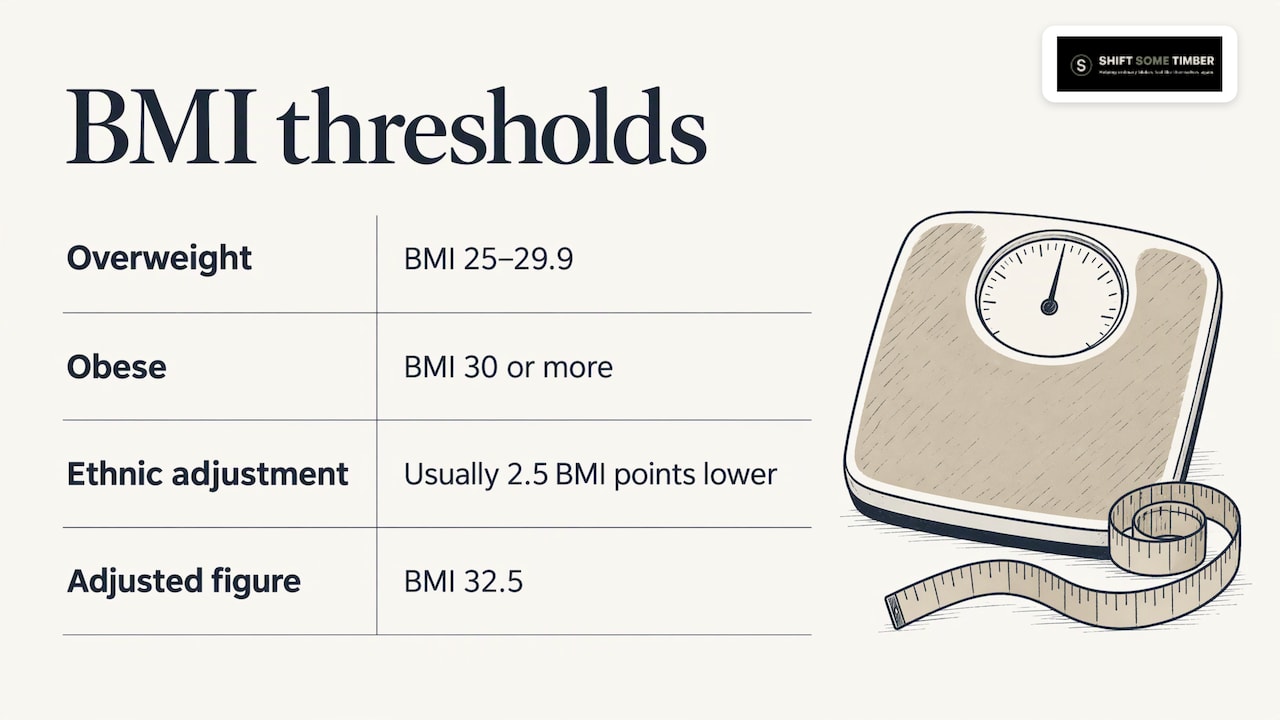
BMI is your weight in kilograms divided by your height in metres squared. The NHS defines a BMI of 25 to 29.9 as overweight and 30 or more as obese, but the thresholds for these injections are higher, as above.
For tirzepatide, semaglutide and liraglutide, NICE says to use lower BMI thresholds, usually by 2.5, for people from the listed ethnic backgrounds. The reason, according to NICE, is that some groups face the same obesity-related health risks at a lower BMI. So the adjusted figure of 32.5 is about fairness of access, not a loophole.
If you think the adjustment applies to you, ask your GP to confirm. They will check which backgrounds are listed.
Tirzepatide vs semaglutide vs liraglutide
The route to treatment depends on the medicine.
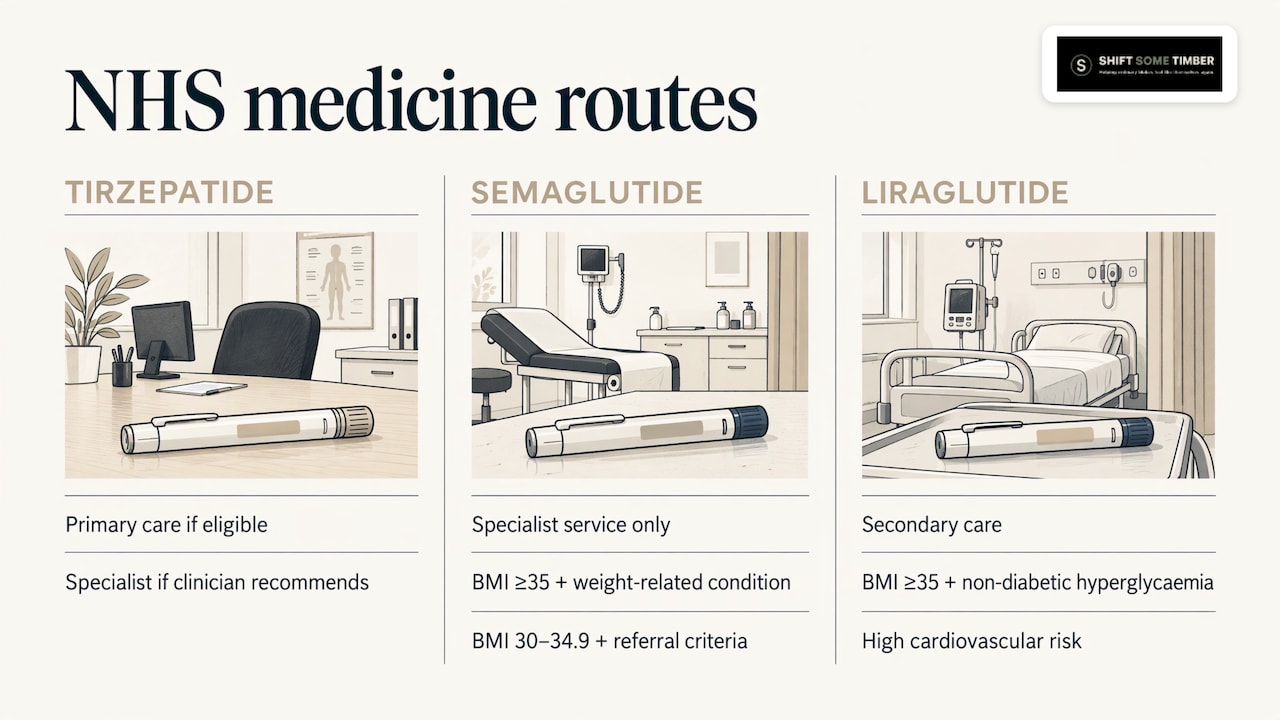
Tirzepatide (Mounjaro). NHS England says it may be prescribed in primary care for eligible patients, or through a specialist service if a healthcare professional thinks it is right for you.
Semaglutide (Wegovy). This can only be prescribed through a specialist weight management service. NICE recommends it alongside diet and activity for adults with at least one weight-related condition and a BMI of at least 35, or a BMI of 30 to 34.9 if they meet the referral criteria for specialist services. Your GP would normally refer you to what is called a tier 3 service.
Liraglutide (Saxenda). NICE authorises it for adults with a BMI of 35 or more who have non-diabetic hyperglycaemia and a high cardiovascular risk, and it is prescribed in secondary care. If you are weighing up the two older options, our Wegovy vs Saxenda comparison sets them side by side.
Meeting the criteria does not guarantee a prescription. A clinician still has to assess whether the medicine is right for you.
What happens once you qualify
Expect more than a prescription. NHS Cheshire and Merseyside explains that NHS tirzepatide treatment involves a clinical assessment and taking part in wrap-around care covering diet, nutrition and physical activity. NICE says these medicines should be used alongside a reduced-calorie diet and more physical activity.
Then comes review:
- Regular monitoring. Your healthcare team checks your progress and whether treatment is still appropriate.
- A six-month checkpoint. NICE guidance says to stop tirzepatide if weight loss is under 5% after 6 months on the highest tolerated dose. For semaglutide, NICE says to consider stopping if less than 5% of starting weight has gone.
- A time limit for semaglutide. It should be used for a maximum of 2 years within a multidisciplinary specialist service.
One safety point: NICE guidance says tirzepatide should not be used in pregnancy or by women of childbearing potential not using contraception, and semaglutide and liraglutide should not be used in pregnancy. If you are a man whose partner is planning a pregnancy, or you have any other medical question about a medicine, speak to your GP or pharmacist.
A practical way to check your own position
- Work out your BMI with the NHS calculator, using your current weight and height.
- List any diagnosed conditions from the five above. Only diagnosed conditions count, so if you suspect high blood pressure or sleep apnoea, get it checked first.
- Note whether an ethnicity adjustment may apply.
- Book a GP appointment and ask where your area is in the rollout and whether you fit a current cohort.
- Ask what wrap-around support is offered locally, so you know what to expect.
Bringing a few readings and a short weight history makes the appointment far more productive. For a wider look at how eligibility works across both NHS and private routes, see our guide to weight loss medication eligibility in the UK.
If you don't qualify (yet)
Most men with weight to lose will not meet the NHS criteria, and that is not a verdict on whether your health matters. NHS Cornwall and Isles of Scilly ICB notes that other NHS weight services and surgery remain available if you need them, so ask your GP what is offered locally.
While you wait, habits still count. Our comparison of a structured programme vs DIY dieting shows why having a plan and check-ins helps. If you are building movement back in, walking versus structured exercise is a good starting point.
Our perspective
Not meeting a medicine's eligibility criteria should not leave you without useful information or practical support. We think that is the wrong way round. Support should not start only when your health has already taken a hit.
The NHS criteria exist because resources are limited, and they are the right first place to look if you meet them. But qualifying or not, the medicine is only part of it. What you eat, how you move and how you feel about yourself decide how well the results hold up.
That is why SHIFT is built around The Programme: Grub for practical food, Fit for achievable movement, Life Back for personal goals and My Timber for check-ins. We support men before, during and after treatment, including those who started elsewhere or want to go without medication. No judgement, plain English, and your privacy respected.
Support from SHIFT while you work out your route
Whether you are waiting on your GP, weighing up private treatment or already on medication, you do not have to do it alone. SHIFT offers general treatment information and practical food, movement and tracking support. SHIFT does not currently provide or book prescribing. Treatment questions go to your own prescriber.
Explore the SHIFT programme and how it works and see where you fit. For more on the medicines themselves, the GLP-1 Knowledge Centre is the place to start.
FAQ
Does the NHS cover GLP-1 medicines?
Yes, in England some are available on the NHS, but only for people who meet the national criteria. Tirzepatide can be prescribed in primary care for eligible patients, while semaglutide goes through specialist weight management services. Availability depends on the rollout in your area.
What BMI do you need for Mounjaro on the NHS?
For the national criteria you need a BMI of 35 or more, or 32.5 or more for people from certain ethnic backgrounds. You also need at least four of five listed conditions. From 1 April 2027 a further group with a BMI of 40 or more and three conditions is due to be included.
Can my GP prescribe Wegovy?
Not directly. Semaglutide can only be prescribed through a specialist weight management service, so your GP would refer you if you are eligible. Ask which tier 3 service covers your area and what the waiting time is.
What if I don't meet the NHS criteria?
Other NHS weight services and, where needed, surgery remain available, so speak to your GP about what is offered locally. You can also look at structured lifestyle support or private routes, which have their own clinical checks.
Sources
- NHS England: Weight management injections
- NHS Cheshire and Merseyside: Mounjaro (tirzepatide)
- NICE NG246: Medicines and surgery
- NICE TA875: Semaglutide recommendations (BMI)
- NICE TA875: Semaglutide recommendations (stopping rules)
- NICE: Access to tirzepatide and other obesity management medications
- NHS Central East ICB: Weight loss management and support
- NHS Cornwall and Isles of Scilly ICB: NHS prescriptions for weight loss injections
Recommended
- Weight Loss Medication Eligibility in the UK: Who Qualifies
- 3 NHS weight loss drugs: who qualifies, why it depends on your postcode
- UK GLP-1 Dosing: 4 week steps to cut side effects and protect muscle
- 1.74 kg Average Lean Loss: Prevent GLP-1 Muscle Loss in UK Men
Last updated .