
Iron Deficiency in Men: Symptoms, Causes and Tests
Yes, men can have iron deficiency, and when a man has it, the useful question is not only "how do I top it up?" but "why is it low?". The NHS lists tiredness, lack of energy, breathlessness, palpitations, pale skin and headaches among the possible symptoms. If you think you may have it, the next step is a GP appointment and a blood test, not guesswork with supplements.
This guide is from the SHIFT Team. It explains what low iron can feel like, why it is looked into more carefully in men, how the testing works and which everyday foods help. Your own GP or prescriber handles individual decisions about your health and any treatment.
TL;DR
- Men can be iron deficient. Symptoms include tiredness, breathlessness, palpitations, pale skin and headaches, and they can show up even before anaemia develops.
- In men, low iron is not usually put down to diet alone. A GP will want to know whether blood is being lost somewhere, often in the gut.
- Testing starts with a full blood count and usually iron studies, with ferritin the most useful single marker.
- Food helps: meat, beans, lentils, leafy greens, dried fruit and fortified cereals all count. Treatment decisions sit with your GP.
- One practical step: write down your symptoms, any painkillers you take and any changes in your toilet habits, then book the appointment.
Table of Contents
- What low iron can feel like
- Why men get a closer look
- How a GP tests for iron deficiency
- Treatment and follow-up
- Everyday food sources of iron
- Iron, energy and the rest of your health
- When to see your GP
- Free support while you sort it out
- What to do this week
- FAQ
- Sources
What low iron can feel like
Iron helps your blood carry oxygen. When stores run low, you can feel it in ordinary moments: the stairs at work, the school run, the walk you used to enjoy.
The NHS lists tiredness, lack of energy, breathlessness, heart palpitations, pale skin and headaches. NICE's clinical knowledge summary for GPs adds that iron deficiency can cause symptoms even without anaemia, including fatigue, poor concentration and irritability. The same page also lists dizziness, weakness, restless legs, tinnitus, a sore tongue, altered taste, pica (cravings for non-food items such as ice or dirt) and difficulty swallowing among possible symptoms or signs.
That is a long list, and almost none of it is specific to iron. Poor sleep, stress, a low mood or low testosterone can all feel similar. That is why a blood test is the only reliable way to tell. Our guide on low energy in men over 40 walks through the other common causes.
Why men get a closer look
In women of childbearing age, heavy periods are a well-known reason for low iron. Men do not have that route, so doctors ask a different question: where is the iron going, or why is it not getting in?
The NHS names several possible causes:
- bleeding in the digestive system, including from anti-inflammatory painkillers (NSAIDs such as ibuprofen), stomach ulcers, bowel inflammation and piles
- less commonly, stomach or bowel cancer
The British Society of Gastroenterology guideline says iron deficiency may reflect poor dietary intake or malabsorption, while chronic blood loss is a common mechanism behind iron-deficiency anaemia. It also reports that around one third of men and postmenopausal women who present with iron-deficiency anaemia have an underlying abnormality, most often in the gut.
Read that the calm way. Most causes are treatable, and finding one early is the point of the tests. It is also why NICE advises that when no cause is obvious, further investigation is guided by age and sex. For a man, that usually means your GP will not stop at "eat more red meat".
How a GP tests for iron deficiency
Here is what the process usually looks like.
- A conversation. The NHS says a GP will usually take a lifestyle and medical history. Expect questions about diet, medicines, any blood in your stools or black stools, and any weight loss you did not intend.
- A full blood count. This measures haemoglobin, the part of your blood that carries oxygen, and shows whether you are anaemic.
- Iron studies. The British Society of Gastroenterology guideline recommends confirming iron deficiency with iron studies and describes ferritin (a protein that reflects your iron stores) as the single most useful marker. Transferrin saturation can help when ferritin might be falsely normal.
- Further tests if the cause is unclear. The NHS says these may include a FIT test (a stool test that looks for hidden blood) and a referral to a specialist. NICE CKS also recommends coeliac blood tests and a urine test for blood in people with iron-deficiency anaemia.
If you want to understand the results on your screen afterwards, our guide to iron, ferritin and full blood count explains how the pieces fit together. For the bowel test, see what FIT checks and when symptoms need a GP.
Reading ferritin without self-diagnosing
The 2021 guideline says ferritin below 15 µg/L indicates absent iron stores, and below 30 µg/L generally indicates low stores. It also notes that inflammation can push ferritin up, so a result can look normal when you are in fact deficient.
That last point matters. A single number on a private test printout can mislead without the rest of the picture. Take any result to your GP, who can read it alongside your symptoms, haemoglobin and history.
Treatment and follow-up
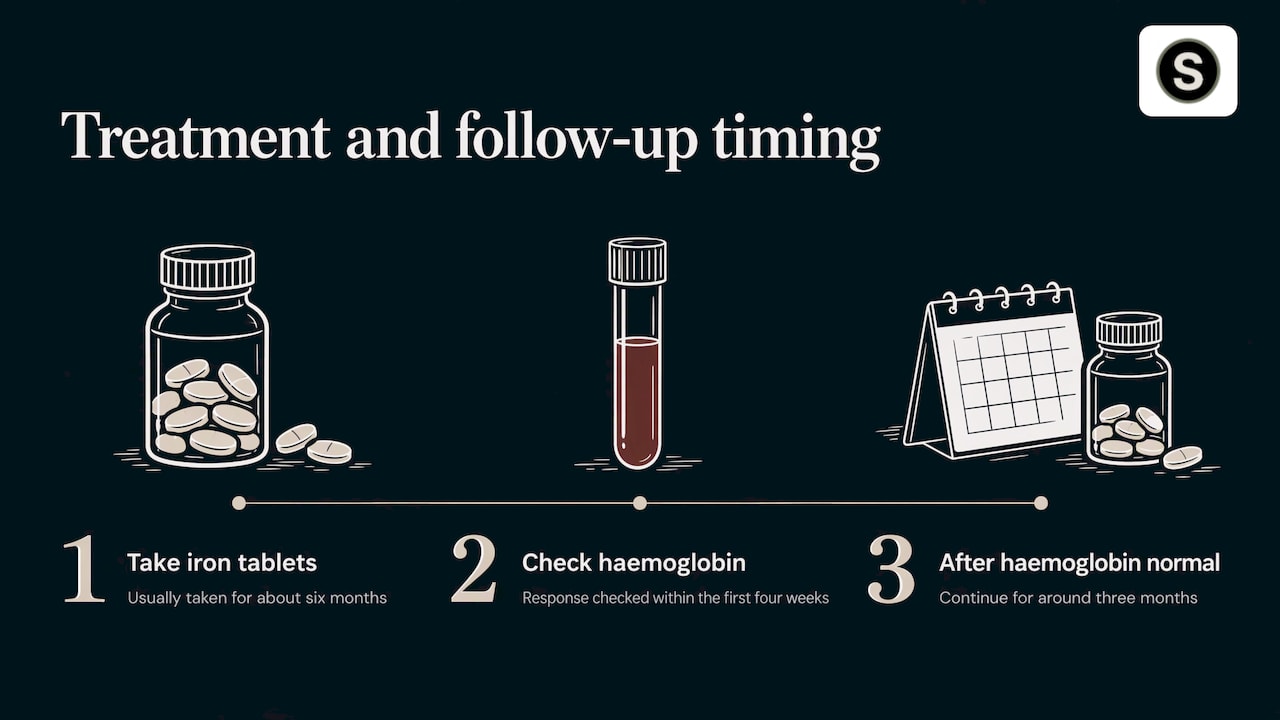
Treatment depends on the cause. The NHS says it may include iron tablets, usually taken for about six months, with repeat blood tests over the following months. The British Society of Gastroenterology guideline recommends checking your haemoglobin response within the first four weeks and continuing for around three months after haemoglobin returns to normal, so your stores refill.
Which product, how much and for how long are decisions for your GP or prescriber. If tablets upset your stomach, tell them rather than stopping quietly: the same guideline lists other options for people who cannot tolerate them, and your clinician can talk you through those.
A note on supplements you already take
It is common to be taking a multivitamin or vitamin D through the winter. If you are, mention it at the appointment so your GP has the full list. If you are curious about how vitamin D and iron sit together, there is a plain read on taking vitamin D and iron together. For testing vitamin D itself, see should UK men get a vitamin D test this winter.
If you are tired and wondering about starting iron on your own, our piece on why tiredness alone is not a reason to start iron sets out why the test comes first.
Everyday food sources of iron
Food will not fix every cause of low iron, but it is a sensible part of looking after yourself. The NHS lists these iron-rich choices:
- meat
- fortified breakfast cereals and bread
- dark green leafy vegetables
- dried fruit
- beans, peas and lentils
In a normal UK week that can look like:
| Meal | Easy iron-containing option |
|---|---|
| Breakfast | Fortified cereal, or a savoury breakfast with eggs and beans |
| Lunch | Lentil soup, or a bean and veg wrap |
| Dinner | Lean beef or turkey mince chilli with kidney beans and spinach |
| Snack | A handful of dried apricots |
What about the question of a drink that is very high in iron? The NHS list above is about foods, and no drink is singled out there. A varied plate is the more reliable plan than looking for one special product.
If you want ideas that fit a busy week, the SHIFT recipes include a barbecue baked beans potato breakfast hash, and a paprika turkey potato breakfast hash for a high-protein start to the day. If you are eating smaller portions for any reason, including while losing weight, it is worth keeping beans, lentils, greens and lean meat on the plate so your food stays varied.

Iron, energy and the rest of your health
Tiredness has many possible causes, so iron is one piece of a wider picture. Sleep, blood pressure, blood sugar, vitamin levels, mood and hormones can all play a part. If you are working out which checks make sense, our guide to weight loss blood tests for UK men explains common checks in plain English, and vitamin D and B12 testing covers two other levels that often come up with tiredness.
If you are also wondering about testosterone, our page on low testosterone symptoms covers what to check. Your GP is the person to decide which tests are right for you.
When to see your GP
The NHS advises seeing a GP if you think you may have iron-deficiency anaemia. In practice, book in if:
- you have been unusually tired, breathless or light-headed for more than a few weeks
- you have noticed blood in your stools, black stools, or a change in bowel habit
- you take anti-inflammatory painkillers regularly and have the symptoms above
- you have lost weight without trying
If you have severe chest pain, or are very breathless, get urgent help through NHS 111 or 999.
A simple checklist for the appointment
- Note when the tiredness started and what it stops you doing.
- List every medicine and supplement, including over-the-counter painkillers.
- Note any changes to your toilet habits, appetite or weight.
- Ask which tests are planned, and when you will hear the results.
- Ask when a repeat test would be due.
None of that needs to be perfect. A rough note on your phone is enough.
Free support while you sort it out
Waiting for tests and results can be frustrating, especially when you feel flat. My Timber is free to use and brings together Today and Journey check-ins, progress tracking, SHIFT Grub for realistic food, SHIFT Fit for approachable walking and strength, and Ask Timber for non-clinical support. You can use it alongside your own clinic or prescriber, after treatment ends, or without treatment. No prescription transfer or purchase is needed. Find it on the Shift Some Timber site.
SHIFT does not currently offer clinical assessment, prescribing or dispensing, so treatment questions stay with your own GP or prescriber. Our Medical Disclaimer sets out what our information is for.
What to do this week
Pick one step, not five. If you have symptoms: book the GP appointment. If you are waiting for it: add one iron-containing meal from the table above, and take a short walk, which also helps with energy. The check-in tools in My Timber can help you track how you feel day to day, so you have something concrete to tell your GP.
FAQ
Can men have iron deficiency?
Yes. Men can be iron deficient, and the symptoms are the same as in anyone else: tiredness, breathlessness, palpitations, pale skin and headaches. In men, doctors also look for a cause, because the British Society of Gastroenterology reports that around a third of men and postmenopausal women with iron-deficiency anaemia have an underlying abnormality, most often in the gut.
What foods are good sources of iron?
The NHS lists meat, fortified cereals and bread, dark green leafy vegetables, dried fruit, and beans, peas and lentils. Mixing these through the week is easier than relying on one food.
What do you crave if your iron is low?
Some people with iron deficiency develop pica, a craving for non-food items such as ice or soil, according to the NICE CKS list of symptoms. Altered taste is also listed. Most people with low iron have no unusual cravings, so a blood test is the way to find out.
How long does iron deficiency take to treat?
The NHS says iron tablets are usually taken for about six months, with repeat blood tests over the following months. Your GP will set the plan for you, and may also look into the cause.
Should I start iron tablets without a test?
Book a blood test first. Tiredness has many causes, and a low iron result in a man can need further checks. Your GP or prescriber should decide on any treatment.
Sources
- Iron deficiency anaemia, NHS
- Signs and symptoms, Anaemia - iron deficiency, NICE CKS
- Confirmed deficiency, Anaemia - iron deficiency, NICE CKS
- Adult Iron Deficiency Anaemia Care Guidelines, British Society of Gastroenterology
- British Society of Gastroenterology guidelines for the management of iron deficiency anaemia in adults, 2021
Recommended
- Iron supplements: why tiredness alone is not a reason to start
- Iron, ferritin and full blood count: different pieces of the picture
- Weight Loss Blood Tests for UK Men: 6 Checks, Results Explained
- Low Energy in Men Over 40: Causes and What to Do
SHIFT provides general UK health information and practical support. Speak to your GP or your own prescriber about symptoms, test results or medicines. My Timber is free to use alongside your own clinic, after treatment ends or without treatment.
Last updated .