Weight-Loss Workouts for Men: Strength and Walking Plan
The best fat loss workout for a man is one you can repeat every week for a year. In practice that means two or three full-body strength sessions, plenty of walking, and a bit of harder cardio if you want it. You don't need a gym membership or an hour a day. Below is a plan you can start this week, whether you are a complete beginner, carrying a lot of extra weight, or already on weight loss medication.
TL;DR
- Do strength training two or three times a week, using bodyweight, bands or dumbbells. It helps protect muscle while you lose fat.
- Add walking and other moderate activity until you reach the NHS target of 150 minutes a week, building up gradually.
- Start with 20 to 30 minute sessions. Consistency beats intensity, especially in the first 12 weeks.
- If you take GLP-1 medication, protein and strength work matter even more, because some of the weight you lose can be muscle.
- Check with your GP before starting if you have a heart condition, diabetes, joint problems or you have been inactive for a long time.
Table of Contents
- What actually works for fat loss
- Before you start
- Your weekly plan
- Workouts for men who are very overweight or out of shape
- Cardio that fits real life
- Exercise on GLP-1 or weight loss medication
- What about food?
- When life gets in the way
- Our view
- Keeping the habit after the weight comes off
- Support that goes beyond the workout
- FAQ
- Sources
What actually works for fat loss
Most of the results online promise a "shred" in 30 days. Real fat loss is slower, and what you eat drives most of it. Exercise does three jobs that diet alone can't do well:
- It helps you keep muscle while you lose weight.
- It improves your fitness, energy and mood, so everything else feels easier.
- It builds the habit that helps you keep the weight off.
The NHS physical activity guidelines for adults aged 19 to 64 set the baseline: at least 150 minutes of moderate activity a week, or 75 minutes of vigorous activity, plus strengthening exercises that work all the major muscle groups. Moderate means your heart rate goes up and you breathe faster, but you can still talk. Think brisk walking, cycling or pushing a lawn mower.
That is a good target, but it is not where you have to start. If you are a long way from it, the first win is simply moving more than you do now.
Why strength training comes first
When you lose weight, some of it is muscle. The Guy's and St Thomas' NHS Foundation Trust says that weight loss medicines can lead to some loss of muscle as well as fat, and that strength-based exercise is one of the best ways to protect it. Muscle matters because it supports your strength, your balance and your metabolism, and it makes the weight you lose look and feel better.
The American College of Sports Medicine updated its resistance training guidance in 2026, the first major update since 2009. It says home-based and non-traditional training, such as bodyweight, resistance bands or everyday items, works well. It also says you don't need to train to failure for general health. Manageable volume and consistency count for more.
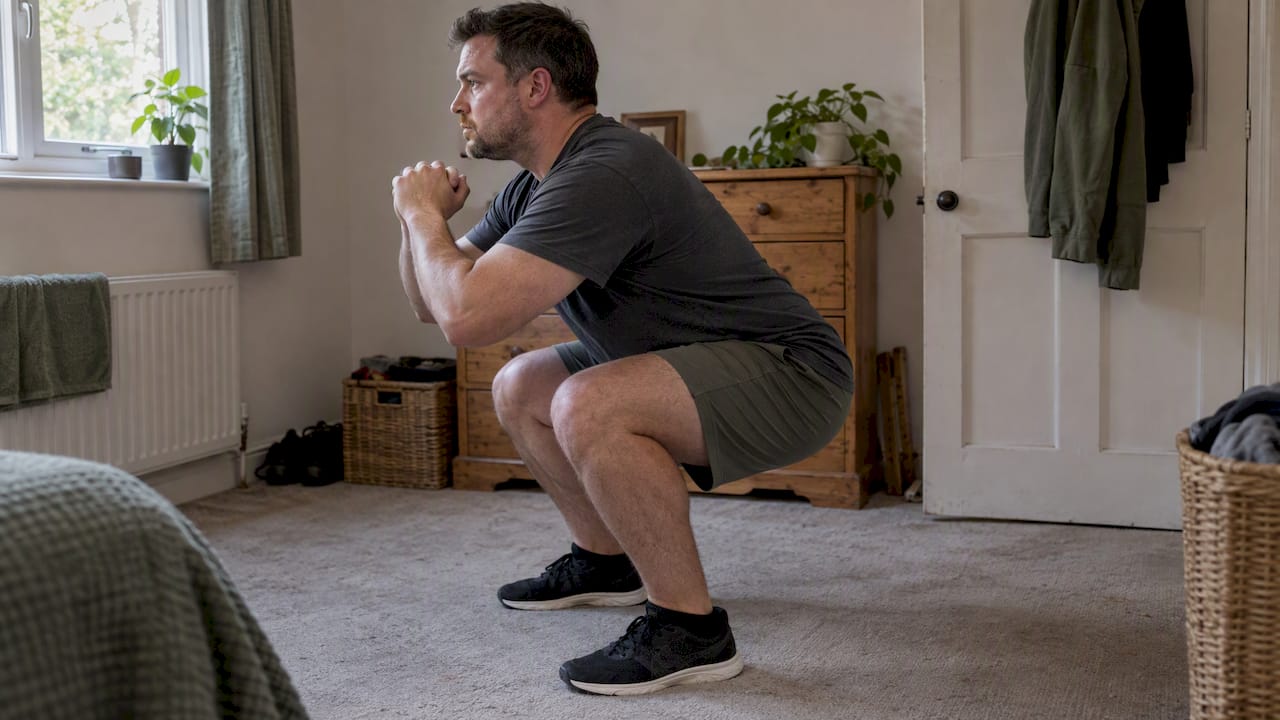
So you can drop the idea that you need a complicated split or a fancy gym.
Before you start
A few minutes of thought now saves you from an injury that sets you back weeks.
- See your GP first if you have chest pain, breathlessness on light effort, high blood pressure that isn't controlled, type 2 diabetes, joint or back problems, or you have not exercised for years. Tell them what you plan to do. They can tell you what is safe for you.
- Start lower than your ego wants. If you can do 10 press-ups, do 6 and leave the rest in the tank. Add reps in the following weeks.
- Pain is not progress. Muscle burn and tiredness are normal. Sharp or joint pain means stop and ask a professional.
- Footwear and floor. A pair of decent trainers and a bit of floor space is all you need.
Your weekly plan
Here is the whole week at a glance. It is built for a man working full time with other demands on his evenings.
| Day | Session | Time |
|---|---|---|
| Monday | Workout A (full-body strength) | 25 to 35 min |
| Tuesday | Brisk walk | 20 to 30 min |
| Wednesday | Workout B (full-body strength) | 25 to 35 min |
| Thursday | Rest, or an easy walk | Optional |
| Friday | Workout A again, or short intervals | 25 to 35 min |
| Saturday | Longer walk, bike ride or football with the kids | 45+ min |
| Sunday | Rest | None |
If three strength days is too much, drop Friday. Two sessions a week still count towards the guideline and still do the job. If your week falls apart, do the shortest version of one workout and call it a win.
Workout A: push, squat and carry
Do each exercise for 3 sets. Rest 60 to 90 seconds between sets.
- Sit-to-stand or goblet squat: 8 to 12 reps. Use a sturdy chair at first. Move on to holding a dumbbell or a heavy bag at your chest.
- Incline press-up: 6 to 12 reps. Hands on a kitchen worktop or the back of a sofa. Lower the angle as you get stronger until you are on the floor.
- Dumbbell or band row: 8 to 12 reps each side.
- Glute bridge: 10 to 15 reps. Lie on your back, feet flat, and lift your hips.
- Farmer's carry: 3 walks of 20 to 30 seconds, holding a heavy bag or dumbbell in each hand.
Workout B: hinge, pull and core
Same format: 3 sets, 60 to 90 seconds rest.
- Romanian deadlift with dumbbells or a loaded backpack: 8 to 12 reps. Keep your back flat and push your hips back.
- Overhead press with dumbbells or a band: 8 to 12 reps.
- Reverse lunge or split squat: 6 to 10 reps each leg. Hold a door frame for balance if you need to.
- Band pull-apart or towel row: 12 to 15 reps.
- Dead bug or plank on your knees: 20 to 30 seconds, or 6 to 10 reps each side.
How to progress
Pick a rep range, for example 8 to 12. When you can do 12 clean reps on every set, make it harder: a heavier weight, a slower lowering phase, or a tougher variation. Write your numbers down. Tracking tells you that you are getting stronger even when the scales are stuck.
Workouts for men who are very overweight or out of shape
If you are carrying a lot of weight, high-impact moves like burpees and jumping can be hard on knees and ankles, and a lot of popular plans lean on them. You don't need them. Here is how to adapt the plan:
- Stay with chair squats, incline press-ups and band rows for the first 4 to 6 weeks.
- Choose low-impact cardio: walking, cycling, rowing machine or swimming.
- Split sessions up. Two 15 minute blocks count as much as one 30 minute block for most people's routine, and they are easier to fit in.
- Use the talk test. You should be able to speak in short sentences.
The ACSM says the biggest hurdle is going from sitting around to any movement at all. Once you are over it, the rest gets easier. Be proud of the first week.
Cardio that fits real life
Strength work is the foundation, but cardio helps your heart, your stamina and your weekly activity total.
Walking
It is unglamorous and it works. Walk at lunch, walk the school run, walk the dog, park further away. A brisk 30 minutes, five days a week, gets you to the 150 minute guideline on its own.
Couch to 5K
If you want to run, the free NHS Couch to 5K plan takes you from nothing to 5km in nine weeks, running three times a week with rest days in between. It starts with one minute runs and walking breaks. It is a good fit if you like a clear plan to follow.
Short intervals
Once you have a few weeks behind you, you can swap one session for intervals if you want a change. On a bike or a brisk incline walk, go hard for 30 seconds, then easy for 90 seconds, and repeat 6 to 8 times. It is short and it is tough, so build up to it slowly. Don't do it more than once or twice a week, and skip it if you feel unwell or your joints complain.
Exercise on GLP-1 or weight loss medication
If you take a GLP-1 medicine, exercise stops being optional extra credit. Medicines reduce your appetite, which makes it easy to eat too little protein and lose more muscle than you would like.
The NHS guidance from Guy's and St Thomas' suggests aiming for 80 to 100g of protein a day alongside strength training two to three times a week to protect muscle. It also says muscle can account for 20 to 30% of the weight lost during calorie restriction. Your own protein target depends on your size and health, so check it with your prescriber or a dietitian, especially if you have kidney problems.
A few practical points:
- Eat before you train even if you aren't hungry. A small protein snack like yoghurt or eggs is enough.
- Go lighter on days you feel nauseous or tired. A walk counts.
- Stay hydrated. Reduced appetite often means you drink less too.
- Tell your prescriber about dizziness, fainting or anything that doesn't feel right during exercise.
We go deeper on this in our guides to GLP-1 and exercise and what men can do about muscle loss on GLP-1 treatment.
What about food?
Workouts alone rarely deliver big fat loss. They work best alongside a sensible calorie deficit and enough protein. You don't have to go extreme. A steady plan you can keep to at the pub, at a barbecue and on a stressful Tuesday is better than a strict one you drop after three weeks. Our UK men's 1,800 calorie diet guide shows what that can look like in practice.
When life gets in the way
Most men don't fail because they picked the wrong exercises. They fail because work, kids, poor sleep and stress eat the time and energy. NHS Essex research with 29 men living with obesity explored how men experience weight loss, and points to the same thing: diet and exercise alone are rarely enough, and things like confidence, wellbeing and day-to-day pressures are part of the picture.
So plan for the bad weeks:
- Have a 10 minute fallback workout: two rounds of squats, press-ups and rows.
- Put sessions in your diary like a meeting.
- Train at the same time on the same days, so it becomes automatic.
- If you miss a week, restart at the same level, not at punishment level.
- Keep an eye on sleep and stress. When you are run down, a short walk often does more good than forcing a hard session. If you are looking at general wellbeing and lifestyle products as part of your routine, thecary has a range of health and wellness resources to browse, but none of them replaces sleep, food and training.
If low mood or anxiety is getting in the way, you are not alone and it is not a willpower problem. See our guide on men's mental health and weight, and talk to your GP if it is affecting daily life.
Our view
We started SHIFT because ordinary men told us the same story. They had tried the big, shouty programmes. They were too complicated, too hard on the joints, or too far from real life, so they stopped. Then they blamed themselves.
We think the answer is smaller. Two strength sessions. A walk most days. Enough protein. A way to see progress that isn't only the scales: how you feel climbing stairs, how your clothes fit, whether you have energy left for the kids in the evening.
That is why The Programme is built the way it is: Grub for practical food ideas, Fit for movement you can actually achieve, Life Back for the goals that matter to you, and My Timber for check-ins and tracking. And it is why we support men before, during and after treatment, including men who started elsewhere or have stopped medication. Weight regain is common, and it is a support gap, not a character flaw.
— Matt O’Brien
Keeping the habit after the weight comes off
NICE updated its quality standard in 2025. It says people who stop weight loss medicines or finish a weight management programme should get advice and support to keep the changes going. NICE also says medicines are not a quick fix, and people need support to keep weight off after treatment ends.
Your workouts are the part of that you control. The sessions you set up now are the ones that still protect your muscle, mood and energy in a year. Keep the routine small enough to survive a new job, a new baby or a bad winter.
Support that goes beyond the workout
If you want structure around training, food, treatment information and progress tracking in one place, take a look at The Shift Programme. If you are thinking about medication, our weight-management medication page explains the pathway, with clinical assessment, prescribing and dispensing handled by regulated partners. Not sure where to begin? Start with weight loss for men in the UK.
FAQ
How many days a week should I work out to lose fat?
Two to three strength sessions plus regular walking or other moderate activity is a solid plan for most men. The NHS suggests spreading activity across the week and aiming for at least 150 minutes of moderate activity, plus strengthening work. If that sounds like a lot, build up over several weeks.
What is the best workout for an overweight beginner?
A full-body routine of chair squats, incline press-ups, band rows and glute bridges, plus walking. These are low impact and easy to scale. Start with 2 sets and add a third when it feels comfortable. See your GP first if you have a health condition or have been inactive for a long time.
Can I lose fat just from the belly?
Not reliably. Exercise and diet reduce fat across the body, and where it comes off first varies from man to man. Full-body strength training and a steady calorie deficit are a better use of your time than endless sit-ups.
Should I do cardio or weights if I am on GLP-1 medication?
Both, but make weights a priority. Strength training helps protect muscle while the medicine reduces your appetite, and NHS guidance suggests two to three sessions a week. Walking helps with general fitness. Talk to your prescriber if you feel dizzy or unwell when exercising.
Sources
- Physical activity guidelines for adults aged 19 to 64, NHS
- Staying active when taking weight loss medicines, Guy's and St Thomas' NHS Foundation Trust
- ACSM publishes updated resistance training guidelines
- ACSM position stand on resistance training
- Get running with Couch to 5K, NHS
- Men's experiences of living with obesity, NHS Essex
- Quality statement 7, NICE QS212
- People need support to keep weight off after treatment ends, NICE
Recommended
- Lose Weight With a Men’s Diet: UK 1,800 Calorie Plans That Last
- Protein for Men Losing Weight: Practical Food, Not Gym Theatre
- Weight Loss for Men Over 40: A Realistic UK Guide
- Belly Fat in Men: Why It Happens and What Helps
Related: Exercise for Weight Loss: Walking, Strength and Mobility.
Last updated .