NICE List vs Private Prices: Mounjaro Cost in the UK
Many men paying privately for Mounjaro spend within a range that commonly extends from a modest to a higher monthly amount, depending on dose, with maintenance doses typically costing more. NHS access avoids private treatment prices, although standard prescription charges can apply in England unless you are exempt. Access now includes specialist weight-management services and a phased primary-care rollout for people with the highest clinical need. Before you commit to a provider, check your prescribed dose and ask whether the quoted price is genuinely all-in.
TL;DR:
- Private Mounjaro costs in the UK typically range from under £120 to over £340 monthly, depending on the dose and provider discounting structures.
- List prices from NICE show a significant jump between low-dose (2.5mg at £133) and higher doses (12.5mg and 15mg at £330), impacting long-term budgeting.
- Providers often include hidden fees such as consultation, delivery, needles, and disposal, which can add up to £40 extra each month.
- NHS access is available through specialist weight-management services and, for prioritised cohorts, primary care. Standard prescription charges can apply in England unless you are exempt, and local access varies.
- Comparing actual maintenance-dose prices and monitoring approaches before signing a contract is essential to avoid inflated or hidden treatment costs.
Table of Contents
- [Mounjaro cost UK by dose: the official list prices explained](#mounjaro-cost-uk-by-dose-the-official-list-prices-explained)
- [How private provider pricing varies: bundles, discounts and hidden fees](#how-private-provider-pricing-varies-bundles-discounts-and-hidden-fees)
- [NHS vs private: eligibility, cost and realistic timelines](#nhs-vs-private-eligibility-cost-and-realistic-timelines)
- [How to compare private quotes so you're not caught out](#how-to-compare-private-quotes-so-youre-not-caught-out)
- [What treatment actually costs from starter dose to maintenance](#what-treatment-actually-costs-from-starter-dose-to-maintenance)
- [What clinical governance actually buys you](#what-clinical-governance-actually-buys-you)
- [Insurance coverage and reimbursement for Mounjaro](#insurance-coverage-and-reimbursement-for-mounjaro)
- [Cost-saving tips and patient support in the UK](#cost-saving-tips-and-patient-support-in-the-uk)
- [The gap between headline pricing and honest pricing](#the-gap-between-headline-pricing-and-honest-pricing)
- [Getting started with a clinically governed route](#getting-started-with-a-clinically-governed-route)
- [Sources](#sources)
- [FAQ](#faq)
Mounjaro cost UK by dose: the official list prices explained
The official list prices for tirzepatide, the active ingredient in Mounjaro, are set out by NICE guidance TA1026. These are the manufacturer's published prices for a 4-week supply, before any commercial discounting.
| Dose | List price (4 week supply) |
|---|---|
| 2.5mg | £133 |
| 5mg | £180 |
| 7.5mg | £255 |
| 10mg | £255 |
| 12.5mg | £330 |
| 15mg | £330 |
Notice that 7.5mg and 10mg share a price band, as do 12.5mg and 15mg. That's a manufacturer pricing decision, not a clinical one, and it matters when you're weighing up dose escalation costs later in your treatment.
A significant price increase occurs when moving from the 2.5mg starter dose to higher maintenance doses such as 12.5mg or 15mg, reflecting a substantial rise in list price. Anyone budgeting for Mounjaro based on the starter-dose price they saw advertised is likely to be badly wrong within three or four months.
Why private prices don't match the list price
List price is what NICE and the NHS use as a reference point. It is not what most private patients actually pay. Retail prices from private providers and pharmacies typically sit above or below list price depending on three things: wholesale purchasing contracts, pharmacy margins, and manufacturer rebate arrangements.
Eli Lilly, the manufacturer of Mounjaro, put rebate agreements in place during 2025, and how much of that rebate a pharmacy passes on to patients varies considerably. That's part of why one provider can advertise a 5mg pen at £145 while another charges £189 for what is clinically the same product, according to pricing analysis from Mounjaro Click Calc.
There's also a structural shift worth knowing about. Drug Tariff records held by the NHSBSA show an effective list-price rise implemented around 1 October 2025. Price rises at the manufacturer level tend to filter through to retail pricing over the following months, so a quote you saw advertised in mid 2025 may no longer reflect what a pharmacy charges today. Always check a provider's current, live pricing rather than relying on a screenshot or a friend's experience from six months ago.
Why the starter-dose price is a poor guide to real cost
Providers frequently market Mounjaro "from £99" or similar. That figure almost always refers to the lowest strength, 2.5mg, taken for the shortest possible period. It's a genuine price, but it describes month one of treatment, not month twelve.
Independent UK price-tracker snapshots, including data compiled by Monj, indicate that private retail monthly totals vary from the lowest starter prices up to considerably higher amounts for maintenance doses, depending on provider and discounting structure. If you're planning a realistic budget, the number that matters is the maintenance-dose price, not the headline figure that got you through the door.
Pro Tip: When you see a "from £ X" price advertised, ask the provider directly what the same pen costs at 10mg and 15mg. If they're reluctant to give you a straight answer, that tells you something about how the business plans to make its money later.
How private provider pricing varies: bundles, discounts and hidden fees
Private Mounjaro pricing in the UK isn't standardised, and providers structure their offers in genuinely different ways. Some charge per pen with a separate consultation fee. Others bundle everything into a single monthly subscription. A few offer steep first-order discounts that quietly disappear once you're locked in as a returning customer.
Bundled subscription models tend to suit maintenance patients best, because they smooth out the cost of consultations, prescriber reviews and delivery into one predictable monthly figure. Pay-as-you-go pricing can look cheaper on paper but often adds consultation and delivery charges back in at each reorder, which stings more once you're on a higher dose and reordering monthly without fail.
Several costs are easy to miss when you're comparing headline prices:
- Consultation or prescriber review fees, if not already bundled into the pen price
- Pen needles, which aren't always included with the injection pen itself
- Sharps bins for safe disposal of used needles
- Delivery charges, particularly for next-day or signed-for shipping
- Repeat-prescription or "reorder" administration fees
None of these individually looks dramatic. Together, they commonly add somewhere in the region of an extra £10 to £40 a month to the advertised pen price, depending on the provider's fee structure. That's the gap between the number in the advert and the number that actually leaves your account.
First-order discounts vs sustainable pricing
Watch closely for the difference between an introductory discount and a sustainable price. A provider offering 30% off your first month is a perfectly normal way to win new customers, but it tells you nothing about what you'll pay in month four or month fourteen. What matters for budgeting is the returning-customer price, sometimes buried in the terms and conditions or only visible once you've created an account.
Subscription models bring their own trade-off. You typically get a lower per-pen price in exchange for a recurring commitment, and cancelling can involve minimum-term clauses or forfeited introductory pricing. That's not necessarily a bad deal, but read the cancellation terms before you sign up, not after your circumstances change.
There's a second, less obvious risk here too. Some providers stop prescribing once a patient reaches a defined weight-loss threshold or leaves their initial treatment programme, according to flags raised by Monj's analysis of maintenance pharmacies. A cheap introductory provider that isn't built for long-term maintenance can end up costing you more overall, because switching providers mid-treatment often means paying for a fresh consultation and starting the discount clock again.
NHS vs private: eligibility, cost and realistic timelines
NHS access to Mounjaro does not use private retail pricing, although standard prescription charges can apply in England unless you are exempt. Access is available through specialist weight-management services and is also being phased into primary care for prioritised cohorts, so the route depends on clinical eligibility and local commissioning.
NHS England's interim commissioning guidance implementing NICE TA1026 sets out how tirzepatide is being rolled out through these specialist services, with supply arranged commercially and separately from private retail pricing. Eligibility generally follows a phased approach based on clinical need, meaning not every GP practice or Integrated Care Board is offering referrals at the same pace.
- Check your BMI threshold and prior history. Tier 3 services typically require a BMI above a defined clinical threshold, often alongside weight-related health conditions, and evidence that other weight-management approaches have already been tried.
- Ask your GP about local Tier 3 referral pathways. Availability varies significantly by area and Integrated Care Board, so what's offered in one part of England may not exist yet in another.
- Expect local variation. NHS England is phasing access through specialist services and primary care, and availability depends on your local Integrated Care Board, service capacity and which priority cohort you fall into. Ask your GP or ICB what pathway is operating locally rather than relying on a national waiting-time estimate.
- Factor in prescription charges if you do get an NHS prescription. England charges a standard prescription fee per item, while Scotland, Wales and Northern Ireland provide prescriptions free of charge, so where you live in the UK genuinely affects what an NHS prescription costs you.
For many men, the practical issue is whether they meet the current NHS criteria and how quickly their local pathway can assess them. Access varies by area and cohort, so check the current local route rather than assuming either immediate access or a fixed national wait. If you want a fuller picture of how the NHS pathway works in practice, the guide by Shift Some Timber to NHS access in England covers the referral routes in more detail.
How to compare private quotes so you're not caught out
Comparing Mounjaro quotes properly means looking past the headline number on the landing page. Here's a practical sequence to work through before you commit to any provider.
- Confirm the exact dose you'll be prescribed, not the cheapest dose the provider advertises. Prices vary substantially by strength, and a quote based on 2.5mg tells you nothing about your likely 10mg or 15mg cost.
- Ask what's actually included. Does the price cover the consultation, ongoing monitoring, and delivery, or are these charged separately at each reorder?
- Check the repeat-prescription and cancellation terms. Some subscriptions lock you into a minimum term or claw back a discount if you leave early.
- Verify the pharmacy's regulator. In Great Britain, check the pharmacy on the General Pharmaceutical Council (GPhC) register; in Northern Ireland, check the Pharmaceutical Society of Northern Ireland (PSNI) register before handing over payment details.
- Convert the pen price to a genuine cost per month at your actual dose, and compare that figure across providers rather than comparing headline "from" prices against each other.
The maths here is simple but frequently skipped. If a 10mg pen costs £220 and lasts four weeks, that's your monthly figure, full stop, don't compare it against a competitor's 2.5mg starter price of £99 and conclude they're cheaper overall.
Pro Tip: Ask every provider you're considering the same three questions in writing: what will I pay at 10mg, what will I pay at 15mg, and what happens if I want to cancel? Compare the answers side by side rather than the marketing pages.
Three red flags should make you walk away immediately: pricing that isn't published anywhere and only appears after you've handed over personal details, no mention of ongoing clinical monitoring once you're prescribed, and any pharmacy you can't verify as UK-regulated through the GPhC register.
What treatment actually costs from starter dose to maintenance
Most tirzepatide treatment plans for weight management run somewhere between 12 and 18 months, with dose escalation happening every four weeks until you reach an effective maintenance dose, typically 10mg or 15mg. That escalation schedule is exactly why total cost estimates matter more than monthly snapshots.
Here's what three realistic pathways look like in practice. A low-dose pathway, where someone responds well at 5mg and stays there, might run roughly £180 a month, totalling around £2,160 to £3,240 across 12 to 18 months. A mid-maintenance pathway reaching 10mg, which is common, runs closer to £255 a month using list-price figures, or towards the higher end of the £250 to £340 private-market range reported by Monj's pricing snapshots, totalling roughly £3,060 to £4,590 over the same period. A high-dose pathway reaching 15mg runs around £330 a month at list price, pushing total costs towards £3,960 to £5,940 across 12 to 18 months.
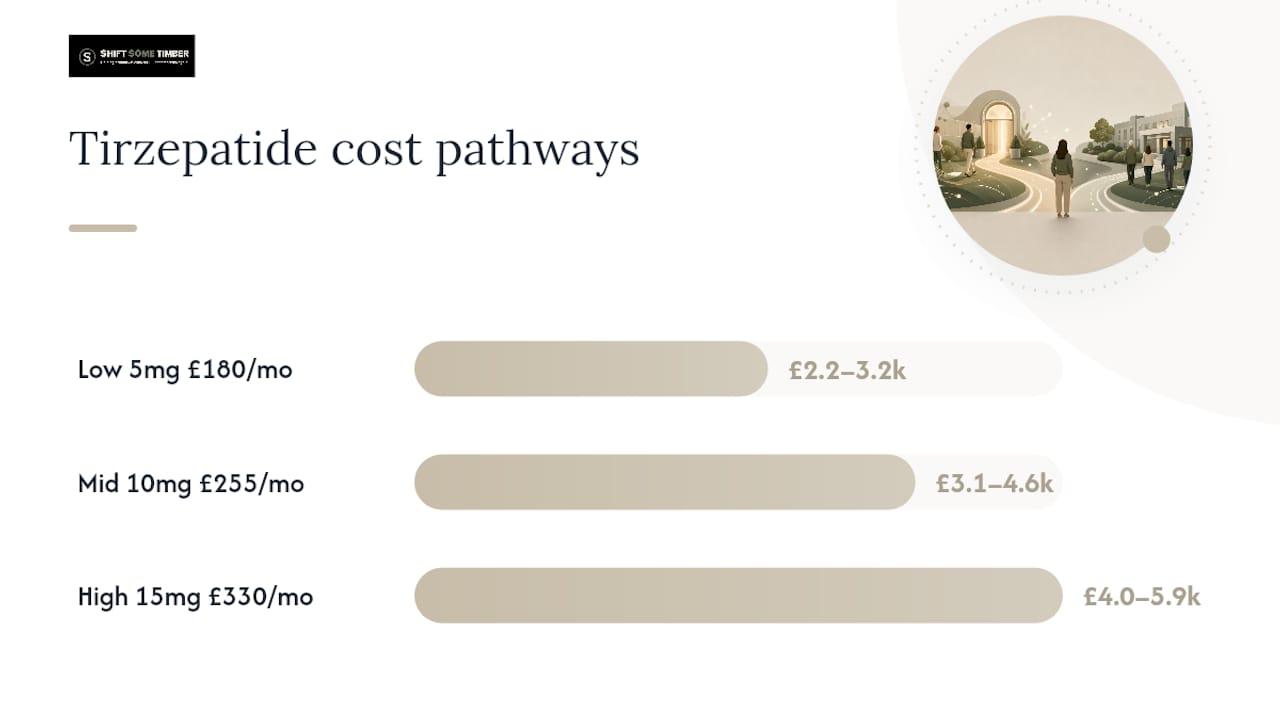
These figures don't include consultation, delivery or ancillary fees discussed earlier, so add your provider's specific extras on top for a realistic personal total.
Cost-effectiveness isn't just about the monthly figure, either. Clinical trial data published in the New England Journal of Medicine shows tirzepatide produces greater average weight loss than currently approved semaglutide regimens in head-to-head comparisons. That doesn't change the UK price you'll pay, but it's a genuine factor if you're weighing up tirzepatide against a cheaper alternative and trying to work out cost per kilogram lost rather than cost per pen. If you want that comparison spelled out properly, Shift Some Timber's Mounjaro versus Wegovy comparison breaks down how the two drugs stack up on outcomes as well as price.
What clinical governance actually buys you
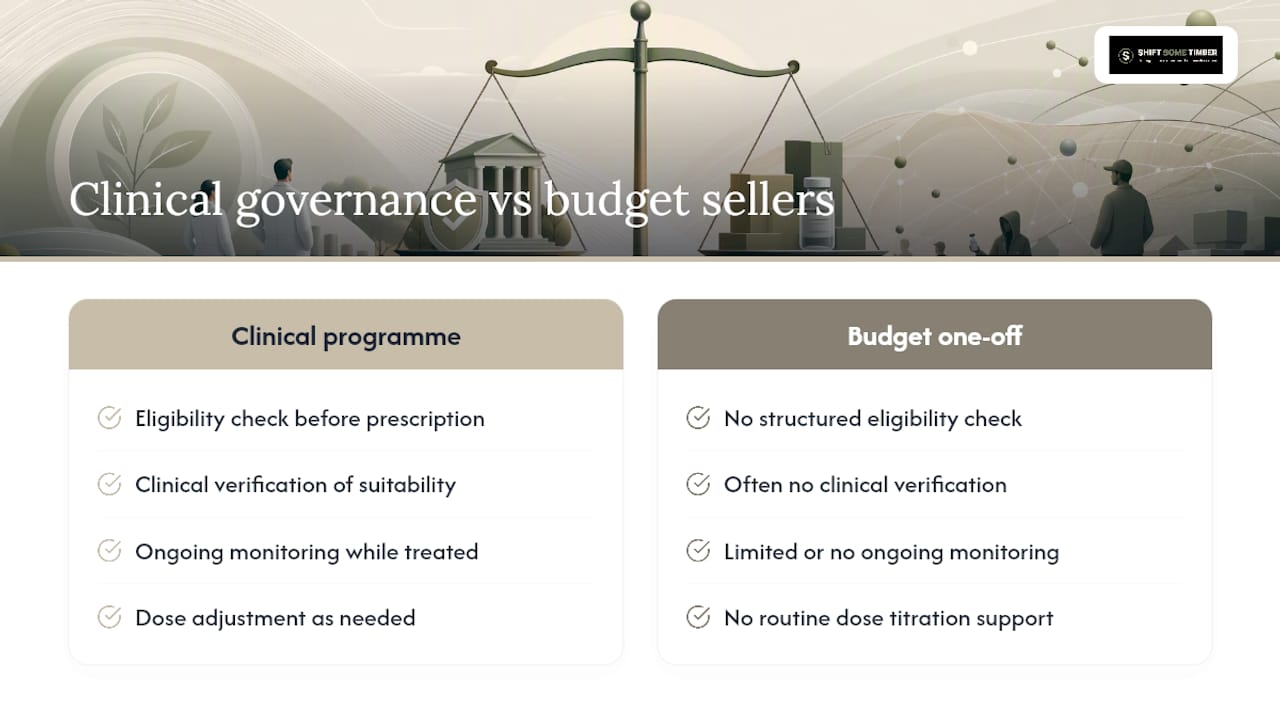
Here's what a lot of pricing guides skip entirely: the cheapest pen isn't always the cheapest treatment. Shift Some Timber's approach to weight management starts with an eligibility check and clinical verification before any prescription is issued, followed by ongoing monitoring for as long as you're on treatment. That structure exists because tirzepatide isn't a product you buy once and forget about. It's a medication that needs dose adjustment, side-effect monitoring and genuine follow-up.
Budget providers built around a one-off transaction often compete purely on the headline pen price, because that's the number people search for. What they frequently don't include is a structured check-in as your dose increases, a proper conversation if you experience side effects, or support if you want to come off treatment and keep the weight off afterwards. That gap doesn't show up on a price comparison table, but it shows up in outcomes.
Clinical governance and ongoing monitoring do add to the upfront cost of a programme compared with a bare-bones pen subscription. The trade-off is a reduction in clinical risk and, for many patients, better adherence over the months where dose escalation and side-effect management matter most. For men who've started treatment elsewhere, felt unsupported, or come off medication without a plan, that ongoing relationship is often exactly what was missing the first time round.
If you're still weighing up whether medication is the right starting point at all, it's worth reading how structured weight-loss support compares with lifestyle changes alone before you commit to any provider, budget or otherwise.
Insurance coverage and reimbursement for Mounjaro
Private medical insurance in the UK rarely covers weight-loss medication like Mounjaro, even under comprehensive policies. Most UK insurers classify obesity treatment and weight-management medication as an exclusion, in the same category as cosmetic procedures, regardless of how the prescription is justified clinically.
There are limited exceptions. Some employer-provided health schemes include weight-management support as a wellbeing benefit, though this tends to cover consultations or a structured programme rather than the medication cost itself. If you have private health insurance, it's worth checking your policy document specifically for "weight management" or "bariatric" exclusions rather than assuming general prescription cover applies.
Reimbursement through the NHS works differently again. If you qualify for and receive Mounjaro through an NHS Tier 3 pathway, you pay only the standard prescription charge in England, or nothing at all in Scotland, Wales and Northern Ireland. There's no separate reimbursement scheme for patients who pay privately and later want to claim costs back. For most UK residents, the honest answer is that Mounjaro is currently an out-of-pocket private cost or a free NHS prescription, with very little middle ground through insurance.
Cost-saving tips and patient support in the UK
A handful of practical habits make a genuine difference to what you spend on Mounjaro over a full treatment course. Comparing providers at your actual maintenance dose rather than the advertised starter price, discussed earlier, is the single biggest lever. Beyond that, a few smaller tactics add up.
Buying in larger multi-pen quantities where a provider offers it usually brings the per-pen price down, provided you're confident in your dose stability. Some providers offer loyalty pricing for patients who stay on the same subscription for six months or longer, which rewards exactly the maintenance behaviour that keeps treatment effective. It's also worth asking providers directly whether they offer a price match or review against competitor pricing, since some do this quietly rather than advertising it.
There is no dedicated NHS-run patient assistance scheme that discounts private Mounjaro purchases, and no manufacturer coupon scheme currently operates in the UK equivalent to those seen in other countries. The realistic savings route for most UK patients is comparing genuine maintenance-dose pricing across regulated providers, checking for bundled versus add-on fees, and avoiding the trap of switching providers repeatedly and paying fresh consultation fees each time.
The gap between headline pricing and honest pricing
The conventional advice on Mounjaro cost treats this as a simple shopping exercise: find the cheapest pen, buy it, done. That's where most pricing guides get it wrong. The number that actually determines what you'll spend isn't the starter price, it's the maintenance-dose price six months in, plus whatever fees weren't in the advert.
What the evidence here actually supports is this: list prices from NICE give you a genuine ceiling to sanity-check quotes against, but the real decision is about sustainability, not the lowest number on day one. A provider that's cheap now but stops prescribing at a certain weight, or bolts on fees at every reorder, costs more over 12 to 18 months than one that's transparent from the start.
If you take one thing from this guide, prioritise providers that show you their maintenance-dose price and their monitoring approach before you sign up, not after.
— Matt
Getting started with a clinically governed route
If you've read this far, you already understand why the cheapest quote isn't always the cheapest treatment. Shift Some Timber exists for exactly that reason: an alternative to piecing together a budget pen subscription and hoping the monitoring sorts itself out later. The programme starts with a clinical eligibility check and verification, so pricing is based on what you're actually prescribed, not a generic advertised dose.
From there, ongoing monitoring runs alongside your treatment rather than stopping once your first pen arrives, whether you're starting fresh or you've come off treatment elsewhere and want proper support this time. If you're deciding between a GP referral, a specialist weight-management route, or starting privately, it's worth comparing how GP and specialist weight-management pathways actually differ before you commit to either. Check your eligibility and see what a clinically governed plan looks like for your specific dose and circumstances.
Sources
This guide draws on the NICE technology appraisal and its list-price table, NHSBSA Drug Tariff pricing entries, and live UK price-tracker snapshots to distinguish official pricing from retail reality. NHS England's interim commissioning guidance and the MHRA Yellow Card system are referenced for eligibility and safety reporting respectively, both worth bookmarking if you want to verify figures independently.
This article is general information, not a substitute for advice from a qualified doctor. Consult a qualified healthcare professional about your own circumstances before acting on anything here.
- NICE guidance TA1026 — information about tirzepatide
- NHSBSA Drug Tariff (VMPP) — tirzepatide pricing entries
- NHS England interim commissioning guidance for tirzepatide
- MHRA Yellow Card
FAQ
How much does Mounjaro cost per month in the UK?
Private monthly costs typically range from roughly under £120 at lower doses to £200 to £340 for higher maintenance doses, according to UK price-tracker data. Official NICE list prices run from £133 for 2.5mg to £330 for 12.5mg and 15mg per four-week supply, as set out in NICE guidance TA1026.
What are the common side effects of Mounjaro?
The most commonly reported side effects are gastrointestinal, including nausea, diarrhoea and reduced appetite, particularly during dose increases. If you experience a suspected adverse reaction, you can report it directly through the MHRA Yellow Card system, the UK's official safety-reporting route.
Where can I buy weight-loss injections like Mounjaro in the UK?
Mounjaro is available through NHS Tier 3 weight-management services for eligible patients, or through private clinically governed providers. Always confirm any pharmacy dispensing the medication is properly registered before paying.
What is the injection used for weight loss called?
Mounjaro, containing the active ingredient tirzepatide, is one of the main injectable medications prescribed for weight management in the UK. It works differently from semaglutide-based treatments, and the two are compared in detail in this Mounjaro versus Wegovy breakdown.
Does private health insurance cover Mounjaro in the UK?
Most UK private health insurers exclude weight-loss medication from standard cover, treating it similarly to cosmetic treatment exclusions. A small number of employer wellbeing schemes support weight-management consultations, but medication costs are almost always paid out of pocket privately.