Online weight loss prescriptions in the UK, explained
An online weight loss prescription is a private prescription issued after a remote consultation, and in the UK it should involve real checks. The prescriber should verify your weight and height, take a full medical history and share relevant details with your regular prescriber. Whether you qualify, and which medicine is right, is a decision for your own prescriber. Whichever route you take, the daily food, movement, sleep and follow-up around the medicine is where free practical support helps most.
This guide covers what the process involves, what good checks look like, how it differs from the NHS route and what to do around treatment. It is general information, not medical advice.
TL;DR
- Weight loss medicines such as semaglutide and tirzepatide are prescription-only in the UK. A suitably qualified prescriber has to assess you first.
- A responsible online service verifies your weight, height or BMI independently. A phone call or a single photo is not enough for the first check.
- NHS access runs through primary care and is phased by BMI and health conditions. You cannot self-refer.
- Follow-up, side-effect monitoring and a plan for stopping matter as much as the first prescription.
- Food, movement and sleep support is free to use alongside any treatment, or without it, through Shift Some Timber.
Table of Contents
- What an online weight loss prescription actually is
- Who qualifies
- How NHS access differs
- What a proper online consultation includes
- Safety points every man should know
- When treatment is reviewed or stops
- The everyday part: food, movement, sleep and mind
- Where SHIFT fits
- A short checklist before any online consultation
- FAQ
- Sources
What an online weight loss prescription actually is
It is the same legal process as an in-person one, done remotely. The General Pharmaceutical Council (GPhC) is the regulator for pharmacies in Great Britain. It lists orlistat, liraglutide, semaglutide and tirzepatide as the weight management medicines available in the UK. The GLP-1 types (liraglutide, semaglutide, tirzepatide) are prescription-only. They can be prescribed by a doctor, a nurse independent prescriber or a pharmacist independent prescriber.
In plain terms:
- Orlistat reduces the fat your body absorbs from food.
- Liraglutide and semaglutide mimic a gut hormone that affects appetite.
- Tirzepatide combines that GLP-1 action with a second hormone-based action called GIP.
GOV.UK says these medicines are licensed and assessed by the MHRA, the UK medicines regulator. They should be used for people who are overweight or have diabetes, not for cosmetic weight loss.
Who qualifies
The eligibility rules come from NICE, the body that advises the NHS on treatments. Its obesity guideline NG246 sets out the criteria for adults. In summary:
- Tirzepatide: an initial BMI of at least 35 kg/m² and at least one weight-related health condition.
- Semaglutide: at least one weight-related condition and either a BMI of 35 or more, or a BMI of 30 to 34.9 with referral to specialist services.
- Orlistat: a BMI of 30 or more, or 28 or more with associated risk factors.
BMI is your weight in kilograms divided by your height in metres squared. A man who is 1.78 m tall and weighs 115 kg has a BMI of about 36.3. Whether a weight-related condition applies to you, such as high blood pressure or type 2 diabetes, is for your prescriber to confirm.
NICE also says lower BMI thresholds, usually 2.5 points lower, apply to people from South Asian, Chinese, other Asian, Middle Eastern, Black African or African-Caribbean backgrounds.
For a longer walk through the criteria, see our guide to weight loss medication eligibility in the UK.
How NHS access differs
NHS access to semaglutide and tirzepatide is being phased in. One example is the North West London ICS guidance, aligned to NHS England's interim commissioning guidance. It starts with people who have a BMI of 40 or more and four or more qualifying conditions. These include heart disease, high blood pressure, abnormal blood fats, obstructive sleep apnoea and type 2 diabetes. A later phase covers a BMI of 35 or more with one weight-related condition plus another qualifying circumstance.
Two points from the same guidance matter for men weighing up the options:
- You cannot self-refer for NHS-funded weight management medication. The referral starts in primary care, usually with your GP.
- NHS eligibility is judged on your BMI and conditions at the time of referral. It does not depend on whether you started treatment privately.
Local rollout differs by area, so your GP practice is the place to ask what applies near you. Our NHS weight-loss medication guide explains the routes in more detail.
What a proper online consultation includes
The GPhC sets out what it expects from online prescribers in its weight management FAQs for pharmacies. Use it as a checklist for anything you are offered.
Checks on the way in
- Two-way communication. A real exchange with a prescriber, not a form that gets approved automatically.
- Independent verification of weight, height or BMI. This can be a video consultation, in person, from your clinical records or through another healthcare provider.
- No phone-only verification. The GPhC says a phone call is not appropriate. A photo or pre-recorded video alone is not appropriate for the first check either, partly because images can be edited.
- A full medical history. NICE's prescribing guide says this covers other medicines and conditions, with baseline height, weight and BMI recorded.
- Willingness to change habits. The same guide says the assessment should check you are willing to follow a reduced-calorie diet and be more active.
- Sharing with your regular prescriber. The GPhC says relevant information should be shared with your GP or regular prescriber, after the service has asked for your consent.
If your details cannot be verified, the GPhC says you should be directed to an appropriate care provider. In its March 2026 article, it also expects online services to check identity using recognised digital standards.
Checks after you start
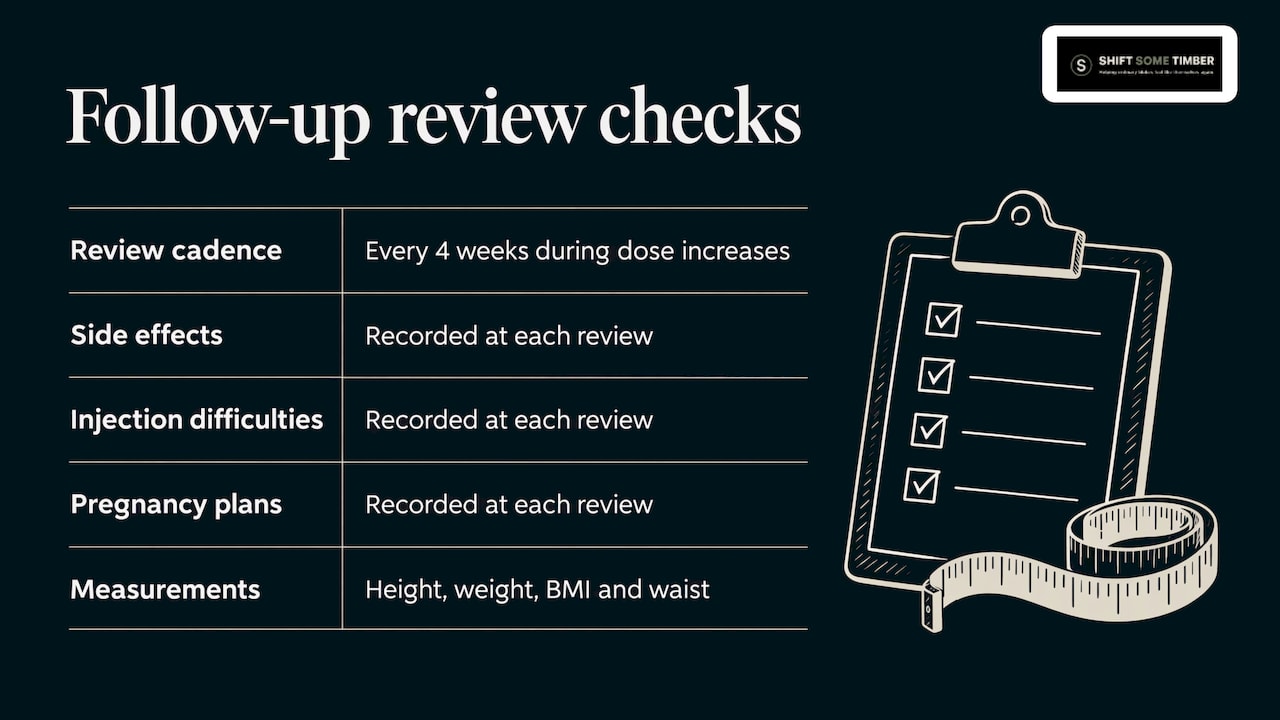
NICE says follow-up should happen every 4 weeks while the dose is being increased. Each review should record side effects, any difficulty with injections, pregnancy plans and your height, weight, BMI and waist measurement. Side effects can be reported through the MHRA Yellow Card scheme. The GPhC says photos or video can be used for later supplies once your details have been verified, with periodic monitoring of progress.
Safety points every man should know
GLP-1 medicines can cause side effects, and the MHRA has flagged one serious one. Its January 2026 Drug Safety Update covers severe acute pancreatitis, which is inflammation of the pancreas. The MHRA received 1,296 Yellow Card reports between 2007 and October 2025, including 19 fatal cases. Its advice is to stop treatment immediately if pancreatitis is suspected, and not to restart if it is confirmed. Caution applies if you have had pancreatitis before.
Persistent severe stomach pain, with or without vomiting, needs urgent medical attention. Call NHS 111 or your GP, or go to A&E if it is severe.
Tell any prescriber about:
- previous pancreatitis or gallbladder problems
- eye conditions, including diabetic retinopathy
- kidney problems or episodes of dehydration
- every medicine you take, including anything bought privately
- plans for a pregnancy with a partner, where relevant to your prescriber's questions
A 2026 academic review of prescribing safety points out that privately sourced medicines may not appear on your GP record, which is why telling your GP matters. It also names slow dose increases, smaller meals and good hydration as the main ways to ease stomach side effects. Your prescriber decides what suits you.
Avoid fake products
The GPhC warns that fake weight management medicines posing as well-known brands have been found in the UK, including some containing insulin. Private prescriptions should only be dispensed by GPhC-registered pharmacies, which you can look up on the GPhC register. Medicine bought without a prescription is not a shortcut.
When treatment is reviewed or stops
Treatment is not meant to be open-ended without review. NICE's table in NG246 sets review points. For example, with tirzepatide or semaglutide, a decision on continuing is considered if less than 5% of starting weight has been lost after 6 months. For a man who starts at 120 kg, 5% is 6 kg.
These are decisions for your prescriber. They depend on your health, how you tolerate the medicine and your goals.
Stopping needs planning too. NICE quality standard QS212 says people coming off weight management medicines should have feedback and monitoring for at least a year. It also recommends:
- "if-then" plans for when habits slip
- changes to your immediate surroundings to prevent regain
- the social support you need
- routines that support the new behaviour
- follow-up at different times and in accessible places
A useful if-then plan might be: "If my weight goes up 2 kg from my target, then I book a GP appointment and go back to my meal prep routine that week."
The everyday part: food, movement, sleep and mind
Medicine is one part. The habits around it shape how you feel on it and how well you keep results afterwards. NHS guidance from Buckinghamshire Healthcare NHS Trust on keeping weight off after stopping suggests:
- weekly weight checks, aiming to stay within about 2 kg of your target
- strength training 2 to 3 times a week
- 150 minutes of moderate or 75 minutes of vigorous activity a week
- a balanced diet with vegetables, fruit, beans, fish and lean meat
- planning your food before the final doses, and cutting back on high-sugar and high-fat foods
That reads like a lot. Here is how to make it fit a working week.
Food
Pick two or three meals you can repeat. A breakfast like the turkey and potato hash with reduced-fat cheddar can be batch-cooked on Sunday. SHIFT Grub has more realistic UK recipes and budget meal prep ideas.
Movement
Start with walking. Ten minutes after lunch is a real start. Add two short strength sessions at home when it feels manageable. SHIFT Fit has approachable guides, and our comparison of walking vs structured exercise can help you choose.
Sleep, energy and mood
Poor sleep and low mood make routines harder to keep. Life Back covers the things that matter beyond the scales. If low mood or worry is affecting you, speak to your GP. If you ever have thoughts of harming yourself, contact NHS 111 or call 999 in an emergency.
Blood pressure and blood tests
Weight, blood pressure, blood sugar and cholesterol are linked. A Health MOT helps you spot what to ask about. Our Men's Health MOT guide explains it in plain English. Testosterone and fertility questions are best raised with your GP, and SHIFT Health has background to help you prepare them.
Where SHIFT fits
SHIFT is a UK men's health platform, and clinical assessment, prescribing and dispensing through SHIFT are currently closed. Treatment questions go to your own prescriber, who handles individual treatment decisions.
What we offer is My Timber, which is free. It brings together Today and Journey check-ins, progress tracking, SHIFT Grub, SHIFT Fit, Life Back and Ask Timber for non-clinical support. You can use it alongside your own clinic or prescriber, after treatment ends or without treatment. No prescription transfer or purchase is needed.
A practical next step: pick one routine from this page, such as the Sunday batch cook or a 10-minute walk, and start there. You can find free support from the Shift Some Timber home page. Our guide on GLP-1 medicines for men lists questions to take to your prescriber.
A short checklist before any online consultation
- Will a prescriber speak to me live, or is it only a form?
- How will my weight and height be verified?
- Will my GP be told, with my consent?
- Who do I contact about side effects, and how are reviews arranged?
- Is the pharmacy on the GPhC register?
- What is the plan if I stop?
FAQ
Can I get weight loss medicine online in the UK without seeing anyone?
No. The medicines are prescription-only and the GPhC expects two-way communication with a prescriber. It also expects independent verification of your weight and height. A questionnaire alone is not enough.
Can I refer myself for NHS weight loss medicine?
No. Under NHS guidance such as the North West London ICS example, referrals start in primary care. Your GP can tell you what applies in your area.
Is a private prescription the same as an NHS one?
The medicines are the same, but the routes differ. NHS eligibility is assessed on your BMI and conditions when you are referred, not on whether you started privately. Costs of private treatment are set by the provider.
What happens if I stop the medicine?
Speak to your prescriber first. NICE says people stopping should get monitoring and support for at least a year, including action plans, routines and advice on food and activity.
Does SHIFT prescribe weight loss medicine?
No. Clinical assessment, prescribing and dispensing through SHIFT are currently closed. My Timber is free practical support that sits alongside your own prescriber.
Sources
- GPhC: Weight loss medications FAQ
- GPhC: Providing weight management services FAQs
- GPhC: Supplying medicines for weight management
- GOV.UK: GLP-1 medicines for weight loss and diabetes
- NICE NG246: Medicines and surgery
- NICE: A guide for prescribing medicines to manage overweight and obesity (TA1026)
- NICE: A guide for prescribing medicines (NG246)
- NICE QS212: Advice and support after stopping medicines
- North West London ICS: Weight management
- MHRA Drug Safety Update, January 2026
- SAS Journal: Prescribing safety and practical risk mitigation
- Buckinghamshire Healthcare NHS Trust: Stopping weight loss medications
Recommended
- 3 NHS weight loss drugs: who qualifies, why it depends on your postcode
- NHS weight-loss medication: access routes and eligibility in 2026
- The Ultimate UK Guide to GLP-1 Weight-Management Medicines
- NHS vs Private Weight-Loss Medication
SHIFT provides general UK health information and practical support. Speak to your GP or your own prescriber about symptoms, test results or medicines. My Timber is free to use alongside your own clinic, after treatment ends or without treatment.
Last updated .