
Thyroid Blood Test: What It Checks and What Happens Next
A thyroid blood test usually starts with one measurement: TSH, thyroid-stimulating hormone. If that result is outside the lab's range, the lab often measures thyroid hormones (T4, sometimes T3) on the same sample. That is the order NICE's guideline for England suggests, and it is why you may be asked for one tube of blood rather than a long list of tests. Your GP decides which tests suit you, and your own prescriber handles any treatment decision.
This guide explains what the test measures, how to prepare, how to read a lab report and what usually happens after an unexpected result. It is written for men who feel tired, are carrying extra weight, or are managing their health alongside treatment, and who want to walk into the appointment knowing the basics.
TL;DR
- The first-line thyroid test is usually TSH alone. Free T4 and sometimes free T3 are added by the lab when TSH is outside its range, as set out in NICE guideline NG145.
- No fasting is normally needed, but tell the person taking your blood about biotin supplements, which can distort some results.
- One result just outside the range is not a diagnosis. Repeat tests, often 3 to 6 months later, are common.
- Tiredness, weight change and low mood have many causes. Bring your symptoms, medicines and supplements to your GP and ask what the result means for you.
Table of Contents
- What the thyroid blood test measures
- Why TSH usually comes first
- How the test is done and how to prepare
- Reading your result: the usual reference ranges
- What usually happens after an unexpected result
- Why a single result is not the whole story
- Thyroid, tiredness and the other tests your GP may consider
- Getting the most from the result
- Free practical support while you wait
- FAQ
- Sources
What the thyroid blood test measures
Your thyroid is a small gland at the front of your neck. It makes hormones that help set how your body uses energy. A thyroid function test looks at a few markers in a blood sample:
- TSH is made by the pituitary gland in the brain. It tells the thyroid how much hormone to make. When the thyroid is underactive, TSH usually rises as the brain pushes harder.
- Free T4 (thyroxine) is the main hormone the thyroid releases into the blood.
- Free T3 (tri-iodothyronine) is the more active form of the hormone. It is measured less often.
- Thyroid antibodies, such as TPO antibodies, show whether the immune system is attacking the thyroid.
NHS laboratories describe TSH as the front-line test, with FT4 and FT3 added by the lab as appropriate based on the TSH result, earlier results and the details on your request form. Our guide to thyroid tests, TSH and T4 covers the same markers in more detail.
Why TSH usually comes first
NICE recommends considering TSH on its own first for adults when pituitary disease is not suspected. If TSH is above range, the lab measures FT4 in the same sample. If it is below range, the lab measures FT4 and FT3. These steps are in recommendation 1.2.8 of NG145.
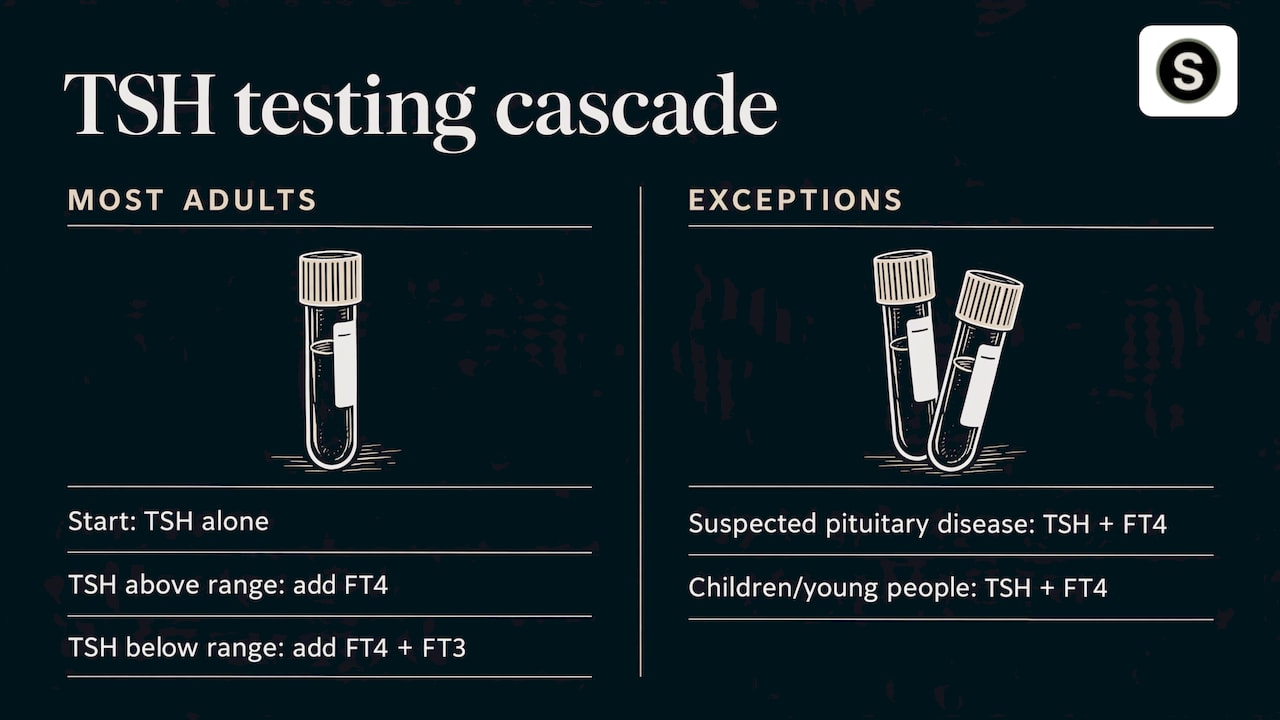
The committee chose this "cascade" because it reduces unnecessary testing compared with running TSH, FT4 and FT3 for everyone. Labs keep the original sample, so follow-up tests can be run without calling you back.
There are exceptions. When pituitary disease is suspected, and for children and young people, both TSH and FT4 are measured from the start (recommendation 1.2.9). The British Thyroid Association also says FT4 should be checked routinely in people recently treated with radioactive iodine for an overactive thyroid, and that TSH alone is enough for monitoring people already on thyroid hormone.
The same BTA Q&A says that in over 99% of people with a normal TSH, FT4 and FT3 are also normal. A longer panel does not automatically give you more answers. It can give you more borderline numbers to worry about.
How the test is done and how to prepare
The test is a standard blood draw, usually from a vein in your arm at your GP surgery or a hospital phlebotomy clinic. It takes a few minutes. The result usually comes back through your surgery.
A short preparation checklist:
- Check for biotin. Biotin (vitamin B7) is in many hair, skin, nail and multivitamin products. NICE decided in 2023 that NG145 should be updated to ask about biotin, because high intake from supplements may cause falsely high or low results. Tell your GP or phlebotomist what you take. Ask them how long to pause it before the test rather than guessing.
- List your medicines. Some medicines can interfere with thyroid results. If you already take levothyroxine, ask your surgery whether to take your dose before or after the test.
- Mention recent illness. Being unwell can temporarily shift thyroid results, so say if you have just had an infection or a hospital stay.
- Write down your symptoms and when they started. A short note helps your GP decide what to test and when.
Fasting is not normally required for a thyroid test alone. If you are having other blood tests on the same day, such as cholesterol or blood sugar, follow the instructions on your appointment letter.
Reading your result: the usual reference ranges
Labs set a reference range so that most healthy people fall inside it. Ranges differ slightly between labs, so always compare your number with the range printed on your own report. One NHS hospital laboratory lists adult ranges of TSH 0.27 to 4.2 mIU/L, FT4 12.0 to 22.0 pmol/L and FT3 3.1 to 6.8 pmol/L.
A few patterns, in plain terms:
| TSH | Free T4 | What it can point to |
|---|---|---|
| Above range | Below range | An underactive thyroid (overt hypothyroidism) |
| Above range | Within range | Subclinical hypothyroidism, a mild rise |
| Below range | Above range | An overactive thyroid |
| Within range | Within range | No thyroid problem suggested by this test |
The 2023 joint British Thyroid Association and Society for Endocrinology consensus describes overt hypothyroidism as TSH above range, typically 10 mU/L or more, with FT4 below range. Subclinical hypothyroidism is TSH above range, typically 5 to 10 mU/L, with FT4 in range. These figures are a guide for clinicians, not a way to diagnose yourself.
Worked example. Dave, 46, has been tired for months. His TSH comes back at 5.1 mIU/L, just over the lab's 4.2 limit. The lab adds FT4, and it is in range. That is a mildly raised TSH with normal FT4. The usual next step is not treatment straight away. It is often to repeat the test, and to check that illness or medicines are not the cause. Dave's GP will also look at his other symptoms and results. (Dave is an illustrative example, not a real patient.)
What usually happens after an unexpected result
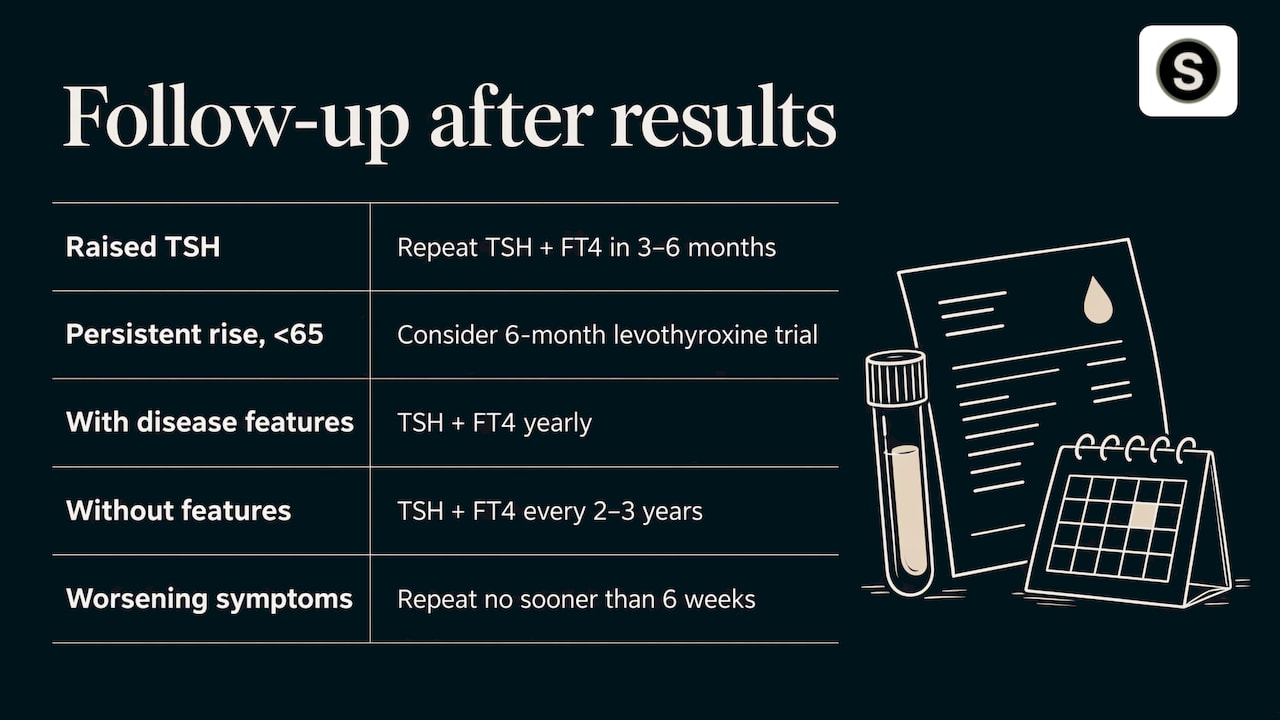
A raised TSH with normal FT4. The BTA guidelines say the test should be repeated 3 to 6 months later with FT4, after non-thyroid illness and drug interference have been ruled out. NHS primary care guidance from the Thames Valley ICB follows the same cascade, adding that TPO antibodies can confirm autoimmune hypothyroidism.
Persistent mild rise. NICE suggests that for adults under 65 with subclinical hypothyroidism and symptoms, a clinician may consider a 6-month trial of levothyroxine. Untreated subclinical hypothyroidism is monitored with TSH and FT4 once a year if features suggest underlying thyroid disease, or every two to three years if not. Whether to start any treatment is a decision for you and your GP or prescriber.
Symptoms get worse. NICE says to consider repeating thyroid tests if symptoms worsen or new ones appear, but no sooner than 6 weeks after the last test.
Already on levothyroxine. The NHS says you will have regular blood tests to check your dose. NICE's committee noted there is no clinically important benefit in keeping TSH at the lower rather than the upper end of the range, so a result anywhere in range is acceptable.
Why a single result is not the whole story
Reference ranges are built so that about 95% of healthy people sit inside them. That means a small number of healthy men will always land just outside. This is why clinicians repeat borderline results and look at symptoms alongside numbers.
It also explains why one blood test rarely settles a question like persistent fatigue. Laboratory tests are useful but have limits, and what labs can and cannot show varies by condition. If your thyroid result is normal and you still feel flat, that is a reason to talk to your GP about other causes, not a reason to feel dismissed.
Thyroid, tiredness and the other tests your GP may consider
Tiredness has many causes: poor sleep, low mood, anaemia, low vitamin levels, blood sugar problems, low testosterone and more. Thyroid is one item on that list. Our guide to blood tests for tiredness explains what a GP typically checks and why. If you are weighing up vitamin checks, see vitamin D and B12 testing. For a wider overview, read what common blood tests actually check.
If you are taking weight loss medication, or have stopped it, mention that to your GP or prescriber when thyroid symptoms come up. Individual treatment questions belong with your own prescriber.
Getting the most from the result
When the result arrives, a short list of questions helps:
- Which tests were run, and was FT4 added automatically?
- Is my result inside the lab's range, and which range was used?
- Do I need a repeat test, and when?
- Could a supplement, medicine or recent illness have affected it?
- What else could explain my symptoms?
Our guide to understanding blood-test results and follow-up walks through reading a report calmly.
Free practical support while you wait
Waiting for a repeat test can feel like standing still. My Timber is free to use and gives you food, movement and check-in support that fits around work and family. You can use it alongside your own clinic or prescriber, after treatment ends or without treatment, and no prescription transfer or purchase is needed. You can use the Today and Journey check-ins to note your energy, sleep and mood, which also gives you something concrete to bring to your GP. Start at SHIFT.
SHIFT does not currently offer clinical assessment, prescribing or dispensing, so anything about your thyroid results or treatment goes to your GP or prescriber.
FAQ
Do I need to fast for a thyroid blood test?
Not normally. A thyroid test on its own does not usually need fasting. If other tests are on the same form, follow the instructions you were given. Tell the person taking your blood about any biotin supplement.
What is a normal TSH level?
One NHS laboratory lists an adult range of 0.27 to 4.2 mIU/L. Ranges vary between labs, so use the one printed on your report. Your GP interprets the number alongside your symptoms.
What is the normal range for T4 in adults?
The same laboratory lists free T4 at 12.0 to 22.0 pmol/L. Total T4 and free T4 are different measures, so check which one is on your report.
What happens if my thyroid test is abnormal?
Often the lab adds a second hormone test on the same sample, and your GP may repeat the test after a few weeks or months. A borderline result is commonly rechecked before any decision is made. Treatment decisions sit with your GP or prescriber.
How soon can I repeat a thyroid test?
NICE says to consider repeating the test if symptoms worsen, but not sooner than 6 weeks after the last one. Your GP will advise on the right timing for you.
Sources
- NICE NG145: Thyroid disease, assessment and management
- NICE NG145: Rationale and impact
- NICE NG145: Recommendations
- NICE NG145: 2023 surveillance decision on biotin
- Gloucestershire Hospitals NHS: Thyroid function tests
- British Thyroid Association 2015 statement Q&As (UH Bristol NHS)
- UK Guidelines for the Use of Thyroid Function Tests
- Thames Valley ICB: hypothyroidism guidelines
- Joint BTA and Society for Endocrinology consensus, 2023
- NHS: Underactive thyroid (hypothyroidism)
- What labs can and cannot show
Recommended
- Thyroid tests: TSH, thyroid hormones and symptoms
- What do common blood tests actually check?
- Blood test results explained: numbers, ranges and context
- Blood Tests for Tiredness: What a GP Checks and Why
SHIFT provides general UK health information and practical support. Speak to your GP or your own prescriber about symptoms, test results or medicines. My Timber is free to use alongside your own clinic, after treatment ends or without treatment.
Last updated .