
Blood Tests for Tiredness: What a GP Checks and Why
If you have been tired for a few weeks and can't say why, book a GP appointment. A GP may offer blood tests, and the NHS says these can check for anaemia, diabetes or an overactive thyroid. Most men with tiredness get normal results. That is not a dead end: it points the search towards sleep, stress, mood, food and movement, and we cover those below.
This guide explains the common tests, what each one can and can't tell you, and how to get the most from the appointment. It is general information. Your GP or own prescriber makes decisions about your individual care.
TL;DR
- See your GP if tiredness has lasted a few weeks with no clear reason, affects daily life, or comes with weight loss or mood changes (NHS).
- A first round of tests is usually small: a full blood count, HbA1c (a longer-term blood sugar marker) and a thyroid test (TSH), according to one NHS local pathway.
- Blood tests often come back normal. A normal result still counts: it rules things out and moves the focus to sleep, stress, mood and lifestyle.
- Testosterone is not a routine tiredness test. It is considered when there are specific symptoms, and timing matters.
- Write down your symptoms, sleep and snoring before you go. It makes the appointment far more useful.
Table of Contents
- Why men get tired, and why a blood test is only one piece
- When to book a GP appointment
- Which blood tests a GP might consider
- Testosterone: not a routine tiredness test
- Match your symptoms to the right conversation
- Preparing for the appointment: a simple checklist
- Fasting and blood-test day basics
- What if the tests are normal?
- Practical things to start while you wait
- Where SHIFT fits in
- FAQ
- Sources
Why men get tired, and why a blood test is only one piece
Tiredness has a long list of ordinary causes. The NHS names poor sleep, an unhealthy lifestyle, stress, low mood, hormonal changes, illnesses such as glandular fever and COVID-19, and some medicines. It adds that tiredness which is unexplained, has gone on a while and isn't improving may signal a medical condition.
For men in their 40s and 50s, life tends to stack up: work, kids, ageing parents, less sleep, less movement. That is why a good assessment starts with a conversation. NICE's clinical knowledge summary says fatigue is one of the most frequent symptoms seen in primary care. Its causes can be physical, drug-related, psychological or a mix, so assessment includes a detailed history and examination, with blood tests chosen on clinical judgement.
An NHS local pathway goes further. It says blood tests have a low rate of identifying underlying disease and that serious causes are excluded mainly through history and examination. So think of a blood test as one useful clue, not the whole answer.
When to book a GP appointment
The NHS advises seeing a GP if:
- you have been tired for a few weeks and don't know why
- tiredness is getting in the way of daily life
- it comes with other symptoms, such as weight loss or changes in mood
- someone has told you that you gasp, snort or choke in your sleep
The same NHS pathway lists red flags a GP will ask about, including unexplained weight loss and drenching night sweats. If you have those, don't wait it out. Book promptly, and use urgent NHS routes if you feel seriously unwell.
No prescription, treatment history or purchase is needed to use the free My Timber support from SHIFT while you wait for your appointment. We come back to that below.
Which blood tests a GP might consider
There is no single "tired test". What you are offered depends on your symptoms, age, history and medicines. Patient.info lists the sort of checks that may be suggested, and notes that results often turn out normal.
| Test | What it can show | Why it comes up |
|---|---|---|
| Full blood count (FBC) | Anaemia, signs of infection or inflammation | Low iron can cause low energy, breathlessness and pale skin |
| HbA1c or blood glucose | Diabetes or raised blood sugar | Tiredness with thirst, night-time urination and weight loss |
| TSH (thyroid) | Underactive or overactive thyroid | Thyroid problems can cause tiredness, restlessness or weight change |
| Vitamin B12, folate, vitamin D | Deficiencies | Often considered, depending on the clinician and your history |
| Kidney and liver function, calcium | Organ problems, imbalances | More often added if symptoms go on |
| Coeliac screen | Coeliac disease | Considered when tiredness persists |
| Inflammation markers (such as CRP) | Ongoing inflammation | Used when infection or inflammatory illness is suspected |
The list in the table follows Patient.info, which names low iron, thyroid, diabetes, B12, folate, vitamin D, coeliac disease, inflammation, liver and kidney function, and infections such as glandular fever. The table's "why it comes up" column follows the NHS symptom guide: low energy with palpitations, breathlessness and pale skin suggests iron-deficiency anaemia, and tiredness with thirst, frequent urination and weight loss suggests diabetes.
Want a plainer walk-through of the lab report itself? Our guide What do common blood tests actually check? explains the usual panels. For the iron side, iron, ferritin and full blood count shows how the numbers fit together.
A small first round is normal
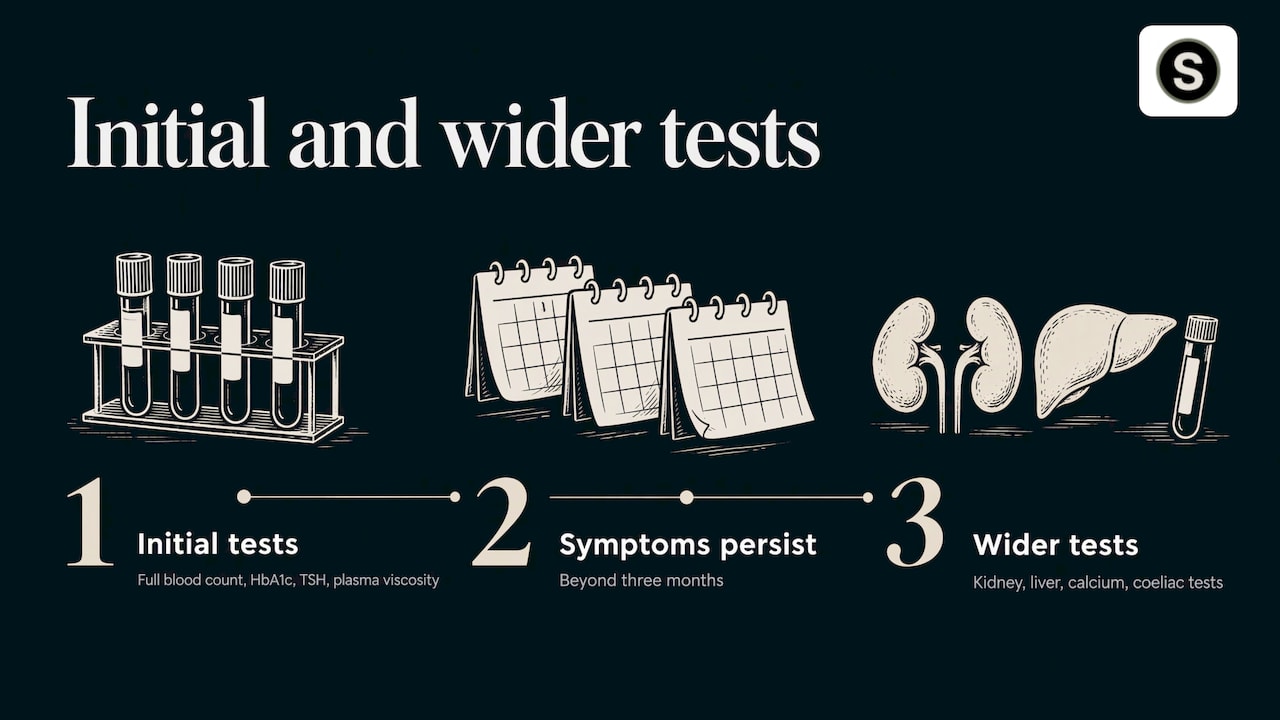
Don't be surprised if the GP orders only a few tests. One NHS pathway suggests initial tests are limited to a full blood count, HbA1c, TSH and plasma viscosity, with a wider set (kidney, liver, calcium, coeliac) if symptoms go beyond three months. Local practice varies, so yours may differ. A short list is a sign of a focused approach, not of being brushed off.
Vitamin D and iron: ask, don't assume
Men often arrive asking for "the vitamin test" or "the iron test". It is fine to raise it, and your GP will say whether it fits your history. Our pieces on vitamin D tests for UK men and why tiredness alone is not a reason to start iron explain why you should have a result and a reason before taking supplements.
Testosterone: not a routine tiredness test
Low testosterone gets a lot of attention for men over 40. NHS prescribing guidance for the Bath, Swindon and Wiltshire area says low testosterone is associated with low libido, loss of energy, fatigue and low mood. It also says there is no clear cut-off below which a diagnosis is made. The level has to be read alongside your symptoms and any underlying illness.
The same guidance sets out how the test is done: blood taken in the morning (08:00 to 10:00), fasting, with two morning samples at least a week apart. It also says testosterone treatment is not indicated for fatigue alone, and that fertility plans should be discussed first because testosterone suppresses sperm production.
In practice, that means:
- Mention other symptoms if you have them: low libido, erection changes, low mood, loss of muscle.
- Ask your GP whether a testosterone test makes sense for you.
- If one is arranged, ask about timing. A late-afternoon sample can mislead.
- If you and your partner are thinking about children, say so.
For more detail, see our guides on low testosterone symptoms, testosterone blood tests: preparation and results and how to prepare for a testosterone blood test. Any decision about treatment belongs with your own GP or prescriber.
Match your symptoms to the right conversation
The NHS symptom guide links patterns to possible causes. Use it to focus what you tell your GP, not to diagnose yourself.
- Loud snoring, gasping or snorting at night, tired despite a full night: the NHS says this can suggest sleep apnoea. Ask a partner what they notice. This is not found by a blood test, so say it out loud in the appointment.
- Thirst, frequent urination (especially at night), weight loss: can point to diabetes, which blood tests check.
- Restless, anxious, irritable, muscle weakness: can point to an overactive thyroid.
- Pale skin, palpitations, breathlessness: can point to iron-deficiency anaemia.
- Extreme fatigue for at least three months with memory and concentration problems and flu-like symptoms: can point to ME/CFS, which a GP assesses with you.
Shift work, late nights and poor-quality sleep can feel exactly like a medical problem. Our guide on shift work, late nights and unrefreshing sleep helps you sort one from the other. If a watch or ring has told you your sleep is bad, sleep trackers and their limits explains how much weight to give it.
Preparing for the appointment: a simple checklist
You have about ten minutes. A short note beforehand makes them count.
- Write down when it started and whether it came on suddenly or slowly.
- Note your sleep: bedtime, wake time, night waking, snoring, how you feel on waking.
- List everything you take: prescribed medicines, supplements, alcohol and caffeine. Some medicines can cause tiredness, so your GP needs the full picture.
- Mention mood, stress and life load. Low mood and stress are common causes of tiredness. Saying so is not weakness.
- Say if you have lost or gained weight without trying.
- Ask what the tests are looking for and how and when you will hear back.
- Ask what happens if they're normal.
If you are taking weight-loss medication, tell the GP or your own prescriber about the tiredness. They are the right people to look at whether it relates to treatment, food intake or something else.
Fasting and blood-test day basics
Some tests need fasting and some don't. Follow the instructions on your request form or from the surgery. Testosterone is usually a morning test, as above. Drink water unless told otherwise, and bring a list of your medicines. If you faint easily with needles, tell the phlebotomist so they can have you lie down.
Results often arrive through the NHS App, a text or a call. If you are unsure what a number means, ask the practice. Reference ranges vary slightly between labs, so a result slightly outside a range isn't automatically a problem. Your GP interprets it with your symptoms.
What if the tests are normal?
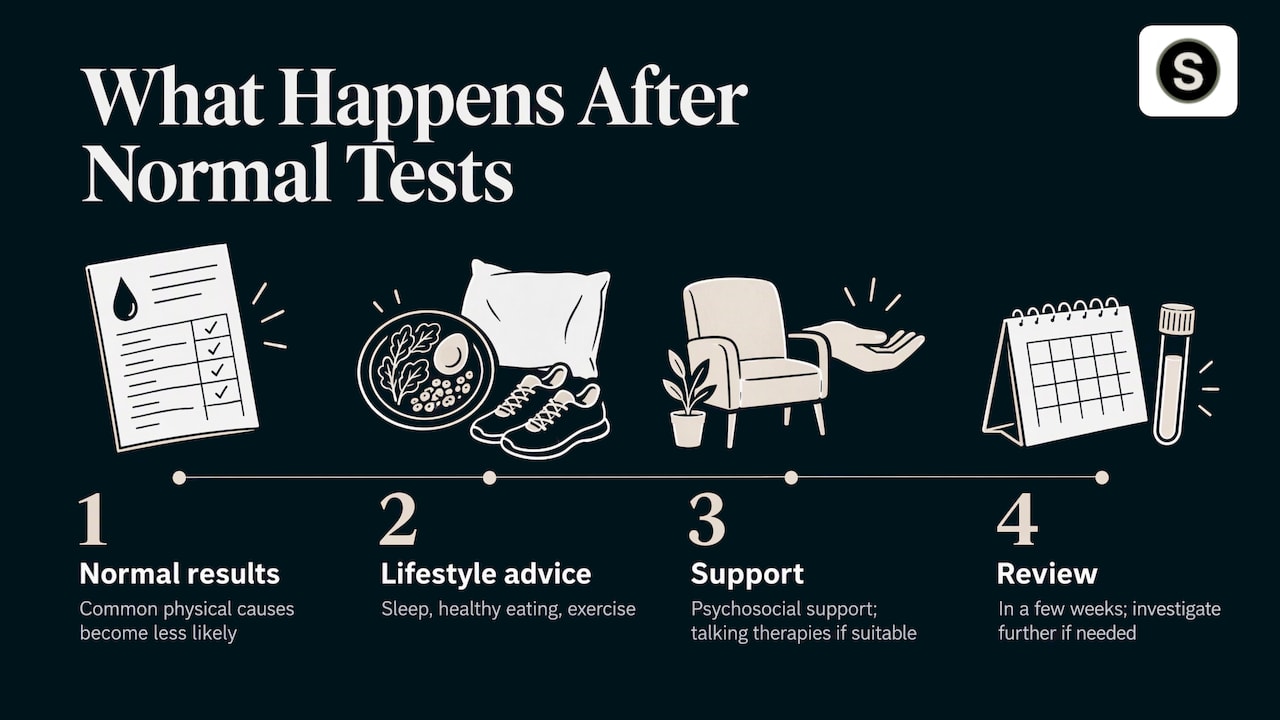
This is the most common outcome, and it is useful. Normal results make the common physical causes less likely. NICE's guidance says primary care management includes advice on sleep hygiene, healthy eating and exercise, psychosocial support, and referral for talking therapies where suitable, followed by a review to see how you are responding and to arrange further investigations if needed.
A GP review in a few weeks is a normal part of that. Don't see it as being fobbed off. Tiredness often has several small causes that add up.
If your day is made harder by attention and focus, for example constant draining meetings, this piece on ADHD and meeting fatigue may help you recognise a pattern worth raising with your GP.
Also worth knowing: NICE's tiredness and fatigue topic was updated in October 2025 with new recommendations on suspected or confirmed ME/CFS. If you have had months of fatigue that gets worse after exertion, mention it to your GP.
Practical things to start while you wait
None of these replace an assessment. They are low-pressure steps that fit around work and family, and they match what NICE lists as general management.
Food
Big gaps between meals and a lot of takeaway can leave you flat. Aim for a regular breakfast with protein. A breakfast hash is easy to batch up, and our recipes include a garlic egg potato hash with mushrooms and a paprika turkey potato hash. One breakfast you can repeat beats a perfect plan you drop.
Movement
A 10-minute walk after dinner is a fair start. If you want to know how it compares with a structured plan, see walking vs structured exercise.
Sleep and mood
Keep a regular wake time, cut caffeine after lunchtime, and try to get light and fresh air in the morning. If low mood or stress is behind the tiredness, say so to your GP. Our Life Back page looks at progress beyond the scales, including energy, confidence and the things that matter to you day to day.
Where SHIFT fits in
SHIFT doesn't provide testing or clinical assessment, and your GP or own prescriber handles individual treatment decisions. What we offer is free practical support. My Timber brings together daily and journey check-ins, progress tracking, SHIFT Grub for realistic food, SHIFT Fit for approachable walking and strength, Life Back, and Ask Timber for non-clinical support. You can use it alongside your own clinic or prescriber, after treatment ends, or without treatment. No prescription transfer or purchase is needed.
For wider plain-English reading on energy, sleep and bloods, start with SHIFT Health. For a longer read on this topic, see low energy in men over 40.
One next step: tonight, write three lines: when the tiredness started, how you slept this week, and any snoring or mood changes. Take them to your GP appointment.
FAQ
Can a blood test tell me why I'm always tired?
Sometimes, but not always. Blood tests can find things like anaemia, diabetes or thyroid problems, yet NHS guidance notes they have a low rate of finding underlying disease. Your GP combines results with your history and examination.
Why am I always tired as a man over 40?
There is rarely one reason. Poor sleep, stress, low mood, less activity and medicines are all common, and so are conditions such as sleep apnoea, diabetes or thyroid problems (NHS). Persistent tiredness is worth a GP conversation.
Should I ask for a testosterone test?
You can raise it, especially if you also have low libido, erection changes or low mood. NHS guidance says a diagnosis depends on symptoms as well as morning blood results, and that treatment is not indicated for fatigue alone. Your GP decides whether it is right for you.
What if my blood tests are normal but I still feel exhausted?
Tell your GP and ask for a review. NICE guidance includes looking at sleep, mood, stress and lifestyle, and arranging further investigations if needed. Small steps on food, movement and sleep are a reasonable thing to start in the meantime.
Sources
- Tiredness and fatigue, NHS
- Tiredness/fatigue in adults, NICE CKS
- Fatigue / tired all the time (TATT) pathway, NHS Gloucestershire ICB
- Tiredness, Patient.info
- Testosterone in men guidance, NHS BSW, September 2025
- CKS Updates, College of Paramedics
Recommended
- What do common blood tests actually check?
- Liver and kidney blood tests: what they can and cannot show
- Iron supplements: why tiredness alone is not a reason to start
- Blood test results explained: numbers, ranges and context
SHIFT provides general UK health information and practical support. Speak to your GP or your own prescriber about symptoms, test results or medicines. My Timber is free to use alongside your own clinic, after treatment ends or without treatment.
Last updated .