
Vitamin B12 Blood Test: When It's Used and What Results Mean
A vitamin B12 blood test measures how much B12 is in your blood. In the UK, NICE guidance says a clinician should offer one when you have a typical symptom, such as unexplained fatigue, brain fog or pins and needles, and a risk factor, such as a vegan diet, metformin or acid-reducing tablets. Your GP or prescriber decides whether you need one and reads the result alongside how you feel. We can help you get ready for that conversation.
This guide is general education from the SHIFT Team. It is not a diagnosis, and individual decisions belong with your GP or your own prescriber.
TL;DR
- NICE NG239 (March 2024) links testing to a symptom plus a risk factor, not tiredness on its own.
- Tell the person taking your sample about any B12 supplements, tablets, injections or patches you use.
- Total B12 under 180 ng/L confirms deficiency, 180 to 350 ng/L is a grey zone, and over 350 ng/L makes deficiency unlikely.
- A grey-zone result may lead to a further test (MMA), and your symptoms count as much as the number.
- Take the result to your GP or prescriber rather than starting supplements on your own.
Table of Contents
- What vitamin B12 does and why it gets tested
- When a clinician might recommend one
- Medicines and weight loss: why men ask about B12
- How the test is taken
- Total B12 or active B12?
- How to read your result
- Other results that sit beside B12
- Where free SHIFT support fits
- One practical next step
- FAQ
- Sources
What vitamin B12 does and why it gets tested
Vitamin B12 helps your body make healthy red blood cells and keeps your nerves working. When levels fall too low, you can develop anaemia (fewer healthy red blood cells) or nerve problems. Symptoms can creep in slowly, which is why many men put them down to work, stress or age.
The test is a simple blood sample. It is one piece of the picture, alongside your symptoms, medicines, diet and other blood results. Our guide to what common blood tests actually check shows where B12 fits.
When a clinician might recommend one
NICE NG239, published in March 2024, says to offer an initial test to people with at least one common symptom or sign and at least one risk factor.
Common symptoms and signs include:
- anaemia or unusually large red blood cells on a blood count
- cognitive difficulties, often called brain fog
- eyesight problems linked to the optic nerve
- a sore, smooth tongue (glossitis)
- pins and needles, balance problems or an impaired walk
- unexplained fatigue
Common risk factors include:
- a low-B12 diet, such as a vegan diet
- coeliac disease or other autoimmune conditions
- medicines such as metformin, proton pump inhibitors (PPIs), H2 blockers, colchicine or some anti-epileptics
- previous bariatric or gastric surgery
- recreational nitrous oxide use
With symptoms but no obvious risk factor, NICE says clinicians use their judgement.
Local guidance varies a little
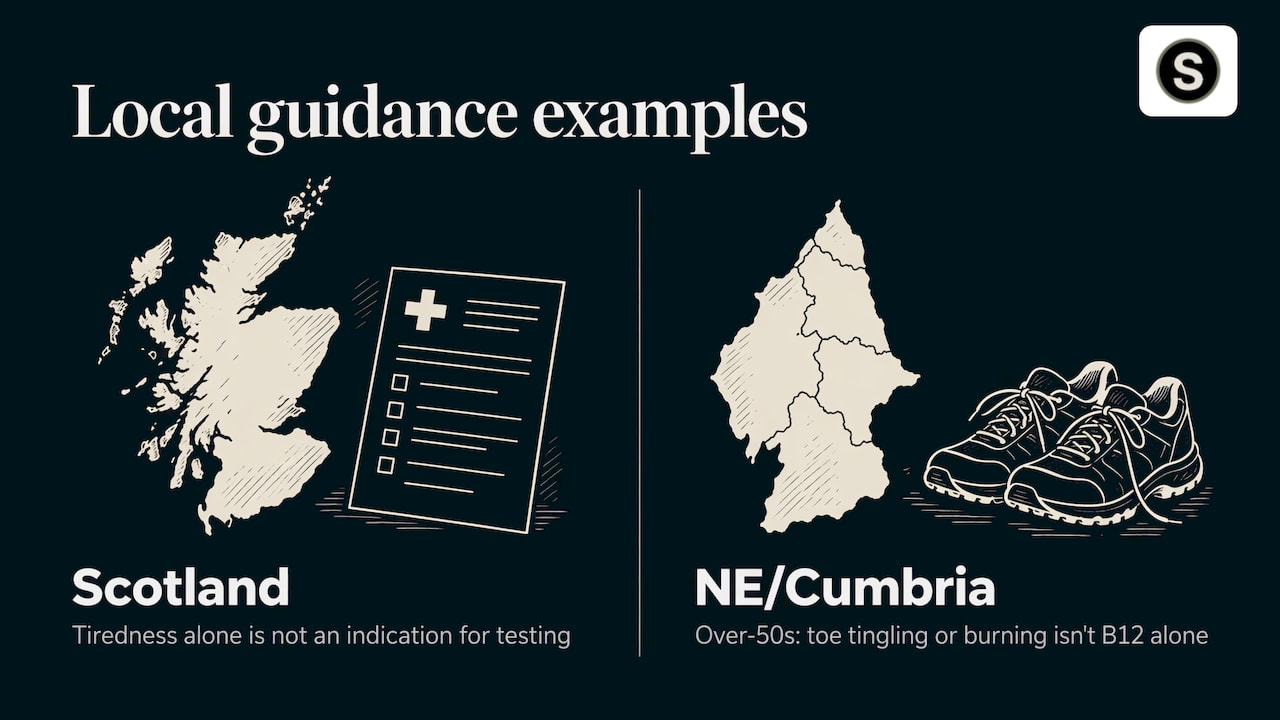
Some NHS areas are more cautious. Scottish primary-care guidance states that tiredness alone is not an indication for testing. A North East and North Cumbria ICB guideline from November 2025 adds that tingling or burning in the toes in people over 50 should not be put down to B12 on its own. So if your GP asks more questions before testing, that is normal practice.
Tired all the time? Low B12 is only one of many possible reasons. Our piece on why tiredness alone is not a reason to start iron makes the same point for another nutrient.
Medicines and weight loss: why men ask about B12
Several risk factors on the NICE list are common in men we speak to: metformin, acid-reducing tablets and bariatric surgery. If you take any of these, or you have cut back sharply on the foods you eat, mention it to your GP or prescriber. They can tell you whether a test makes sense for you. Questions about your own treatment belong with them.
How the test is taken
It is a standard blood draw from a vein in your arm, usually at your GP surgery, a hospital or a phlebotomy clinic. Some labs need only about half a millilitre of blood. For example, North West London Pathology lists the active B12 test as a 0.5 mL sample in a gold-top tube with a one-day turnaround in the lab. Your result may take longer to reach you.
Preparation: the one thing that matters
NICE says samples should be taken before you start B12 replacement. It also says clinicians should ask whether you use over-the-counter B12 tablets, injections or patches, because these can raise your levels without fully treating a deficiency. The combined contraceptive pill can lower total B12 without causing deficiency, which is not relevant to most men but is worth knowing.
So before your appointment:
- List every supplement, multivitamin and energy drink you take, with how often.
- List your regular medicines, including anything from the pharmacy.
- Note your symptoms, when they began and what makes them better or worse.
- Ask the surgery whether they want you to fast. B12 doesn't usually need it, but other tests taken at the same time might. Our fasting before a blood test guide covers the basics, and our sample preparation guide covers timing and medicines.
Total B12 or active B12?
There are two main versions, as NICE NG239 describes:
- Total B12 (serum cobalamin) is the standard test and measures all the B12 in your blood.
- Active B12 (holotranscobalamin) measures the portion your cells can use.
Either can be the first test. Active B12 must be used in pregnancy. Your lab decides which it runs, so you will see one or the other on your report.
How to read your result
The table below follows NICE NG239 Table 1. Labs print their own reference ranges, so use this to understand the language, not to diagnose yourself.
| Result | Total B12 | Active B12 | What NICE says it suggests |
|---|---|---|---|
| Deficiency confirmed | Below 180 ng/L (133 pmol/L) | Below 25 pmol/L | Deficiency |
| Indeterminate | 180 to 350 ng/L (133 to 258 pmol/L) | 25 to 70 pmol/L | Possible deficiency |
| Deficiency unlikely | Above 350 ng/L (258 pmol/L) | Above 70 pmol/L | Look for other causes |
If you land in the grey zone
For symptoms with an indeterminate result, NICE says to consider a further test called serum MMA (methylmalonic acid), which can help decide whether long-term replacement is needed. In some situations, such as rapidly worsening symptoms, a clinician may decide to start treatment while waiting. That is a clinical judgement for your GP.
If the result is normal but you still feel unwell
NICE says clinicians should look for other causes and consider repeating the test if symptoms persist 3 to 6 months later. The NHS diagnosis page also notes that some people have symptoms even when results look normal. Hospital guidance for clinicians from Royal United Hospitals explains that there is no gold-standard B12 test, so the clinical picture matters most.
If the number is high
A high result usually means deficiency is unlikely. If you take B12 supplements, that alone can explain it. Tell your GP what you take. They may look for other reasons for your symptoms.
For more on reading numbers in context, see blood test results explained.
Other results that sit beside B12
The NHS says the diagnostic blood work for B12 or folate deficiency anaemia also checks red blood cell size and folate. A full blood count is the usual source of that information. Our guide to iron, ferritin and full blood count explains how these pieces fit together, and the vitamin D and B12 testing guide looks at when a check can be useful.
Where free SHIFT support fits
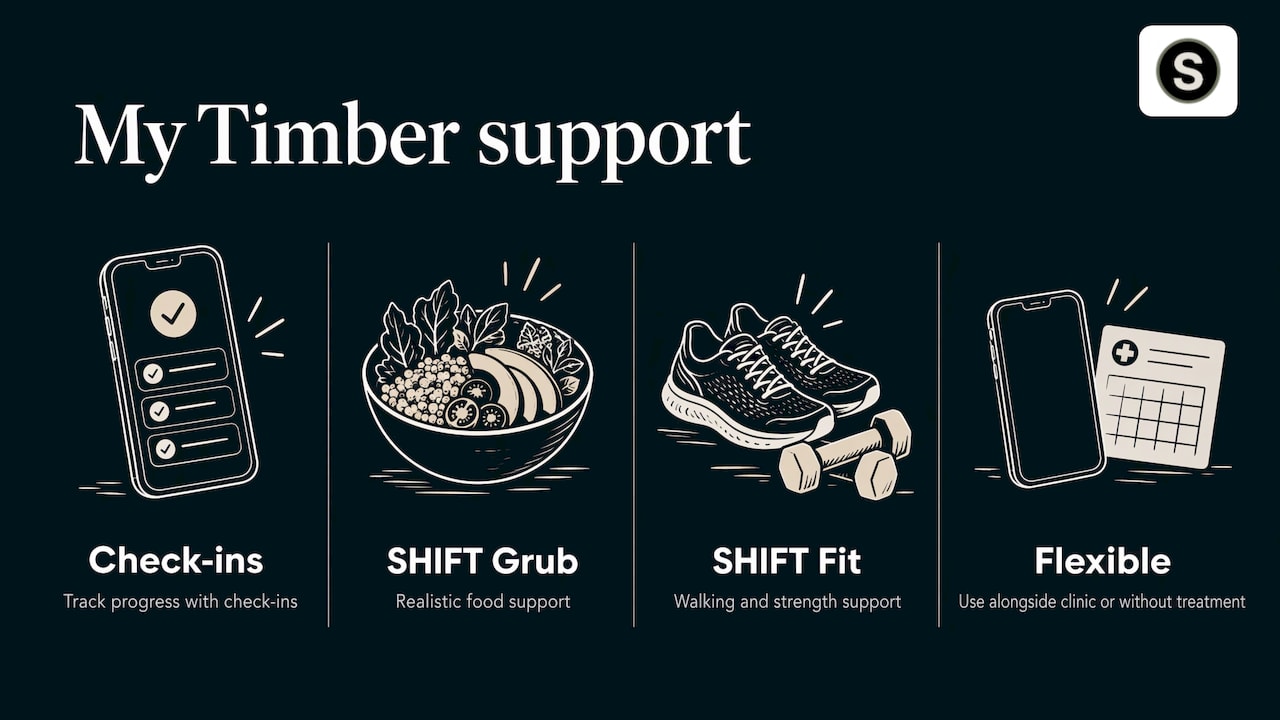
A B12 result is one part of feeling like yourself again. Food, movement, sleep and mood all matter too. My Timber is free to use and gives practical support with check-ins, progress tracking, SHIFT Grub for realistic food and SHIFT Fit for walking and strength. You can use it alongside your own clinic or prescriber, after treatment ends, or without treatment. No prescription transfer or purchase is needed. Start on our free weight-loss support for men page. Clinical assessment, prescribing and dispensing through SHIFT are currently closed, so treatment questions go to your own prescriber.
One practical next step
Before you book anything, write a one-page note: symptoms, when they started, medicines, supplements and diet. Take it to your GP. It is a calm, judgement-free way to make the appointment count, and it helps whoever reads your result put it in context.
FAQ
How do I check B12 levels in a blood report?
Find the line marked B12, total B12 or active B12 (holotranscobalamin), and note the unit: ng/L, pmol/L or both. Compare it with the lab's own range and the NICE bands above. Then talk it through with your GP, because symptoms and medicines change what a number means.
What is the difference between a normal B12 test and an active B12 test?
The normal test measures total B12 in your blood. Active B12 measures the part your cells can use. NICE accepts either as the first test, and their cut-offs differ.
What happens if serum B12 is high?
A high result generally makes deficiency unlikely, and supplements can push it up. Your GP may look for other causes of your symptoms and may repeat the test if they continue.
Do I need to stop my B12 supplements before the test?
Don't stop or start anything without advice, but do tell the clinician what you take. NICE says supplements can raise levels without fully treating a deficiency, so the result needs that context.
Sources
- NICE NG239 Recommendations: Vitamin B12 deficiency in over 16s
- NICE NG239: diagnosis and management (PDF)
- NHS: Vitamin B12 or folate deficiency anaemia, diagnosis
- North West London Pathology: Vitamin B12 test
- NHS Scotland: Indications for B12 deficiency testing
- North East and North Cumbria ICB: Vitamin B12 guideline, November 2025
- Royal United Hospitals: Information for clinicians, PATH-029
Recommended
- Vitamin D and B12 testing: when might a check be useful?
- Blood test results explained: numbers, ranges and context
- What do common blood tests actually check?
- Iron, ferritin and full blood count: different pieces of the picture
SHIFT provides general UK health information and practical support. Speak to your GP or your own prescriber about symptoms, test results or medicines. My Timber is free to use alongside your own clinic, after treatment ends or without treatment.
Last updated .