Wegovy Injection Sites: Where to Inject and How to Rotate

You can inject Wegovy into three places: your stomach, your upper legs (thighs) or your upper arms. All three are approved in the UK, and none is the "best" for everyone. Pick the one you can reach easily and keep clean, and use a different spot from last week's. This guide covers how to choose, how to rotate, what to avoid and what to do if a site gets sore.
TL;DR
- Wegovy goes under the skin (subcutaneous) in the stomach, thigh or upper arm. Never into a vein or muscle.
- On the stomach, keep 5 cm away from your belly button.
- You can use the same body area every week, but not the same spot as last time.
- The UK product information reports similar semaglutide exposure from all three areas, so the thigh is not a weaker choice.
- If a reaction is persistent or worrying, talk to your prescriber or pharmacist. Do not change your dose to chase a different site.
Table of Contents
- The three approved Wegovy injection sites
- Stomach, thigh or arm: does it matter?
- How to choose your site
- How to rotate Wegovy injection sites
- Higher doses and spacing between injections
- Injecting with confidence: a step-by-step routine
- Bruising, soreness and other site reactions
- Our view: the site matters less than the routine
- Support beyond the injection
- Making it a habit
- FAQ
- Sources
The three approved Wegovy injection sites
The UK manufacturer's instructions say Wegovy is injected under the skin of the upper arms, stomach or upper legs. The UK Summary of Product Characteristics says the same: Wegovy is given subcutaneously in the abdomen, thigh or upper arm, and must not be injected into a vein or a muscle.
In plain English, you are aiming for the layer of fat just under the skin. That is why the approved sites are all places with a bit of soft tissue you can reach with one hand.
Stomach (abdomen)
The stomach can be easy to see and reach. Leave a gap of 5 cm around your belly button, as the UK how-to guide advises. Pick an area of normal-looking skin, not a scar, a rash or somewhere your belt rubs.
Thigh (upper leg)
The front and outer part of the upper leg works well if you sit down to inject. It is a good option if your stomach feels tender or you would rather not look at it, which is a common feeling and nothing to be embarrassed about.
Upper arm
The upper arm is the trickiest because you usually cannot see or steady it easily on your own. Many men use it only when someone else is helping, or when the other sites need a rest. Ask your clinician or pharmacist to show you how to reach it safely with a pen.
Stomach, thigh or arm: does it matter?
Short answer: not for how well the medicine works. The UK SmPC reports similar semaglutide exposure after injection in the abdomen, thigh or upper arm. It does not identify the thigh as less effective than the stomach, and it does not say one site changes the chance of the usual body-wide side effects such as nausea.
So the real choice is practical. Use this as a quick guide:
| Site | Easy to reach alone? | Good for | Watch for |
|---|---|---|---|
| Stomach | Yes | Most people, seated or standing | Keep 5 cm from the belly button; avoid belt lines and scars |
| Thigh | Yes, when seated | Giving the stomach a rest; a calmer, more private spot | Choose the upper leg, not near the knee |
| Upper arm | Harder | Days when someone can help | Tricky to steady the pen on your own |
If you have read online that one site gives "better results", treat that as opinion. The official documents describe the three sites as options, and your results come from taking the right dose, on schedule, alongside food and activity habits. If you want to see how results usually unfold, our guide to semaglutide results timelines and review points sets out what to expect and when.
How to choose your site
Think of it as three simple questions.
- Can I reach it and see it? If you are fumbling, you are more likely to jab at an angle or hit the wrong spot.
- Is the skin healthy? Skip anywhere that is bruised, tender, scarred, hard or broken.
- Can I stay relaxed? A tense muscle makes any injection feel worse. Sit down, breathe out and drop your shoulders.
Most men settle into a routine, such as stomach on one side one week, thigh another. Whatever you choose, make it something you can repeat without thinking, because the injection is once a week and the habit matters more than the site. The UK SmPC confirms it can be taken once weekly at any time of day, with or without meals, and that the injection site can be changed. Pick a day and time that fits around work and family, and keep it steady.
How to rotate Wegovy injection sites
Rotation sounds fussy, but the rule is simple. The UK instructions say you may use the same body area each week, but you must pick a different spot from the one you used previously. You do not have to swap between stomach and thigh every week.
Two easy ways to keep track:
- Clock-face method. Picture the stomach area as a clock face outside the 5 cm zone around the belly button. Move round it a few positions each week.
- Left and right. Alternate sides: left thigh, right thigh, left side of stomach, right side of stomach. Write it in your phone notes alongside your dose day.
If you track your progress in the My Timber check-ins on our weight management support pages, add the site you used to your notes. A month later you will be glad you did.
Areas to avoid
- Anywhere closer than 5 cm to your belly button
- Skin that is bruised, sore, scarred, lumpy or irritated
- Spots where clothing, belts or waistbands press or rub
- Any attempt to inject deeper into muscle, or into a vein. The official guidance is clear that Wegovy is not for either.
Higher doses and spacing between injections
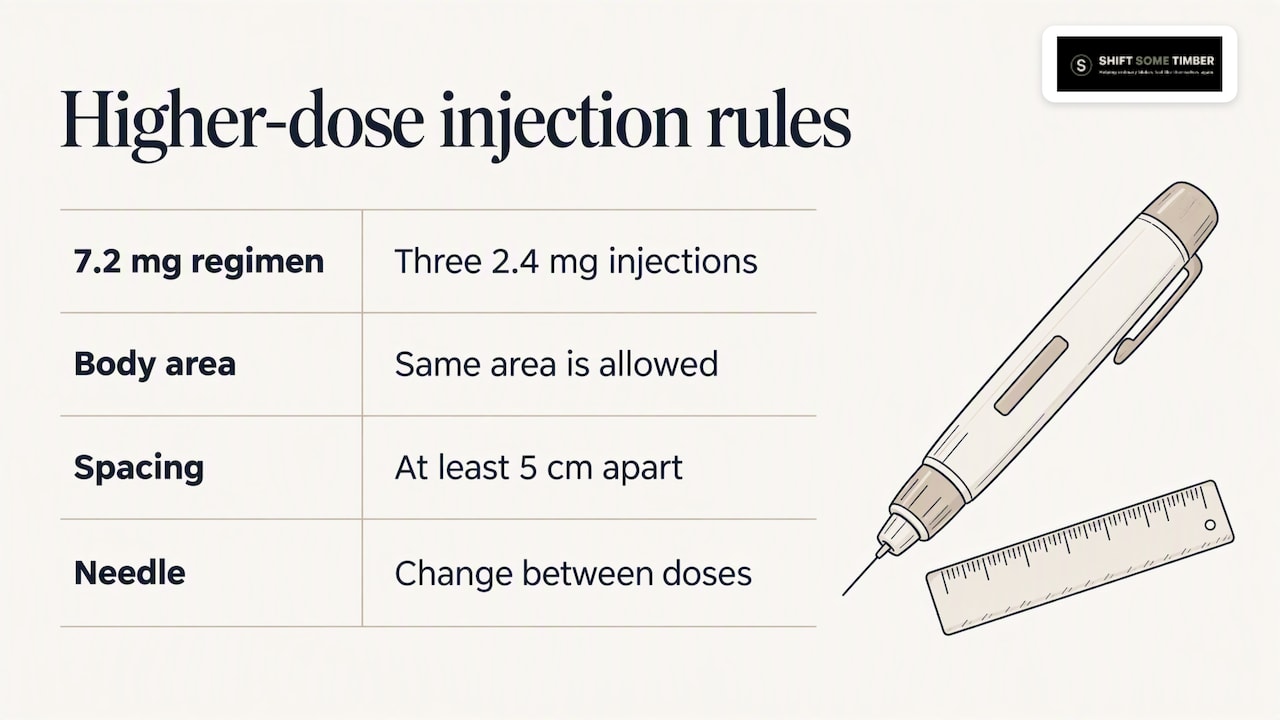
The newer UK 7.2 mg regimen is given as three 2.4 mg injections. According to the patient information leaflet, those injections may go in the same body area but must be at least 5 cm apart, with the needle changed between doses. If your prescriber moves you to that regimen, follow the leaflet and ask them to walk you through it before the first time. Our UK GLP-1 dosing guide explains how dose steps are normally handled.
Injecting with confidence: a step-by-step routine
The UK patient leaflet tells you to ask a doctor or nurse how to use the pen before your first injection. Do that. Then use the manufacturer's step-by-step guide for the detail on your particular pen. In outline:
- Wash your hands and get everything in front of you: pen, new needle, sharps bin.
- Check the pen. Confirm the name and your prescribed dose. The solution should be clear and colourless. If it looks cloudy or coloured, do not use it.
- Attach a fresh needle as shown in your pen's instructions.
- Choose your spot using the rules above and make sure the skin is clean and dry.
- Inject under the skin as your pen's guide describes, then hold it for as long as the instructions say.
- Dispose of the needle straight away in a sharps bin. The manufacturer says the bin should be kept safely, out of children's sight and reach, and never put in household waste. Ask your pharmacist how to get rid of a full one locally.
Should you pinch the skin?
This is one of the most common questions, and the honest answer is that it depends on your pen and your build. The UK documents we have checked do not tell everyone to pinch, so do not rely on forum advice. Ask your nurse or pharmacist to watch you do your first injection and tell you what works for your body and your pen.
Bruising, soreness and other site reactions
A small bruise, a little bleeding or some tenderness where the needle went in can happen with any injection. It does not automatically mean you did anything wrong. What helps:
- Rotate to a fresh spot each week, away from the last one.
- Do not rub the area hard afterwards.
- Avoid injecting into skin that is still sore from last time.
- Relax the area and do not rush.
See your prescriber or pharmacist if a reaction keeps coming back, spreads, looks infected or worries you. Get urgent medical help for signs of a serious allergic reaction, such as swelling of the face or throat or difficulty breathing.
One point worth stressing: the UK SmPC does not say that stomach, thigh or arm changes how likely you are to get side effects across the whole body. If you feel sick or have other symptoms, changing site will not fix it. Speak to your prescriber rather than changing your dose or stopping on your own. The same goes for questions about other medicines. Our piece on semaglutide and antidepressants is a good example of the sort of question to raise with a clinician.
Our view: the site matters less than the routine
A practical question is: am I doing this right? Usually the question is about the stomach versus the thigh, as if one is a secret shortcut.
It is not. The official UK information describes all three sites as approved, and shows no difference in how much of the medicine you absorb. What changes your experience is the routine around the injection: the same day each week, a clear way to rotate, a quiet few minutes to do it properly, and someone to ask when something feels off.
That is how we built SHIFT. Treatment is one part of the picture, and we pair it with practical food ideas, achievable movement and check-ins, so you are not working it out alone at the kitchen counter. SHIFT does not currently provide or book prescribing. We offer general information and practical support before, during and after treatment, including if you started somewhere else. Treatment questions go to your own prescriber.
If injecting still feels daunting, say so. Nobody judges that here.
Support beyond the injection
Knowing where to inject is the easy part. Staying consistent, handling food noise and keeping progress after the first few months is where most men want a hand. SHIFT combines treatment information and pathways with Grub for food ideas, Fit for movement, Life Back goals and My Timber check-ins, and men are welcome whether they are starting, already on treatment, or want support without medication.
If you want to see how it works, start with our men's weight management page, or read about Wegovy for men in the UK to understand access and the options. Not sure which format suits you? Compare the Wegovy injection and Wegovy tablets, or see how it stacks up against Saxenda. Using a different weekly injection? Our Mounjaro injection sites guide covers rotation for that pen. Considering a daily option instead? Our article on oral semaglutide for weight loss explains the numbers.
Making it a habit
A few practical habits keep the weekly injection from becoming a chore:
- Anchor it. Same day, similar time, and put a repeating reminder in your phone.
- Prepare the night before. Take the pen out as your instructions say, and put the sharps bin where you will use it.
- Keep a simple log. Date, site, any reaction. It helps your clinician if you ever need to ask a question.
- Plan for travel and busy weeks. Pack the pen, spare needles and a travel-safe sharps option, and read the storage section of your leaflet before you go.
- Know the missed-dose rule. Your leaflet explains what to do if you miss a dose. Check it, or ask your pharmacist, rather than guessing or doubling up.
The manufacturer's leaflet is the final word on how your pen works, and your prescriber knows your history. We are here to make the practical side easier.
FAQ
Where is the best place to inject Wegovy?
There is no single best place. The UK guidance approves the stomach, thigh and upper arm. Choose the one you can reach comfortably, with healthy skin, and rotate your spot each week. Keep 5 cm clear of your belly button if you use your stomach.
Is Wegovy less effective in the thigh than the stomach?
No. The UK SmPC reports similar semaglutide exposure from the abdomen, thigh and upper arm, and it does not single out the thigh as weaker. Use a site that is approved, comfortable and manageable for you.
Can I inject in the same place every week?
You can use the same general body area, such as your stomach, each week. What you must not do is inject into exactly the same spot as last time. For the 7.2 mg regimen, injections in the same area must be at least 5 cm apart.
Should I pinch my skin when injecting Wegovy?
The UK documents we reviewed do not give a blanket instruction either way. Ask your doctor, nurse or pharmacist to show you on your own pen before your first dose, as the patient leaflet advises, and follow the guide that came with it.
What should I do if an injection site is bruised or sore?
Choose a different spot next time and avoid the sore area. Small bruises and tenderness can happen. If a reaction is persistent, spreading or concerning, contact your prescriber or pharmacist, and do not change your dose yourself.
Sources
- How to use Wegovy (UK manufacturer infographic)
- Wegovy 2.4 mg FlexTouch, Summary of Product Characteristics (eMC)
- Wegovy 0.25 mg FlexTouch, Summary of Product Characteristics (eMC)
- Wegovy FlexTouch patient information leaflet (eMC)
- How to take Wegovy (UK manufacturer guide)
Recommended
- Mounjaro Injection Sites: Where to Inject and How to Rotate
- Wegovy Injection vs Wegovy Tablets UK: Full Comparison
- Wegovy vs Saxenda UK: Full Comparison
- 16–20 Weeks: Wegovy Side Effects Timeline, Dose Steps and Red Flags
Last updated .