Busy Dad Workouts: A Realistic Two-Week Plan
The best workout for a busy dad is one you can still do on a bad day. That usually means a short walk, two simple no-kit strength sessions a week, proper rest days, and a 5-minute fallback for when everything goes sideways. Below is a two-week diary built on exactly that. Adjust every part of it to your own ability.
There is no pressure here and no promised result. The aim is a routine you can keep going.
TL;DR
- Aim for activity you can repeat, not a perfect week. Official UK guidance says any activity is better than none.
- The long-term target is about 150 minutes of moderate activity a week plus strength work on at least 2 days. Build towards it gradually.
- This plan uses 15-minute walks, two 15-minute no-kit strength sessions and two rest days a week.
- Every day has a fallback of 5 minutes or less, so a missed slot never means a missed week.
- If you have a heart condition, chest pain or a health worry, talk to your own GP or prescriber before you step things up.
Table of Contents
- What counts as a good workout when you have no time
- How much should you aim for?
- Before you start
- Your two-week diary
- Strength A: no-kit routine
- Strength B: a little more
- Make the walks work harder for you
- When the day gets away from you
- Rest is part of the plan
- If you have a gym nearby
- Keep it going: small habits that help
- Free support from SHIFT
- FAQ
- Sources
What counts as a good workout when you have no time
A good workout is one that fits into your actual week. Most dads do not have a free hour. They have a 15-minute gap before the school run, a lunch break, or 20 minutes after the kids are in bed.
UK guidance is on your side. The Chief Medical Officers' guidelines say that any level of activity is linked to health benefits, and that any activity is better than none, with more being better still. You do not need to wait until you can do it "properly".
The NHS also suggests thinking ahead. It advises you to decide where and on which days you will exercise, and when in the day it fits. A little preparation can be the difference between getting going and putting it off. That is why the diary below is written down day by day.
How much should you aim for?
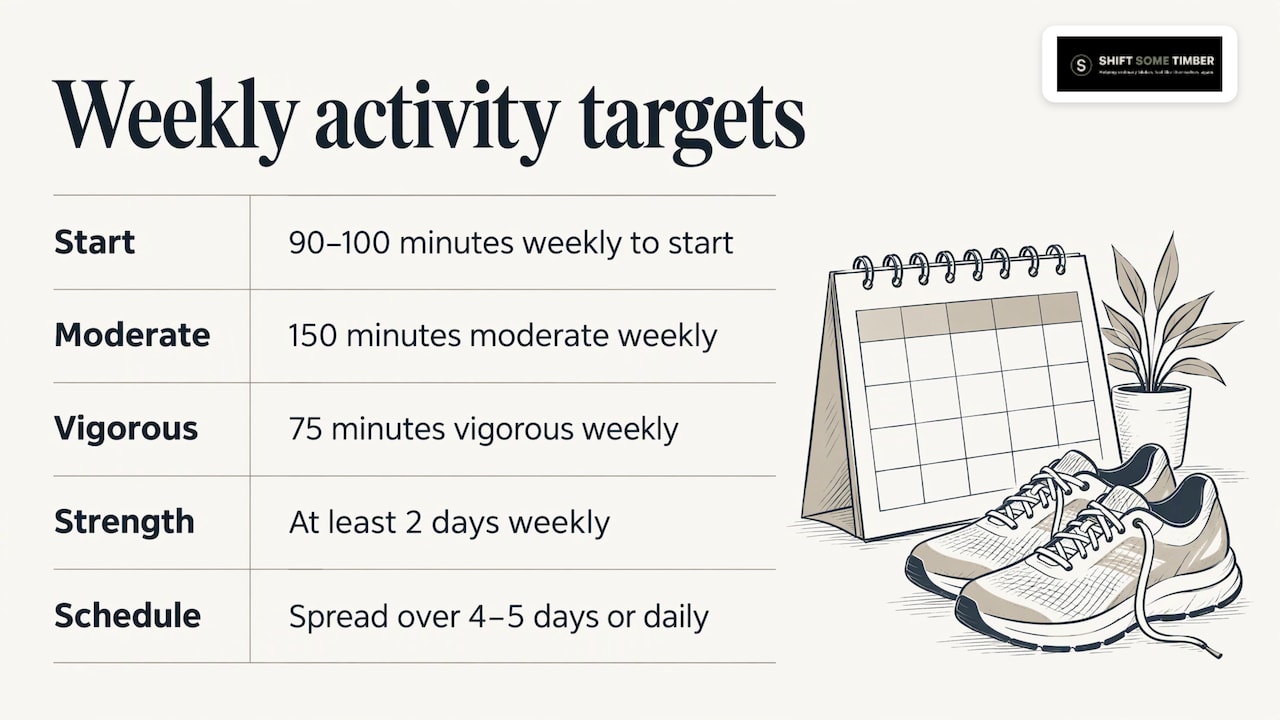
The UK guidelines for adults say to aim for at least 150 minutes of moderate-intensity activity a week, or 75 minutes of vigorous activity, or a mix. They also say to build strength on at least 2 days a week.
The NHS says the 150 minutes works out at around 20 to 30 minutes a day. It also says you can spread it over 4 to 5 days a week or do something every day, and that you should cut down on time spent sitting or lying down.
The 150 minutes does not have to come in one go. Heart-health guidance from a UK NHS trust says it can be split into 30-minute sessions, two 15-minute sessions or three 10-minute sessions, and that some exercise is better than none if you cannot reach the full target.
The plan below adds up to roughly 90 to 100 minutes a week to start with. That is a sensible place to begin if you have not done much lately. The NHS weight loss programme advises that if you have not been active for a while, you should increase your activity gradually over the next few weeks.
Before you start
You need very little. Trainers, a chair or the bottom stair, a wall or kitchen worktop, and a backpack with a few books or a couple of bottles of water in it.
If you want a bit more resistance later, a set of resistance bands is a cheap, compact option that lives in a drawer.
A few ground rules:
- Pick your slots first. Write the days in your phone or on the fridge calendar.
- Keep it comfortable. For walking, you should be able to talk but not sing. You should feel warm and a little out of breath, not gasping.
- Stop if something feels wrong. Chest pain, dizziness or unusual breathlessness means stop and speak to your GP.
- Heart or health conditions. If you have one, or you are on treatment, ask your own GP, clinic or prescriber what level of effort suits you. NHS heart guidance advises starting slowly and building up, and cautions against intense static efforts such as heavy lifting or press-ups for people with some heart conditions. That is a conversation for your own doctor.
Your two-week diary
Every day has a main option and a fallback. The fallback is not a failure. On a rough day it keeps the habit alive.
Week 1: get moving
| Day | Main option | Fallback (5 minutes or less) |
|---|---|---|
| Monday | 15-minute brisk walk. Try the school run on foot, or a lap at lunch. | 5-minute walk round the block or up and down the street. |
| Tuesday | Strength A, 2 rounds (about 15 minutes). | 1 round only (about 6 minutes). |
| Wednesday | Rest. Optional 5 minutes of gentle stretching. | Nothing. Rest is part of the plan. |
| Thursday | 20-minute walk, easy to steady pace. | 5-minute walk while you take a phone call. |
| Friday | Strength A, 2 rounds. | 10 sit-to-stands and 5 wall press-ups, done once. |
| Saturday | 30-minute family walk, park or woods. Let the kids set the pace. | 10 minutes in the garden or at the playground. |
| Sunday | Rest. | Rest. |
Week 2: build a little
| Day | Main option | Fallback (5 minutes or less) |
|---|---|---|
| Monday | 20-minute brisk walk. | 5-minute walk at lunch or after tea. |
| Tuesday | Strength B, 2 to 3 rounds (about 15 to 20 minutes). | 1 round only. |
| Wednesday | Rest, with an optional easy stroll. | Nothing. |
| Thursday | A free 10-minute home workout video. | 5 minutes of the same video. |
| Friday | Strength A or B, 2 to 3 rounds. | 10 sit-to-stands and 5 wall press-ups, done once. |
| Saturday | 30 to 40 minute walk, maybe with a gentle hill. | 10-minute kick-about or park lap. |
| Sunday | Rest. | Rest. |
If Week 1 felt like plenty, repeat it. Staying on the same week is not falling behind.
Strength A: no-kit routine
Do each move for 8 to 10 repeats, with a short rest between moves. Do 2 rounds. Choose the version that suits you today.
- Sit-to-stand squats. Sit on a sturdy chair, stand up, sit down slowly. Easier: use your hands on your thighs. Harder: hover just above the chair without sitting.
- Wall or worktop press-ups. Hands on the wall or kitchen worktop, lower your chest towards it, push away. Easier: stand closer. Harder: use the bottom stair, then the floor.
- Glute bridges. Lie on your back, knees bent, lift your hips, lower slowly.
- Backpack carry. Hold a loaded backpack at your chest and walk slowly for 30 seconds along the hallway. Turn round and come back.
The NHS says that to get the benefit from strength work, you should do it to the point where you need a short rest before repeating it. So choose a version that feels like effort, but still tidy.
Strength B: a little more
This is Strength A with a few swaps. Do 2 to 3 rounds of 8 to 10 repeats.
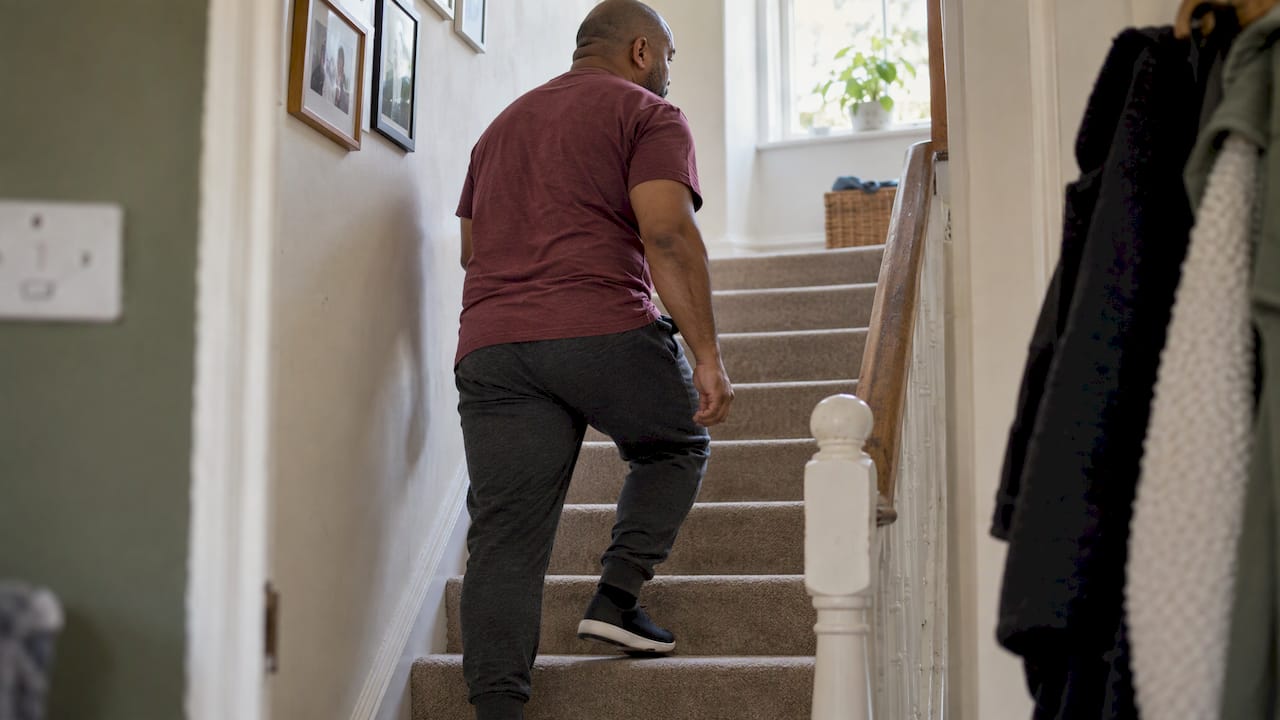
- Step-ups. Use the bottom stair or a sturdy step. Step up, step down, then swap legs. Hold the banister if you need to.
- Backpack rows. Hinge forward from the hips with a flat back, a loaded backpack hanging in both hands. Pull it towards your belly, lower it slowly.
- Incline press-ups. Hands on a worktop, sofa arm or stair, lower and push.
- Knee plank. Hold for 15 to 30 seconds on forearms and knees.
The NHS lists push-ups, sit-ups, lifting weights, working with resistance bands and lifting and carrying children as muscle-strengthening activities. So yes, a toddler on your shoulders counts. So does heavy shopping, as the NHS strength-building tips point out.
Want picture guides and alternative versions of each move? Browse the SHIFT Fit exercise library, which shows movement at your pace. For a longer set of at-home options, see our guide to simple strength training at home.
Make the walks work harder for you
Walking is the easiest part of this plan to fit around a family. Some ideas that need no extra time:
- Turn the school run into a school walk a few days a week. The NHS suggests exactly this, along with taking the stairs and setting a reminder to move every 30 minutes.
- Walk a phone call. Any call that does not need a screen can be done on your feet.
- Break up long sitting. NHS inform advises breaking up long periods of not moving with light activity where possible. A 2-minute walk to the kettle counts.
- Use the weekend. A park loop with the kids is exercise, family time and fresh air in one.
If you want a structured build-up, our beginner walking plan for men takes it step by step. If you are wondering whether to stick with walking or move on to a set plan, the walking versus structured exercise comparison sets out the differences in plain English.
When the day gets away from you
It will happen. Someone is ill, work runs late, the car needs fixing. Here is what to do instead of writing the day off.
The 5-minute rule. Do one of these and call it done:
- 5 minutes of walking, indoors or out.
- One round of sit-to-stands, wall press-ups and bridges.
- Stair climbing for a couple of minutes, if your knees and breathing are happy with it.
The swap rule. If you miss Tuesday, do the session on Wednesday and push rest to Thursday. Keep at least one rest day.
The restart rule. If you miss several days, pick up with the next day in the diary. Do not try to catch up. Nothing needs making up.
The NHS has a useful option for tight days: free 10-minute home workout videos for cardio, strengthening and warm-down stretching. It also offers a 9-week Couch to Fitness plan with 30-minute videos three times a week, if you want a longer programme later.
Rest is part of the plan
Two rest days a week are built in on purpose. Your muscles and joints need time to settle, especially if you are new to this or coming back after a long gap. Rest days are also where family life gets a look in.
If sleep and stress are making it hard to stick to the plan, you are not alone. Our guide to dads and mental health is a calm place to start, and breathing exercises for stress take only a couple of minutes. The NHS also notes that any amount of activity is good for you, so do not worry if you need to start off easy.
If you have a gym nearby
A gym is a bonus, not a requirement. If you have access to one, the same principle applies: two strength sessions a week is enough to start with. Resistance training in a gym is one of the recognised ways to meet that target, according to NHS heart-health guidance, which also recommends a warm-up of light exercise beforehand and a cool-down afterwards.
A simple 30-minute gym session could be:
- 5 minutes on a bike or cross-trainer to warm up.
- Leg press or goblet squat, 2 sets of 8 to 10.
- Chest press or incline press-up, 2 sets of 8 to 10.
- Seated row or cable row, 2 sets of 8 to 10.
- 5 minutes easy walking to cool down.
Choose weights where the last couple of repeats feel tough but your form stays tidy. If you are unsure about technique, ask a gym instructor to show you.
Keep it going: small habits that help
- Write it down. The NHS weight loss programme advises planning when and where you will exercise and writing it down.
- Lay out your kit the night before. Trainers by the door beat good intentions.
- Tie it to something you already do. After the morning brew, before the evening shower.
- Tell someone. A mate, a partner or the kids. Ask the kids to count your press-ups.
- Track the doing, not the number. Tick off each day you did something, however small.
Weight is not the only reason to move. The CMO guidance says activity can lower the chance of type 2 diabetes by up to 40% and cardiovascular disease by up to 35%, and is linked with improved sleep, managing stress and quality of life. Those are good reasons to stick with it even in weeks when the scales do not move.
If food and weight are also on your mind, our realistic weight loss plan for busy dads covers meals, routines and support without the pressure.
Free support from SHIFT
My Timber is free to use. It brings together daily check-ins, progress tracking, SHIFT Grub for realistic food and recipes, SHIFT Fit for approachable walking and strength, and Ask Timber for non-clinical support. You can use it alongside your own clinic, after treatment ends, or with no treatment at all. No prescription transfer or purchase is needed.
SHIFT is not currently offering clinical assessment, prescribing or dispensing. If you have questions about treatment, take them to your own prescriber. Our medical disclaimer explains how to use our information.
A good first step: visit Shift Some Timber, pick one day from the diary above, and book it into your calendar.
FAQ
How long should a busy dad workout be?
Fifteen minutes is enough to count. UK guidance says you can build up your weekly activity in short bursts, such as three 10-minute or two 15-minute sessions in a day. A short session you do beats a long one you skip.
How often should I do strength training?
The NHS and UK Chief Medical Officers advise strengthening activity on at least 2 days a week, working all the major muscle groups. The diary above does this with two 15-minute sessions, one early in the week and one later.
Can I do these workouts at home with no equipment?
Yes. Strength A and B use a chair, a wall or worktop, a stair and a backpack. The NHS also lists bodyweight exercises, carrying heavy shopping and lifting children as muscle-strengthening activities.
What if I have not exercised for years?
Start with the walks and the fallback versions, and stay on Week 1 for as long as you like. The NHS advises increasing activity gradually. If you have a health condition, chest pain, or take regular medication, ask your own GP or prescriber before you step things up.
What should I do if I miss a day?
Do the 5-minute fallback if you can, or simply carry on with the next day. Do not try to double up. One missed day does not undo the rest of the week.
Sources
- Physical activity for adults and older adults: 19 and over, GOV.UK
- How to be more active, NHS Better Health
- Home workout videos, NHS
- Physical activity guidelines for adults aged 19 to 64, NHS
- Exercise and the heart, Royal Berkshire NHS Foundation Trust
- NHS weight loss programme, Week 2
- Physical activity guidelines, NHS inform
- Be active for your mental health, NHS Every Mind Matters
Recommended
- Weight Loss Support for Busy Dads: A Realistic UK Plan
- Men's Fat Loss Workouts: A Realistic Weekly Plan
- Meal Prep for Busy Blokes
SHIFT provides general UK health information and practical support. Speak to your GP or your own prescriber about symptoms, test results or medicines. My Timber is free to use alongside your own clinic, after treatment ends or without treatment.
Last updated .