Weight Loss Support for Busy Dads: A Realistic UK Plan
If you are a dad juggling work, school runs and a house that never stays tidy, you do not need a punishing regime. You need a plan that survives a bad week. The best weight loss support for busy dads is small, repeatable habits (protein-led meals, short bursts of movement, protected sleep), a steady pace, and someone in your corner when motivation dips. This guide covers all of that, plus where medication fits and how to keep the weight off.
TL;DR
- Aim for a steady pace of about 0.5 to 1kg (1 to 2lb) a week, not a crash diet you abandon by Friday.
- Build meals around protein and vegetables, move in short bursts, and treat sleep as part of the plan.
- Strength work on two days a week matters more than most dads think, especially if you use weight loss medication.
- Medicines can help some men, but they work best alongside food, movement and follow-up support.
- Plan for maintenance from day one. Regain is common, and support after the first few months is what helps.
Table of Contents
- Why the usual advice fails busy dads
- Set a pace you can actually keep
- Food: simple rules that fit a busy kitchen
- Movement: ten minutes still counts
- Sleep: the habit dads skip first
- Starting small when motivation is low
- Where medication fits
- Keeping the weight off
- Perspective: what we have learned at SHIFT
- How SHIFT can help
- A simple four-week start
- FAQ
- Sources
Why the usual advice fails busy dads
Most online advice for dads assumes you have an hour a day for the gym and the headspace to weigh every meal. You probably have neither. The result is a familiar cycle: strict Monday, slip on Thursday, write the week off, start again next Monday.
The fix is not more willpower. It is lowering the bar so the plan still works on your worst day. That means:
- Choosing habits that take minutes, not hours.
- Planning for the foods you actually eat, including takeaways and the kids' leftovers.
- Counting a bad day as one bad day, not a failed month.
The NHS says finding what works for you matters, and its 12-week weight loss plan is built around setting a 12-week goal, tracking what you eat and building healthier habits. Twelve weeks is a useful frame for a dad: long enough to see change, short enough to stay focused.
Set a pace you can actually keep
Crash diets feel productive and then collapse. NHS Inform describes 1 to 2 pounds (0.5 to 1kg) a week as a safe and healthy pace, and says quick fixes are hard to sustain.
NICE goes further. It advises against nutritionally unbalanced restrictive diets because they are ineffective long term and can be harmful. It also says dietary treatment should be flexible and individualised, taking account of your food preferences, circumstances and any medical conditions.
In plain English: the right diet is the one that fits your life and still leaves you eating properly.
If you are losing weight much faster than this without trying, feel unwell, or have a long-term condition or take regular medicines, speak to your GP or pharmacist before changing anything. Unexplained weight loss is a reason to get checked, not to celebrate.
Food: simple rules that fit a busy kitchen
You do not need a meal prep Sunday that eats half your weekend. You need a few defaults.
Build dinner around protein and veg
Protein and vegetables fill you up faster, which helps you stop reaching for biscuits at 9pm. Think eggs, fish, chicken, beans and lentils, with whatever veg you can get on the plate. Then add the carbs and extras around that, rather than the other way round.
Swap, don't scrap
You do not have to give up everything you enjoy. Small swaps add up:
- Greek yoghurt and fruit instead of sugary cereal.
- A wrap or wholemeal bread instead of a white roll at lunch.
- Water or a zero sugar drink instead of fizzy pop.
- A smaller portion of the same dinner instead of a different "diet" meal for you alone.
The NHS points to healthier food choices and managing portion sizes as the core of its plan. Portion size is often the easiest lever for a dad who eats what the kids leave.
Make flavour easy
Plain chicken and steamed veg gets boring by Wednesday. Having a few seasonings you like makes simple meals something you look forward to. A flexible seasoning blend subscription is one way to keep home cooking varied without extra effort.
A sample day for a working dad
| Meal | Easy option | Why it works |
|---|---|---|
| Breakfast | Eggs on toast, or Greek yoghurt with fruit | Protein early, less mid-morning snacking |
| Lunch | Chicken or tuna wrap with salad, piece of fruit | Takes five minutes, easy to take to work |
| Dinner | Same meal as the family, bigger share of protein and veg, smaller share of pasta, rice or chips | No separate cooking |
| Snacks | Fruit, nuts in a small handful, yoghurt | Keeps you from the vending machine |
This is an example, not a prescription. If you have diabetes, kidney problems or another condition, ask your GP or a registered dietitian what suits you.
Movement: ten minutes still counts
The gym membership you cannot use is worse than a walk you actually take. The NHS says even 10 minutes of activity a day can make a difference.
The UK Chief Medical Officers' guidance, updated in July 2026, recommends adults build up:
- At least 150 minutes of moderate activity a week, or 75 minutes of vigorous activity.
- Muscle-strengthening activity on at least two days.
- Less time spent sitting for long stretches.
It also says short bouts, including those under 10 minutes, add up across the day and week, and that activity can be part of daily life, such as walking or cycling for travel.
Where the minutes come from
- Walk or cycle part of the commute, or get off a stop early.
- Take calls on your feet.
- Walk to school with the kids rather than driving the whole way.
- Do a 10-minute bodyweight circuit while the pasta boils.
- Play properly at the park instead of watching from the bench.
Do some strength work
Strength training protects muscle while you lose fat, and muscle helps your body work well as you get older. Two short sessions a week is enough to start. Our realistic weekly fat loss workout plan shows how to set that up without living in the gym.
If you are taking, or have recently taken, a GLP-1 medicine, this matters even more. The CMO guidance says muscle-strengthening activity is likely particularly important for maintaining muscle mass and preventing regain in these men. If you want to understand how to regain muscle mass after weight loss, that is worth reading alongside your training.
Sleep: the habit dads skip first
New baby, late shifts, a teenager out late: sleep is the first thing to go. It also quietly wrecks weight loss. The NHS warns that not enough sleep can push you towards high-calorie food and leave you too tired to exercise or cook a healthy meal.
You cannot always control the night, but you can protect the edges:
- Keep a regular bedtime on the nights you can.
- Put the phone down 30 minutes before bed.
- Go lighter on caffeine in the afternoon.
- On a bad night, do not punish yourself with a hard workout. Take the walk and have the protein breakfast.
If tiredness is constant and not explained by life with kids, it is worth a conversation with your GP. Our men's health page on energy and sleep covers what to look at.
Starting small when motivation is low
Some weeks you will have nothing left. That is normal, and it is not a character flaw. The trick is a goal so small you can do it anyway: one glass of water before dinner, one 10-minute walk, one proper breakfast.
Our page on tiny goals when motivation is low walks through this approach. Small wins keep the streak alive, and the streak is what builds confidence.
It also helps to bring your family in. Kids can join the walk, and a partner can make the plan easier or harder. If you want them on side, we have a guide on how to support your partner with weight loss that you can share.
Where medication fits
Some men do everything sensible and still struggle with constant hunger or "food noise". For some, medication is a reasonable option, and it is worth knowing how it works in the UK.
NICE says weight-management medicines should be considered after dietary, exercise and behavioural approaches have been started and evaluated. They are used alongside a reduced-calorie diet and more activity, with information, support and counselling on diet, activity and behaviour.
On NHS criteria, NICE's current position includes specialist semaglutide for adults with at least one weight-related condition and either a BMI of 35 or more, or a BMI of 30 to 34.9 who meet referral criteria. Tirzepatide is indicated at an initial BMI of 35 or more with at least one weight-related condition. Your GP or a specialist service can tell you whether you qualify.
A few honest points for busy men:
- Medicine is a tool, not a shortcut. The food, movement and sleep habits above still matter.
- Any prescribing needs a proper clinical assessment, regardless of where it happens.
- Ongoing monitoring and support matter as much as the first prescription.
Want to compare routes? Our NHS vs private weight loss medication page sets them out, and our lifestyle alone vs weight loss medication comparison helps if you are unsure whether you need treatment at all. If you are already on treatment, see our semaglutide results timeline for what to expect and when to review.
Keeping the weight off
Losing weight is half the job. NICE recognises that weight regain may happen and encourages a nutritionally balanced diet long term, with follow-up to help maintain loss.
If you stop medication, this matters even more. NICE says tirzepatide treatment could be long term if weight loss is achieved, and that stopping without continued reduced-calorie eating and more activity is likely to lead to regain.
NICE's 2025 quality standard on support after stopping says people should get:
- Regular monitoring for at least a year.
- An if-then action plan (for example, "if my weight goes up 2kg, then I go back to tracking meals for two weeks").
- Environmental and social support.
- Help building small, manageable routines.
It also points to family-based changes, self-monitoring and ongoing activity as ways to prevent regain and weight cycling. For a dad, family-based changes are a gift: what you cook and do together becomes the maintenance plan. Our guide to life after stopping semaglutide covers the practical side.
Perspective: what we have learned at SHIFT
We built SHIFT because ordinary men do not get much support that sounds like them. Most advice is either a bodybuilder's routine or a clinical leaflet. Neither fits a dad who has 20 minutes and a hungry toddler.
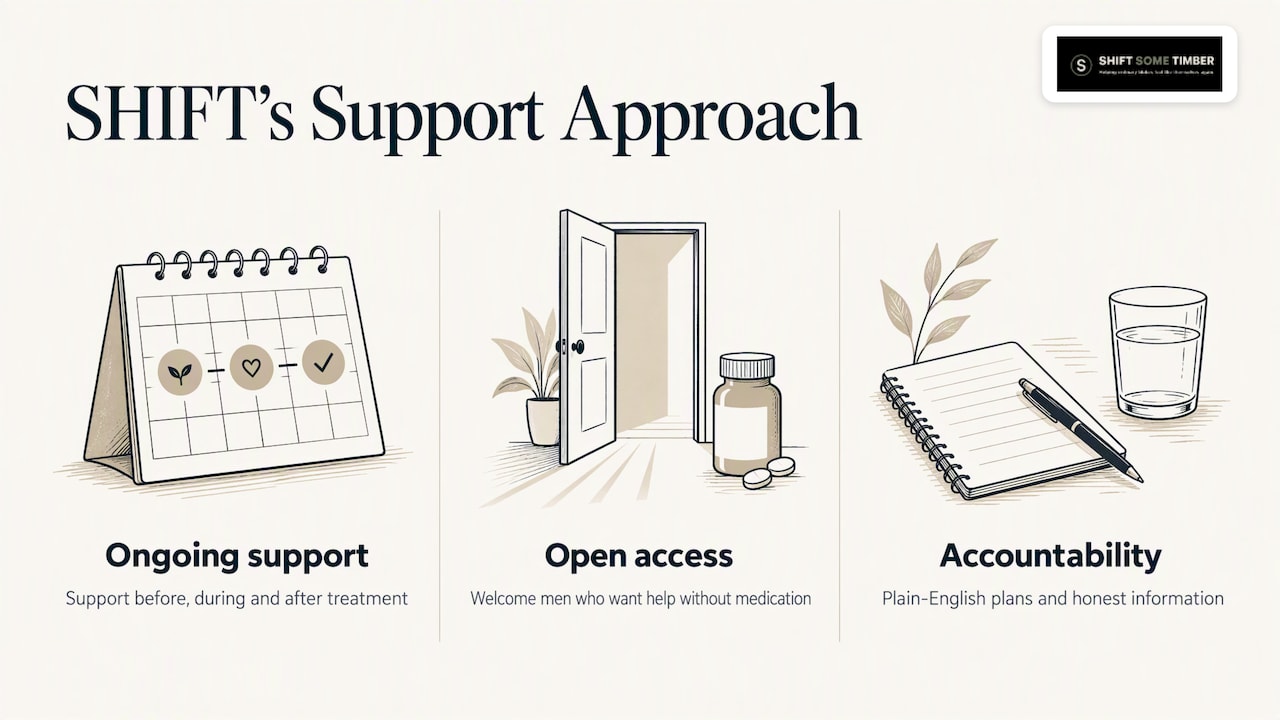
Our view is simple. Weight loss is not only about the scales. It is about energy, confidence and being the dad you want to be. Support should cover before, during and after treatment, and it should welcome men who started elsewhere, stopped medication, or want help without any medication at all.
We also think judgement gets in the way. Men put off asking for help because they feel they should be able to handle it alone. You do not have to. A plain-English plan, honest information and a bit of accountability go a long way.
— Matt O’Brien
How SHIFT can help
The Programme brings the practical pieces together: Grub for food ideas, Fit for achievable movement, Life Back for personal goals beyond weight, and My Timber for check-ins and progress tracking. Treatment information and pathways sit alongside it, with clinical assessment, prescribing and dispensing handled by appropriately regulated partners.
You can start with our men's weight management page, explore The Shift Programme, or use the weight management review questions to prepare for a conversation with a clinician. Not sure about next steps? Our Weight-Loss Decision Centre helps you work through the options.
A simple four-week start
- Week 1: Notice. Write down what you eat for a few days. No changes yet. Add a 10-minute walk on three days.
- Week 2: Swap. Pick two food swaps and make protein the centre of dinner. Aim for a consistent bedtime.
- Week 3: Strengthen. Add two short strength sessions at home. Keep walking.
- Week 4: Review. Check how you feel, your energy and your clothes as well as the scales. Decide what to keep, then set your next 12-week goal.
If you have a health condition, take medicines or have been inactive for a long time, check with your GP before increasing exercise or changing your diet significantly.
FAQ
How much weight can a busy dad realistically lose in a month?
A steady pace is about 0.5 to 1kg a week, according to NHS Inform. That works out at roughly 2 to 4kg a month, though real progress is rarely a straight line. If you lose much faster without trying, see your GP.
I only have 10 minutes a day. Is that enough?
It is a real start. The NHS says even 10 minutes a day can make a difference, and the CMO guidance says short bouts add up over the week. Over time, work towards 150 minutes of moderate activity plus two strength sessions.
Do I need medication to lose weight?
No. Many men lose weight with food, movement and sleep changes alone. Medication is something to discuss with a clinician if you meet the criteria or struggle despite your efforts, and it works best alongside lifestyle support.
What happens if I stop weight loss medication?
Weight regain is likely if you also drop the eating and activity habits, according to NICE. Ask your prescriber for a stopping plan and follow-up, and keep tracking and strength training going.
Can I get support if I started treatment somewhere else?
Yes. At SHIFT we welcome men before, during and after treatment, including those who started elsewhere or have stopped. Our lifestyle and behaviour change page is a good place to begin.
Sources
- NHS Better Health: NHS weight loss plan
- UK Chief Medical Officers' physical activity guidelines (GOV.UK)
- NICE CKS: Obesity management
- NICE: Prescribing, reviewing and stopping tirzepatide
- NICE quality statement 7: Advice and support after stopping medicines
- NHS Inform: Tips for losing weight safely
Recommended
- Men's Fat Loss Workouts: A Realistic Weekly Plan
- Lose Weight With a Men’s Diet: UK 1,800 Calorie Plans That Last
- Healthy Meals on a Budget: A UK Guide for Men
- Protein for Men Losing Weight: Practical Food, Not Gym Theatre
Last updated .