
How to Talk to a Mate Who Is Struggling: What to Say and Do
Pick a quiet, unhurried moment, say what you have noticed, ask an open question, then listen more than you talk. You do not need the perfect words or any answers. You need to be there, stay calm and offer one small next step. If he mentions suicide or seems in immediate danger, call 999.
This guide is for blokes who have a feeling something is off with a mate and are not sure how to bring it up. It gives you the signs to look for, a few natural things to say, how to listen without diagnosing, what to do if he clams up, and where to turn if it turns serious.
TL;DR
- Look for changes: he is distant, short-tempered, tired, drinking more, or not replying to messages.
- Choose a private, unhurried moment. Doing something side by side, like a walk or a drive, often makes it easier.
- Describe what you have noticed, ask an open question, and listen. Do not diagnose or rush to fix.
- If he is not ready, do not push. Keep ordinary contact going and offer one specific thing, like another chat or a lift to the GP.
- If he is in immediate danger, call 999. Samaritans are free on 116 123, any time.
Table of Contents
- Signs a mate might need a check-in
- Before you speak: pick the moment
- What to say: natural ways to open up
- How to listen without diagnosing or fixing
- If he does not want to talk
- When a mate mentions suicide or seems in danger
- Helping him take the next step
- Looking after yourself too
- A quick checklist before you reach out
- Where SHIFT fits in
- FAQ
- Sources
Signs a mate might need a check-in
Most men do not announce that they are struggling. It tends to show up in small changes. Samaritans list signs to look out for that include:
- feeling restless, agitated, angry or tearful
- seeming tired or lacking energy
- not wanting to be around people or do things he usually enjoys
- using alcohol or drugs to cope
- finding everyday things hard to manage
- not replying to messages, or being distant
- talking about feeling hopeless, worthless or trapped
- changes in routine, such as sleeping or eating more or less than normal
- risk-taking, such as gambling or violence
None of these proves anything on its own. A mate who skips the pub quiz once is probably just knackered. A mate who has gone quiet for weeks, looks worn out and has stopped answering the group chat is worth a proper check-in.
Trust your gut. If something feels different about him, that is reason enough to ask.
Before you speak: pick the moment
Where and when you ask matters almost as much as what you say. Here for Someone advises a calm, private, unhurried moment, so he is not worried about who might overhear or when you have to leave.
Some practical thoughts:
- Go side by side. Plenty of men find it easier to talk while doing something: walking the dog, driving, fishing, watching the match. No eye contact, no pressure. Young Minds notes that some people prefer a car for exactly this reason.
- Keep it private. A pub on a Friday night with the lads is rarely the place. A one-to-one is.
- Give it time. If you only have ten minutes before the school run, wait. Starting a conversation you have to cut short can leave him feeling worse.
- Ask permission. Something like "Got a minute for a proper chat?" gives him the choice, and it is fine if the answer is "not now".
A walk is also a gentle way to get a conversation going. If you both want to build more movement into the week, our exercise guide on walking, strength and mobility is a place to start.
What to say: natural ways to open up
You do not need a script, but a few openers help when your mind goes blank. Here for Someone suggests describing a change you have seen without putting a label on it, then asking an open question. Open means it needs more than yes or no.
Try:
- "You've seemed a bit quiet lately. How are you doing, really?"
- "I've noticed you're not yourself at the football. What's going on for you?"
- "I know things have been full on at work. How are you holding up?"
- "No pressure, but I'm here if you want to talk."
Ask twice
In the UK, "you alright?" is often just a greeting, and the automatic answer is "yeah, fine". Young Minds, drawing on Roman Kemp's BBC documentary Our Silent Emergency, suggests asking twice and trying a different line such as "What's going on for you today?". If the first answer is "fine", a calm "Are you sure? I've got time" can open the door.
Keep your body language easy
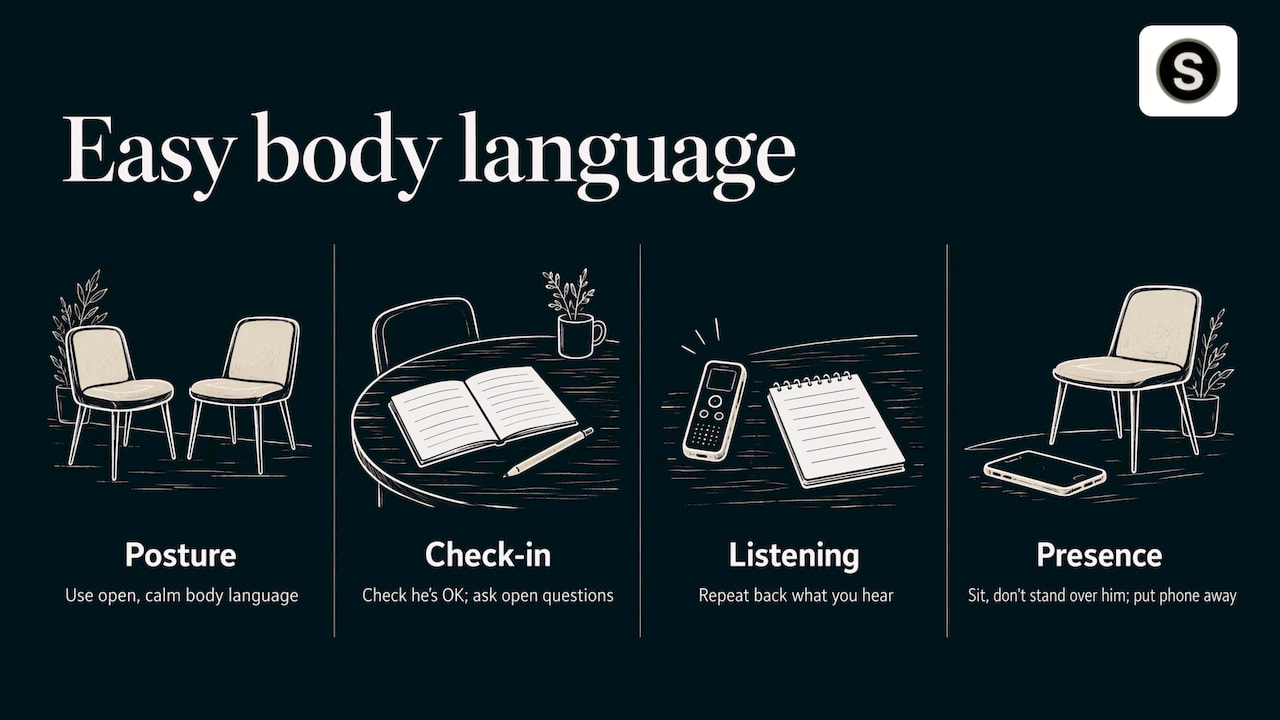
Samaritans' Small Talk Saves Lives guidance is to approach with open, calm body language, ask if they are OK, ask open questions, and repeat back what you hear. Sit rather than stand over him. Put the phone away.
Offer privacy
Young Minds also suggests reassuring him that what he says stays between you, apart from situations where emergency services are needed. Saying "this stays with me" at the start can make a real difference to a bloke who worries about being judged. Only say it if you mean it, and be honest that you would need to get help if his life were at risk.
How to listen without diagnosing or fixing
This is the hard part. Your instinct as a mate is to sort it: "Right, here's what you need to do." Try to resist it.
The Mental Health Foundation's advice boils down to this:
- Let him lead. He can share as much or as little as he wants, at his own pace.
- Do not diagnose. You are not trying to work out whether it is depression, anxiety or burnout. That is for a professional.
- Keep questions open and neutral. "What's that been like?" works better than "Why don't you just...?"
- Give him time to answer. Silence is fine. Let it sit.
- Repeat back what you hear. "So work's been relentless and you're not sleeping." It shows you have listened and respect how he feels.
- Let him make the decisions. Offer support, such as going to the GP with him, without taking control.
Young Minds adds that sometimes people do not want a response at all. They want to say it out loud and know someone is listening. Simple lines such as "that sounds really hard" do more than advice.
The Mental Health Foundation also points out that talking can take a lot of trust and courage, and you might be the first person he has told. Treat that as a privilege, not a problem to solve.
Things that rarely help
- "Cheer up" or "others have it worse"
- Telling him what he should do
- Telling the story back to him as a joke
- Sharing what he said with the group chat
Our piece on men's mental health myths covers some of the ideas that keep blokes quiet, and our guide to helping a mate with his mental health goes through the conversation in more detail.
If he does not want to talk
Sometimes the answer is "I'm fine, mate." That is okay. Here for Someone says not to push if he does not want to talk at first. Instead, keep ordinary contact going where it is welcome and try another approach, such as a message or doing something together.
A low-pressure follow-up can be as simple as:
- a text on Sunday: "Fancy a walk Tuesday evening? No agenda."
- inviting him to watch the game, with no heavy talk
- a message a week later: "Still thinking of you. Door's open."
The point is that he knows the offer stands. Many men come back to it when they are ready, and it helps that you did not make a fuss. Keep showing up. Do not mention it to others unless you are worried about his safety.
A worked example of a follow-up message
Say you tried on Thursday and he brushed it off. On Sunday you might send:
"No need to reply to this. Just wanted to say I'm around if you ever want a chat or a pint. Walk Tuesday if you fancy it?"
It asks nothing of him, offers one clear option and leaves the choice with him.
When a mate mentions suicide or seems in danger
If you are worried he might be thinking about suicide, it is okay to ask directly. Herefordshire and Worcestershire NHS Trust says asking about suicide will not put the idea into someone's head. An NHS Borders leaflet on suicide awareness adds that some people feel relief at being asked a plain question like "Are you thinking about suicide?". Listen without trying to make it better.
What to do
- Immediate danger: call 999. Samaritans say to call an ambulance on 999 if someone is in immediate danger. Do not leave him alone if he has a plan and the means to carry it out.
- Urgent, but not an emergency: the NHS Trust guidance says NHS 111 can help if you are unsure whether you need 999, the GP is unavailable, or you cannot leave him and do not know what else to do. Call 111 and choose the mental health option. Friends, family and carers can all call.
- Someone to talk to: Samaritans are free on 116 123, 24 hours a day. He can call, and so can you. You can also text SHOUT to 85258, 24/7. In Scotland, Breathing Space is on 0800 83 85 87, and for under-35s Papyrus HOPELINE247 is on 0800 068 4141. All of these are listed in the NHS Borders leaflet linked above.
- A plan to take his own life: the Mental Health Foundation says to encourage him to call 999 or go to A&E, and to ask for the contact for the nearest crisis resolution team.
If you do not feel safe approaching someone in person, Samaritans say you can speak to a passer-by, station staff or a police officer instead.
If the situation is not an emergency but you think he needs more than a chat, our guide on when to get mental health help explains the signs in plain English. For how the NHS thinks about this now, see our summary of the shift towards person-centred suicide prevention.
Helping him take the next step
Listening is the start. Once he has opened up, offer one specific next step he might welcome. Here for Someone suggests things like another chat, a lift to the GP or help finding a number.
In practice, that could be:
- The GP. Offer to help him book, or go along. Our guide to helping someone book a GP appointment and what to expect at a GP appointment for mental health can take the mystery out of it.
- NHS Talking Therapies. In England you can usually refer yourself without seeing a GP first. See how to self-refer to NHS talking therapy, and when it fits for anxiety.
- Specialist services. The Mental Health Foundation explains that community mental health teams, often based at a hospital or local centre, provide counselling and talking treatments, and some offer 24-hour crisis services.
Support is not always quick. A November 2025 London Assembly Health Committee report on men's mental health in London found considerably fewer men than women access NHS Talking Therapies in the capital, and that long waiting lists are keeping some men from help. So keep checking in while he waits. Your support in the meantime counts.
If he is struggling with depression, our page on supporting someone with depression gives practical ideas. For general help finding the right route, see getting professional mental health help.
Looking after yourself too
Supporting a mate can be draining, especially if he is very low. Samaritans advise giving yourself time to process what happened, talking to someone you trust, asking for help if you need it, and calling them if you want someone to listen without judgement or pressure.
Herefordshire and Worcestershire NHS Trust adds that supporters can talk to friends and family or their own doctor, keep doing things they enjoy, try mindfulness, or try Talking Therapies if they have anxiety, low mood or depression.
Some conversations also get tense, particularly if your mate is irritable or angry. Some calm scripts for tense conversations can help you keep your own temper steady while you stay alongside him.
You are not his therapist. You do not have to be available around the clock. Setting a limit, such as "I can't talk tonight, but I'll ring you tomorrow", is fine as long as you follow through.
A quick checklist before you reach out
- Have I picked a private, unhurried time?
- Can I describe one thing I have noticed, without labelling it?
- Do I have an open question ready?
- Am I ready to listen, not fix?
- Do I know one next step I can offer?
- Do I know the numbers: 999, 111 and Samaritans on 116 123?
That is enough. Starting an imperfect conversation is better than waiting for a perfect one.
Where SHIFT fits in
Many of the blokes we hear about are carrying weight, poor sleep, stress and low confidence all at once, and they affect each other. My Timber is our free practical support for UK men: check-ins, progress tracking, realistic food and recipes, approachable walking and strength, and Life Back for the things that matter beyond the scales. You can use it alongside your own clinic or prescriber, after treatment ends, or without treatment. No prescription transfer or purchase is needed.
If your mate is also trying to get back to feeling like himself, point him to our free weight-loss support for men. For the bigger picture, see Life Back. It is practical support, not a replacement for a GP or a crisis service. Individual treatment questions are for his own prescriber.
FAQ
What if I say the wrong thing?
It is very unlikely to do harm if you are kind and honest. Saying "I'm not sure what to say, but I'm glad you told me" works well. Avoid pressure, judgement and quick fixes, and keep listening.
Should I ask him directly about suicide?
If you are worried, yes. NHS guidance says asking will not put the idea into someone's head. Ask plainly, listen, and if there is immediate danger call 999. Samaritans are free on 116 123.
What if he asks me not to tell anyone?
You can keep ordinary worries private, but safety comes first. If his life is at risk, call 999 even if he has asked you not to. Be honest with him that this is a line you cannot hold.
How often should I check in?
There is no set rule. A short message every week or so, plus the odd invitation to do something together, keeps the door open without feeling like pressure. Let his responses guide you.
Is it okay to talk to him by text?
Yes. Here for Someone suggests a message as one way to keep contact going if face-to-face feels too much. A short, no-pressure text can be easier for him to answer than a phone call.
Sources
- How to support someone you're worried about, Samaritans
- How to raise your concerns with them, Here for Someone
- How to Talk to a Friend You're Worried About, Young Minds
- How to start a conversation with somebody who needs help, Samaritans
- How to support someone with a mental health problem, Mental Health Foundation
- Supporting someone at risk of self-harm or suicide, Herefordshire and Worcestershire NHS Trust
- Suicide awareness leaflet, NHS Borders (May 2024)
- Getting additional help for someone, Samaritans
- Urgent or emergency situations, South West Yorkshire Partnership NHS Foundation Trust
- Men's mental health in London, London Assembly Health Committee (November 2025)
- Calm scripts for tense conversations
Recommended
- Helping a Mate With His Mental Health
- Male Friendships & Mental Health
- How to Talk About Your Mental Health
- Feeling Low or Not Like Yourself? Help for Men
SHIFT provides general UK health information and practical support. Speak to your GP or your own prescriber about symptoms, test results or medicines. My Timber is free to use alongside your own clinic, after treatment ends or without treatment.
Last updated .