
Low Calorie Filling Foods: What to Eat and How to Build Meals
The foods that fill you up for the fewest calories are the ones heavy with water, fibre and protein: vegetables, fruit, pulses, potatoes, oats, eggs, fish, lean meat and plain yoghurt. Put one or two of them in every meal and you can eat a proper portion without feeling you are on a diet. This guide shows which foods to pick, why they work, and how to turn them into three full UK meals.
No food here is "bad" and no one number suits every man. Start with one change that fits your week.
TL;DR
- Foods with a lot of water, fibre and protein give you more food for fewer calories, so you feel fuller.
- The NHS suggests filling about half your plate with veg and adding a protein to each meal.
- Protein matters: a big bowl of salad alone can leave you hungry an hour later.
- Three simple meals below show how to do it with supermarket staples, plus swaps if you dislike something.
- If you take weight loss medication or have a health condition, your own GP or prescriber decides what suits you.
Table of Contents
- Why some foods fill you up for fewer calories
- Fullness is not only about volume
- The low calorie filling foods worth knowing
- Low calorie does not mean the right choice every time
- How much should you eat?
- Three full meals built from filling foods
- A simple shopping list for the week
- Snacks that fill the gap
- If you take weight loss medication
- Where My Timber fits in
- Fullness and the rest of your week
- FAQ
- Sources
Why some foods fill you up for fewer calories
The idea is called energy density. The British Dietetic Association explains that it is the number of calories per gram of food. Foods high in water, such as fruit, veg, soups and stews, add weight and volume without adding many calories. Pasta, pulses and rice soak up water as they cook, so they do the same job.
Two other things help. Fibre slows chewing and digestion. Protein-rich foods such as poultry, fish, lean meat, eggs, beans and pulses reduce hunger and keep you full for longer.
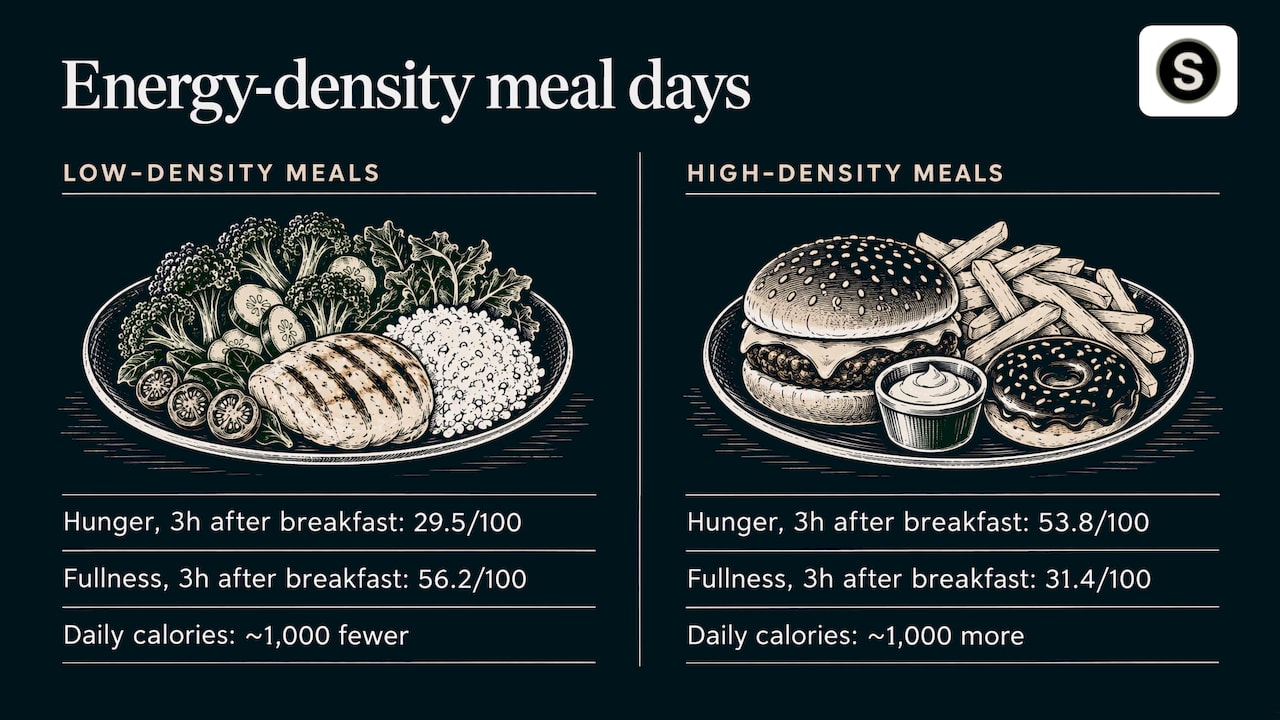
There is UK research behind this. In a University of Leeds study published in 2018, people eating low energy density meals of vegetables, lean meat and rice ate about 1,000 fewer calories a day than on high energy density days. They also reported lower hunger and higher fullness. Three hours after breakfast, average hunger scores were 29.5 against 53.8, and fullness 56.2 against 31.4, on a 0 to 100 scale. It was a controlled study of meals, so real life will look different for each man. It does show that what you eat changes how hungry you feel, not only how much you eat.
Fullness is not only about volume
Big portions of watery food can look impressive and still leave you flat. The Institute of Nutrition points out that appetite is hormonal: ghrelin tells your brain you are hungry and leptin tells it you are full. It adds that protein may be the most effective at prompting those fullness signals. So a plate of cucumber and lettuce on its own can leave you stuffed but unsatisfied, while the same plate with eggs, chicken or beans works far better.
A registered dietitian quoted by the same institute explains that protein takes longer to digest than fat or carbohydrate and costs the body more energy to process. Fibre has a similar effect because it cannot be digested and slows how quickly carbohydrate is released.
If you are curious how eating patterns more broadly affect the body, this piece on intermittent fasting and bone density is a good next read. For everyday fullness, though, the simplest lever is still protein plus fibre plus water-rich food at each meal.
The low calorie filling foods worth knowing
Here are the foods that come up again and again in NHS and dietitian guidance, grouped by what they do for you.
Vegetables and fruit
The NHS Better Health guide says most vegetables are high in fibre and low in calories, and can help you feel fuller for longer. It suggests two or more portions of veg in a main meal, filling about half the plate.
Good everyday picks:
- Carrots, cabbage, broccoli, cauliflower, peppers and mushrooms
- Frozen mixed veg, which is cheap, keeps for months and needs no chopping
- Tinned tomatoes, a base for chilli, curry, soup and pasta sauce
- Strawberries, berries, apples and grapefruit
For fruit, an NHS dietetics leaflet from Sheffield Teaching Hospitals lists up to 100g of strawberries and up to 100g of grapefruit as snacks based on less-processed foods. Treat it as a snack idea rather than a rule.
Pulses and beans
Chickpeas, lentils, kidney beans and baked beans bring protein and fibre together in one tin. MoneyHelper lists pulses and beans among cheap, filling ingredients to build meals around, alongside wholegrain rice, potatoes, tinned tomatoes, frozen or tinned fish and turkey mince.
Eggs, fish and lean meat
The NHS advice is to include a protein with every meal: beans, pulses, fish, eggs or lean meat. Tinned tuna, sardines, eggs, chicken breast and turkey mince are all easy to find in any UK supermarket.
Oats and wholegrains
Oats are a good example of a food that is not "low calorie" gram for gram but fills you well. A pack of Quaker jumbo oats on Ocado lists 374 kcal, 9.0g fibre and 11g protein per 100g. A 40g serving is therefore roughly 150 kcal with about 3.6g of fibre and 4.4g of protein, before milk or toppings. Cooked with water or milk, it swells into a large, warm bowl.
Plain yoghurt
Plain natural or Greek-style yoghurt is a quick protein hit. The Sheffield leaflet above includes 3 tablespoons (100g) of plain natural, Greek or non-dairy yoghurt among its snack ideas. Our own banana and berries yoghurt pot puts it with fruit for an easy breakfast or snack.
Low calorie does not mean the right choice every time
A food that is low in calories is not automatically the best thing to put on your plate. Use this quick test:
- Does it have water or fibre? Veg, fruit, pulses, oats and potatoes do.
- Does the meal have a protein? Eggs, fish, meat, beans or yoghurt.
- Will you actually enjoy it? If not, swap it. A meal you skip or resent will not last.
Small amounts of fat, such as olive oil on veg or peanut butter on toast, are fine in sensible quantities. The NHS Eatwell Guide notes that all types of fat are high in energy and should be eaten in small amounts. That is a reason to measure the oil, not to cut it out.
How much should you eat?
There is no universal calorie target here, and we will not give you one. The Eatwell Guide gives an average of around 2,500 calories a day for men, but your age, size, job and activity all change that. It also suggests fruit and veg should make up just over a third of what we eat, with at least five portions a day, and starchy foods just over a third, choosing higher fibre or wholegrain versions.
The NHS weight loss plan also points out that portion sizes today are far bigger than they were 30 years ago, which it calls portion distortion. Its tips are practical: use smaller plates and bowls, and aim for two portions of veg on the plate so that low calorie filling food takes up the space.
A few habits from the NHS pages are easy to try this week:
- Weigh dry pasta and rice rather than guessing.
- Put snacks in a bowl, not eat from the bag.
- Aim for 6 to 8 cups of fluid a day, as the NHS suggests.
- Keep starchy food to no more than a third of the plate, and go wholegrain where you can.
Three full meals built from filling foods
These meals follow the pattern the NHS describes: half veg, a protein, a measured portion of starch. Portions depend on you, so adjust them to your appetite and ask your GP if you have a medical reason to eat differently.
Breakfast: potato and egg hash with mushrooms
A hash gives you potato for fibre and fuel, egg for protein, and mushrooms for bulk. Our garlic egg potato breakfast hash with mushrooms is a ready-made version.
Sensible swaps:
- Prefer meat? Try the paprika turkey potato breakfast hash.
- Want something cheap and quick? The barbecue baked beans potato breakfast hash gets its protein and fibre from beans.
- No time? Have a bowl of porridge made with oats, topped with a handful of berries and a spoon of plain yoghurt.
Lunch: tuna and bean jacket potato with salad
Bake a potato in the oven or microwave. Top with tinned tuna mixed with plain natural yoghurt instead of mayonnaise, and a side of salad or sweetcorn and cucumber. Fill half the plate with the salad.
Swaps:
- Tuna out, baked beans in. Or mashed chickpeas, which the NHS Norfolk and Waveney guide lists as a budget topping idea on toast.
- Potato out, wholemeal wrap or two slices of wholegrain bread in.
- Tinned sardines in tomato sauce instead of tuna.
Dinner: turkey mince and lentil chilli with rice
Brown turkey mince, then add a tin of chopped tomatoes, a tin of kidney beans, a handful of dried or tinned lentils, and a bag of frozen peppers and onions. Season with chilli, cumin and paprika. Serve over a weighed portion of wholegrain rice, with broccoli or green beans on the side.
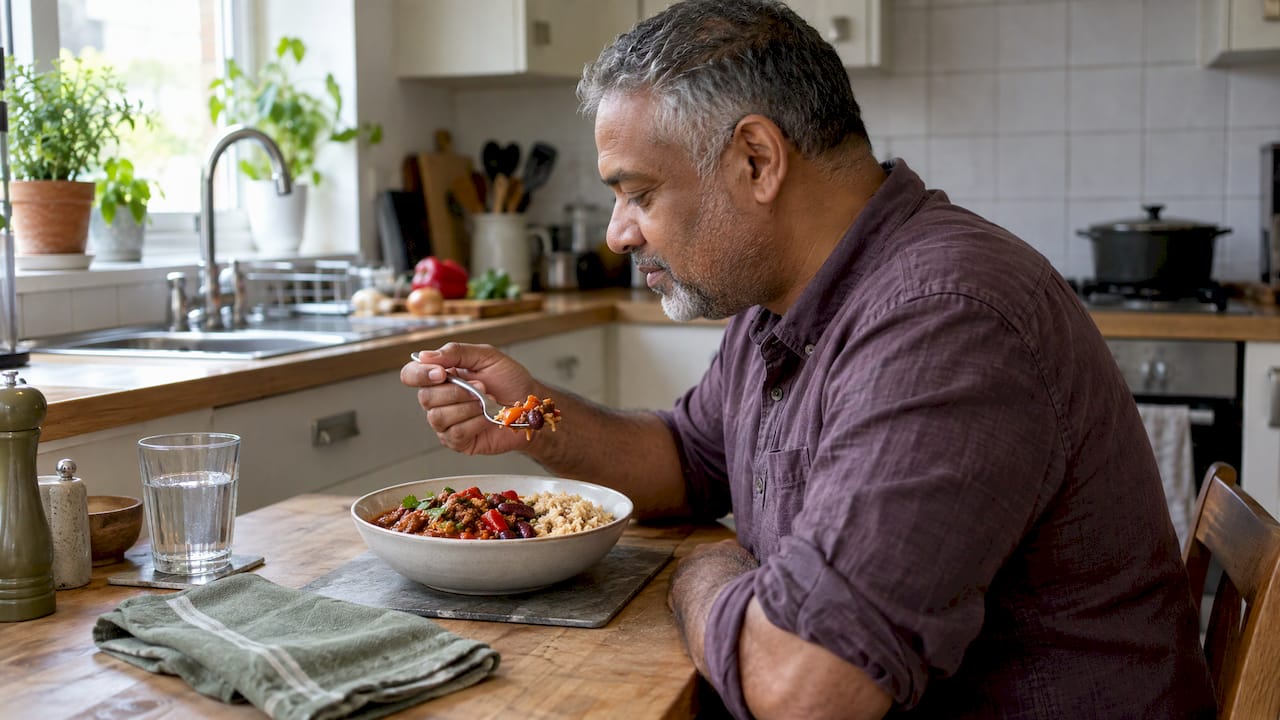
This follows the ingredients MoneyHelper recommends for cheap, filling meals: pulses, tinned tomatoes, turkey mince and wholegrain rice. It also freezes well, so one cook-up covers several evenings.
Swaps:
- Vegetarian? Skip the mince and double the beans and lentils.
- No rice? Use a baked sweet potato or a small portion of wholewheat pasta.
- Add grated carrot or courgette to the sauce for extra veg that nobody notices.
A simple shopping list for the week
This list is built around the foods above, and the sort of things you find in any UK supermarket or frozen aisle.
| Aisle | Pick up |
|---|---|
| Fresh | Mushrooms, carrots, peppers, cabbage, bananas, apples, eggs |
| Frozen | Mixed veg, broccoli, berries, white fish or salmon fillets |
| Tins | Chopped tomatoes, kidney beans, lentils, chickpeas, tuna, sardines, baked beans |
| Cupboard | Porridge oats, wholegrain rice, wholemeal wraps, dried herbs and spices |
| Fridge | Plain natural or Greek-style yoghurt, turkey mince, chicken breast |
Frozen and tinned versions count towards your five a day and cost less. They also save you from throwing out wilted veg.
Snacks that fill the gap
If the gap between meals is where it goes wrong, plan for it:
- A pot of plain yoghurt with berries. Try our apple and berries yoghurt pot.
- Strawberries or a grapefruit.
- A boiled egg and a carrot.
- A bowl of soup made from tinned tomatoes and frozen veg.
- Yoghurt and fruit with crackers, as in our banana and berries yoghurt box.
Snack because you are hungry, not because you feel you ought not to be. Hunger is information, not failure.
If you take weight loss medication
Medication can change your appetite, and how much you can eat at one sitting may be smaller. That can make protein and fibre even more worth planning. Smaller, filling meals built from the foods above are simple to put together. Your own prescriber handles individual treatment decisions, including what you should eat on treatment, so take those questions to them. Shift Some Timber does not currently provide clinical assessment, prescribing or dispensing.
The same applies if you have diabetes, a heart condition, kidney problems or any other diagnosis. Speak to your GP or a registered dietitian before changing how you eat.
Where My Timber fits in
My Timber is our free practical support. It brings together check-ins, progress tracking, SHIFT Grub for realistic food and recipes, and SHIFT Fit for approachable walking and strength. You can use it alongside your own clinic or prescriber, after treatment ends, or without treatment at all. No prescription transfer or purchase is needed.
If you want a place to start, see free weight-loss support for men. Pick one meal from this page, cook it this week, and see how you feel two hours later. That is the whole task.
Fullness and the rest of your week
Food is one part. Poor sleep can make you hungrier, a stressful week makes planning harder, and a bit of walking makes the plan easier to stick to. Our knowledge hub and tools cover sleep, blood pressure, blood tests and movement in plain English, so you can build habits that last rather than a plan that lasts a fortnight.
FAQ
What are the most filling low calorie foods?
Vegetables, pulses, potatoes, oats, eggs, fish, lean meat and plain yoghurt. They are high in water, fibre or protein, which the British Dietetic Association links to feeling fuller for longer. Combine a protein with a veg-heavy plate for the best effect.
Can I eat a lot and still lose weight?
Foods with low energy density let you eat a bigger volume for fewer calories, and a University of Leeds study found people ate fewer calories and felt fuller on such meals. Results differ between people, though. Your GP or a dietitian can help if you want a plan for your own situation.
Are there foods that act like weight loss injections?
No food does the same as a prescribed medicine. Protein, fibre and water-rich foods can help you feel full, but that is a different thing from a treatment. Ask your own prescriber about medication.
How can I feel full on a small number of calories?
Half fill your plate with veg, add a protein, and choose wholegrain starch in a measured portion, as the NHS advises. Drink plenty of fluid and use smaller plates. Do not set a very low target without speaking to your GP.
Sources
- NHS Better Health: Healthy eating when trying to lose weight
- British Dietetic Association: Energy Density factsheet
- University of Leeds: A low energy diet leaves people feeling full
- Institute of Nutrition: Volume eating
- Institute of Nutrition: Calories on menus
- Sheffield Teaching Hospitals: Low carbohydrate snacks
- MoneyHelper: Cheap healthy meals
- Ocado: Quaker Oats Jumbo Rolled Oats
- NHS Eatwell Guide
- NHS weight loss plan
- NHS Norfolk and Waveney ICB: Eating well for less
- Intermittent fasting and bone density
Recommended
- Nutrition for Weight Loss: Protein, Calories and Meal Planning
- High Protein Meals for Weight Loss: A Practical UK Guide
- Healthy Meals on a Budget: A UK Guide for Men
- Calories Explained Without the Nonsense
SHIFT provides general UK health information and practical support. Speak to your GP or your own prescriber about symptoms, test results or medicines. My Timber is free to use alongside your own clinic, after treatment ends or without treatment.
Last updated .