
Sleep Diary for Snoring and Daytime Tiredness: What to Record
If you snore and feel tired in the day, a sleep diary gives your GP real information to work with. Fill it in each morning for at least a week. Two weeks is better. Record when you slept, when you woke, how tired you felt, and what your partner noticed overnight. Then take it to your appointment.
A diary does not diagnose anything. It shows a pattern, and a pattern is far easier to talk about than "I'm just knackered". This guide gives you the fields to use, a worked example, and a simple way to prepare for the GP.
TL;DR
- Keep the diary for one week as a minimum. NHS services suggest a couple of weeks if you have daytime sleepiness.
- Fill it in each morning. Estimates are fine. You don't need to watch the clock.
- Ask a partner, friend or relative to note snoring, gasping or pauses in breathing. You may not know about them yourself.
- See your GP if your breathing stops and starts in your sleep, you gasp, snort or choke, or you always feel very tired in the day.
- Don't drive if you feel sleepy. Your GP and the DVLA rules decide what happens next.
Table of Contents
- Why a sleep diary helps when you snore and feel tired
- How long to keep it
- What to write down each day
- The partner column: snoring, gasping and pauses
- A worked example
- Reading your diary before you see anyone
- When to take the diary to your GP
- What happens at the appointment
- Other things your diary may point to
- Small things to try while you keep the diary
- Support that fits around the diary
- FAQ
- Sources
Why a sleep diary helps when you snore and feel tired
Snoring on its own is common. Feeling tired is common too. The useful bit is how they fit together over several nights.
A diary helps you record your sleep-wake pattern and spot habits that may affect your sleep, for better or worse. That is how the NCMH sleep diary describes its purpose. For a bloke who snores, it also helps separate a few different explanations:
- Not enough time in bed, such as late nights and early starts.
- Irregular sleep, such as shift work or weekend lie-ins.
- Things around bedtime, such as late caffeine or alcohol.
- Breathing problems in sleep, which a diary alone can't confirm.
NHS Lothian guidance says a two-week diary is essential for people whose history fits obstructive sleep apnoea. It helps other explanations, such as erratic sleep patterns, shift work or general lack of sleep, to be picked up. So the diary is not a chore. It saves time in the surgery.
How long to keep it
Start with seven days. Aim for fourteen.
East Sussex Healthcare NHS Trust says that if you suffer from daytime sleepiness, a sleep diary for a couple of weeks is a good starting point. The NCMH diary also asks for at least two weeks. Two weeks gives you two full sets of weekdays and weekends, so differences show up.
Don't let that put you off. If you are worried, you don't have to wait until the fortnight is finished. A week of notes, plus what your partner has seen, is enough to start the conversation with your GP.
If you miss a day, leave it blank. Don't make it up later. A gap is more honest and more useful than a guess.
What to write down each day
Keep it short. Five minutes in the morning, with a cuppa, is plenty. Use a notebook, a printed sheet or the notes app on your phone.
NHS sleep guides suggest recording what you did before bed, what time you went to bed, how long it took to fall asleep, what happened in the night, when you woke and got up, and how you rate your sleep. The UHBW NHS Sleeping well guide lists these over roughly seven days. The NCMH diary adds caffeine, alcohol, exercise, medicines, naps and daytime mood.
Here is a version built for snoring and tiredness.
| Field | What to write | Why it matters |
|---|---|---|
| Date and day | e.g. Tuesday 10th | Shows weekday and weekend differences |
| Bedtime | Time you got into bed | Shows how much time you give yourself |
| Lights out (roughly) | Time you tried to sleep | Separates bed time from sleep time |
| Time to fall asleep | Minutes, estimated | Helps spot trouble getting off |
| Waking in the night | How many times, and why if you know | Shows broken sleep |
| Final wake-up and getting up | Two times | Shows total time in bed |
| How you feel on waking | Refreshed, OK or rough | Unrefreshing sleep is worth noting |
| Headache on waking | Yes or no | Another detail for the GP |
| Dry mouth on waking | Yes or no | Another detail for the GP |
| Daytime tiredness | Score 1 to 5, plus when it hit | Shows the daily effect |
| Dozing off | Where, e.g. on the sofa, at your desk, in traffic | Shows how bad sleepiness is |
| Naps | Time and length | Naps can mask night problems |
| Caffeine | Number of drinks and the time of the last one | Common cause of poor sleep |
| Alcohol | Units and time | Affects sleep quality |
| Exercise | Minutes and type | Part of the daily picture |
| Medicines | Anything new or taken at night | Some medicines affect sleep |
| Partner's notes | See below | Often the most useful column |
You don't need to fill in every box every day. If it feels like homework, cut it back to bedtime, wake time, tiredness score and partner's notes. A half-finished diary that you actually keep going is better than a perfect one you abandon.
The partner column: snoring, gasping and pauses
This is the part most diary templates leave out, and it matters most for snoring.
NHS Lothian guidance explains that a person with sleep apnoea is often unaware of the problem despite being very sleepy in the day. It is usually the bed partner who brings it to medical attention. NHS inform also suggests it may help to ask a partner, friend or relative to watch you while you're asleep.
Ask them to jot down, in plain words, anything like:
- Snoring: none, light, loud, or loud enough to hear through a wall.
- Gasping, snorting or choking noises.
- Pauses in breathing, roughly how long, and how often.
- Sleeping on your back versus your side, if they notice.
- Restlessness, or sitting up suddenly.
A few honest tips:
- Ask once, kindly. This isn't a criticism of your snoring.
- They don't need to stay awake all night. A few notes when they happen to wake are enough.
- If you sleep alone, a friend or relative who has stayed over can help. Say so in your notes if nobody has seen you sleep.
One point worth knowing: NHS Lothian says an absence of snoring does not exclude sleep apnoea. So if you feel exhausted but nobody has heard you snore, still keep the diary and still mention the tiredness.
A worked example
This is an illustration of how entries might look, not a real person's record.
| Mon | Tue | Sat | |
|---|---|---|---|
| Bedtime | 22:45 | 23:15 | 00:30 |
| Got up | 06:15 | 06:15 | 09:00 |
| Woke in night | 2 times, loo once | 3 times | 1 time |
| Feel on waking | Rough | Rough | OK |
| Tiredness (1-5) | 4, worst mid-afternoon | 4 | 2 |
| Dozed off | Sofa, 21:00 | Nearly at desk, 14:30 | No |
| Caffeine | 4 coffees, last 16:00 | 5 coffees, last 17:30 | 2 coffees |
| Alcohol | 0 | 2 pints, 20:00 | 3 pints, 21:00 |
| Partner's notes | Loud snoring, a few snorts | Pause noticed, then a gasp | Quieter |
What can you see? Short weeknight sleep, a lot of coffee, and rough mornings. The weekend is better, but alcohol was higher. The partner's notes mention a pause and a gasp. Don't try to work out the cause yourself. Just notice that the gasp and pause are exactly the sort of detail your GP will want to hear about.
Reading your diary before you see anyone
After a week or two, spend ten minutes with it. Ask yourself:
- How many hours was I really in bed, and how many asleep? NHS guidance notes that the average adult needs between seven and nine hours a night.
- Were my bedtimes and wake times steady, or all over the place?
- On which days was I most tired, and what was different the night before?
- How often did my partner mention snoring, gasping or pauses?
- Did I doze off somewhere I shouldn't, such as at the wheel or at work?
If you spot something small, such as the last coffee at 5pm, the NCMH diary suggests trying small changes for at least a week and seeing what happens. Keep the diary going while you do, so you can see any difference.
If your diary shows mostly trouble getting off to sleep or lying awake, rather than snoring and breathing problems, you may be dealing with insomnia. In that case, reading about sleep therapy for insomnia can help you understand the options to raise with your GP.
When to take the diary to your GP
Don't wait for a perfect diary if any of these sound familiar. The NHS advises seeing a GP if your breathing stops and starts while you sleep, you make gasping, snorting or choking noises, or you always feel very tired during the day. If someone else has seen these things, it can help to bring them with you.
Royal Papworth Hospital says that if you snore and also wake unrefreshed, feel sleepy in the day, have breathing pauses seen by your partner or wake choking, you should consult your GP about referral to a sleep centre.
The NCMH diary also advises seeing a GP if you have felt constantly tired for more than four weeks.
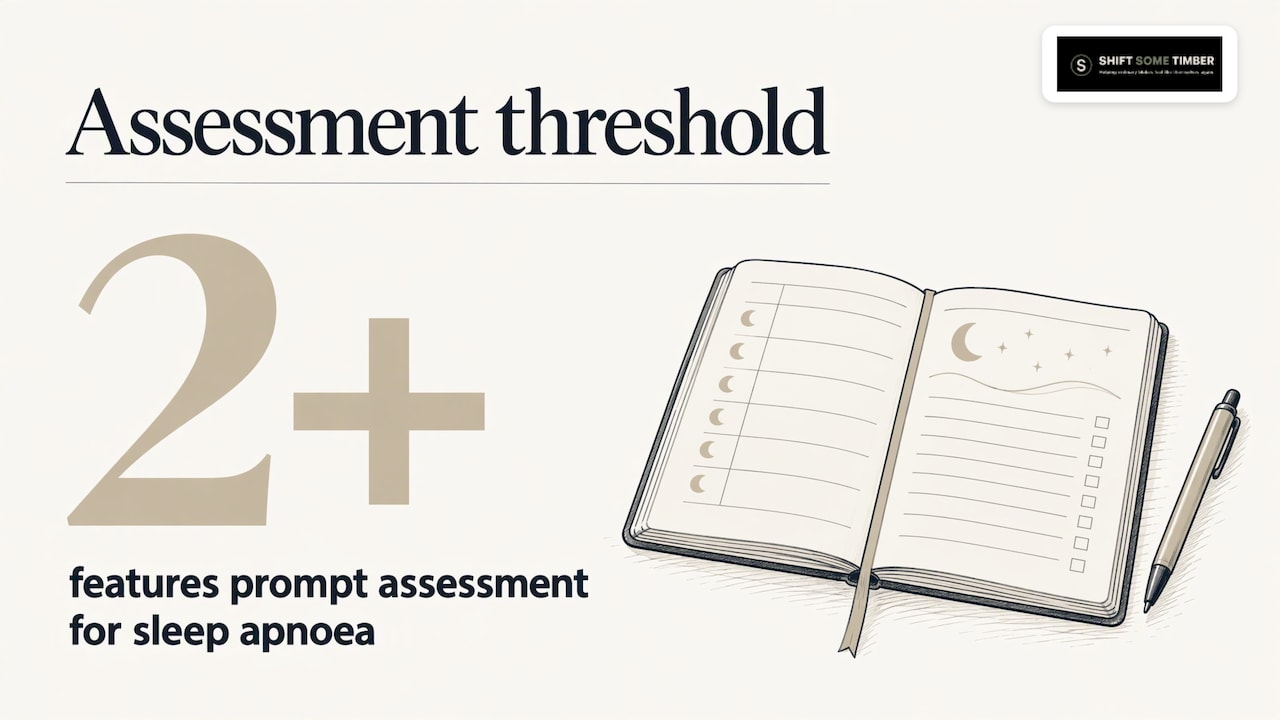
These are the same things your GP will look for. NICE guidance says healthcare professionals should take a sleep history and assess for obstructive sleep apnoea/hypopnoea syndrome in people with two or more features. These include snoring, witnessed pauses in breathing, unrefreshing sleep, waking headaches, unexplained excessive tiredness, needing the loo at night, choking in sleep and trouble concentrating. Your diary can show several of these at once.
Driving and sleepiness
If you feel sleepy, don't drive. The NHS says that if sleep apnoea with excessive sleepiness has been confirmed, you must not drive until symptoms are under control, and you may need to tell the DVLA. If you have nearly nodded off at the wheel, tell your GP at the first opportunity, and don't wait for the diary to be finished.
What happens at the appointment
Here is how to get the most from ten minutes.
- Bring the diary, or photos of the pages on your phone.
- Start with your main worry in one sentence: "I snore loudly, my partner has seen me stop breathing, and I'm shattered by 3pm."
- Point to two or three entries that show it.
- Mention any medicines, alcohol and caffeine habits honestly. Nobody is judging.
- Ask what the next step is.
NHS inform says your GP will usually ask about your symptoms, may check your blood pressure and take a blood sample to rule out other conditions such as hypothyroidism or anaemia. The next step is usually an assessment through the night, a sleep study, which can be done at home with monitoring equipment or at a clinic.
Your GP may also ask you to fill in the Epworth Sleepiness Scale, a short questionnaire about how likely you are to doze off in everyday situations. NICE recommends using it in the first assessment, but says it should not be used alone to decide on referral, because not everyone with sleep apnoea is very sleepy. That is another reason the whole picture in your diary matters, not just one score.
Your own GP or prescriber makes individual decisions about tests and treatment. Nothing in a diary, or in this article, replaces that.
Other things your diary may point to
Snoring and tiredness don't always come from the same cause. A diary can nudge you towards other sensible conversations with your GP.
- Weight and sleep. Carrying extra weight around the neck and middle can go along with snoring and poor sleep. Our guide to sleep apnoea, snoring and weight in men explains the link in plain English. We can't promise that losing weight will fix snoring, and it is one thing to discuss with your GP.
- Low mood or winter tiredness. If the diary shows low mood alongside tired days, see our piece on low mood when the clocks go back.
- Energy and testosterone. Tiredness has many causes. Our page on low testosterone symptoms explains what to check, and a GP can look at the whole picture.
- Shift work. If your rota changes week to week, mark each shift in the diary. Irregular patterns are one of the first things a GP will want to rule in or out.
If you aren't sure where to start with your health in general, which health check a man should get first is a good next read.
Small things to try while you keep the diary
These are everyday habits, not treatments. Change one at a time so you can see what the diary shows.
- Keep a steady wake-up time, including weekends, for a week.
- Move your last coffee earlier, and note the effect.
- Notice how alcohol in the evening shows up in your notes the next morning.
- Get outside for a walk after tea. A short, easy walk is a gentle start if you've been inactive.
- Wind down for twenty minutes before bed without a screen, if you can.
Our sleep calculator and guide can help you work out a bedtime to match your wake-up time. Our article on sleep and weight covers how poor sleep and appetite can feed each other. If your tiredness goes with stress, the breathing exercises for stress page is a calm place to begin.
The British Snoring & Sleep Apnoea Association is a not-for-profit organisation for snorers and their bed partners. UHBW NHS lists it as a source of support.
Support that fits around the diary
A week of notes can bring up other questions: what to eat when you're tired, how to move more without overdoing it, how to keep track of it all. That is where we come in.
My Timber is free. It brings together daily check-ins, progress tracking, SHIFT Grub for realistic food, SHIFT Fit for approachable walking and strength, and Life Back for the things that matter beyond the scales. You can use it alongside your own clinic or prescriber, after treatment ends, or without treatment. You don't need a prescription transfer or a purchase. Take a look at the Shift Some Timber home page to see what's there.
SHIFT doesn't currently offer clinical assessment, prescribing or dispensing. For sleep concerns or treatment questions, your GP or own prescriber is the right person.
Your one next step: tonight, put a notebook by the bed and ask your partner to jot down anything they notice. Tomorrow morning, fill in just four things: bedtime, wake time, tiredness score and what they saw.
FAQ
Can a sleep diary tell me if I have sleep apnoea?
No. A diary can't diagnose anything. It records your pattern and what others notice, which helps your GP decide on next steps. NHS inform says the usual next step is an overnight sleep study.
I don't have a partner. Can I still do this?
Yes. Fill in the rest of the diary and mention that nobody has seen you sleep. If a friend or relative stays over, ask them to note anything they notice. Also tell your GP about waking choking or with a dry mouth or headache.
Is a week enough, or do I need two?
A week is a fair start. NHS services suggest a couple of weeks if you have daytime sleepiness. If you are worried about breathing pauses, gasping or near misses while driving, see your GP sooner and bring what you have.
Will losing weight stop my snoring?
We can't promise that. Weight is one of several things that can affect sleep and snoring, and your GP can look at the whole picture. Our Sleep & apnoea pathway explains the topic in plain English.
Should I buy an anti-snoring product first?
It is better to speak to your GP first, especially if you have gasping, pauses in breathing or heavy tiredness. Snoring and tiredness can have more than one cause, and a diary gives your GP a clear starting point.
Sources
- What are sleep disorders? East Sussex Healthcare NHS Trust
- Sleeping well, UHBW NHS guide
- Sleep diary, NCMH
- Sleep Disordered Breathing, NHS Lothian RefHelp
- Obstructive sleep apnoea (OSA), NHS inform
- Sleep apnoea, NHS
- Obstructive sleep apnoea/hypopnoea syndrome, NICE NG202
- Snoring, choking, pauses in breathing, Royal Papworth Hospital
- Sleep therapy for insomnia
- British Snoring & Sleep Apnoea Association
Recommended
SHIFT provides general UK health information and practical support. Speak to your GP or your own prescriber about symptoms, test results or medicines. My Timber is free to use alongside your own clinic, after treatment ends or without treatment.
Last updated .