
Weight Loss Treatment Handover Checklist for UK Men

If you are changing provider, or your clinic has gone quiet, the safest handover is a one-page record you build yourself: your contact attempts, your prescription and dispensing history, the side effects you have had and the questions you want answered. Take it to your new provider or GP, who makes every medicine decision. NICE guidance says records should be kept up to date and shared between providers, if possible and with your permission. Having your own copy makes that easier.
This page gives you the checklist, explains each line, and covers what carries on while the handover is sorted. We are the SHIFT Team. We do not currently provide clinical assessment, prescribing or dispensing, so every treatment question goes to your own prescriber.
TL;DR
- Build a one-page record: who you contacted and when, what was prescribed and dispensed, side effects, and your questions.
- Ask your GP or new provider to record the treatment on your notes so all clinicians can see it.
- Keep medicine decisions with your prescriber. Do not change or stop anything on your own.
- Food, movement and check-ins can carry on during any gap. My Timber is free and works alongside any provider, after treatment, or without treatment.
- Your next step: fill in section 1 of the checklist today.
Table of Contents
- Why a handover needs your own paperwork
- The one-page checklist
- A worked example
- Who is responsible for what
- If the transfer is delayed
- Keep the everyday habits going
- Where My Timber fits
- FAQ
- Sources
Why a handover needs your own paperwork
A handover is when your care moves from one provider to another. It might be a clinic closing, a switch for cost or convenience, a move back to your GP, or a gap that nobody has explained.
Things get lost in that move. NICE recommends that the outcome of any weight discussion is recorded so later professionals know what was raised, your views and actions already taken. It also says professionals should discuss any previous or ongoing attempts at weight management with you, to keep care continuous and avoid duplication.
If you started treatment privately, your GP may not hold the full picture. A local NHS policy says it is crucial that GP practices accurately record medicines prescribed elsewhere, so clinicians know about ongoing treatment and clinical risk is reduced. Your checklist gives them what they need to do that.
The one-page checklist
Copy this into a note on your phone or print it. Fill in what you can. Gaps are fine: you are not being tested.
1. Contact attempts
- Date and method of each attempt (phone, email, app message, portal).
- Who you spoke to, or that nobody replied.
- What you asked for, such as a review, a repeat request or your records.
- Any reply you were promised and the date it was due.
Keep screenshots of messages. A dated list shows your new provider or GP what happened without you having to remember it all.
2. Prescription and dispensing history
- Name of the medicine and brand, as on the box or label.
- Name of the prescriber and the service they worked for.
- Name and address of the dispensing pharmacy.
- Date of each supply, and the date of your last injection or dose.
- The dose and any changes, copied from your labels or records. Do not guess.
For context on why this matters, NICE sets out a starting dose, a stepped increase and maintenance doses for tirzepatide. Your new prescriber needs to know exactly where you are on that path. That is their decision, not one to make yourself.
3. Side effects and how you have been
- Common effects you have had. The NHS lists nausea, vomiting, constipation, diarrhoea, tiredness and skin reactions at the injection site as examples.
- Anything that worried you, and when it happened.
- Any signs of dehydration, such as vomiting or diarrhoea that would not settle. The MHRA warns that common stomach side effects affect more than 1 in 10 people and can lead to severe dehydration and hospital admission.
- Difficulty with injections, appetite, eating enough, energy or mood.
If you feel seriously unwell, do not wait for a handover. Contact your GP, call NHS 111, or call 999 in an emergency.
4. Measurements and tests
- Starting weight and recent weights, with dates.
- Height, BMI and target weight if you were given one.
- Blood pressure readings.
- Any blood test results, such as lipids or HbA1c.
- Whether you have type 2 diabetes or other conditions, and all other medicines you take.
This mirrors what one NHS area asks for before starting tirzepatide: recent body weight, BMI, lipid profile, blood pressure, and HbA1c if you have type 2 diabetes. Local requirements vary, so your new provider will tell you what they need.
5. Questions for the new provider or GP
- Will you take over prescribing, or should I go to someone else?
- How will you record my treatment so everyone involved can see it?
- Who is responsible for reviews, and how often are they?
- What should I do if a dose is late or I run out?
- Who do I contact if I have side effects between appointments?
- What food and activity support is available alongside treatment?
Our weight-management review questions page gives you more prompts to take into an appointment.
A worked example
Dave, 46, is a delivery driver. This is an illustration, not a real person. His private clinic stopped answering messages three weeks before his next supply was due.
He writes down four message attempts with dates. He photographs his last two pharmacy labels. He notes that nausea was worst after each dose increase, and that his last recorded weight was in the clinic app. He books a GP appointment and brings the page.
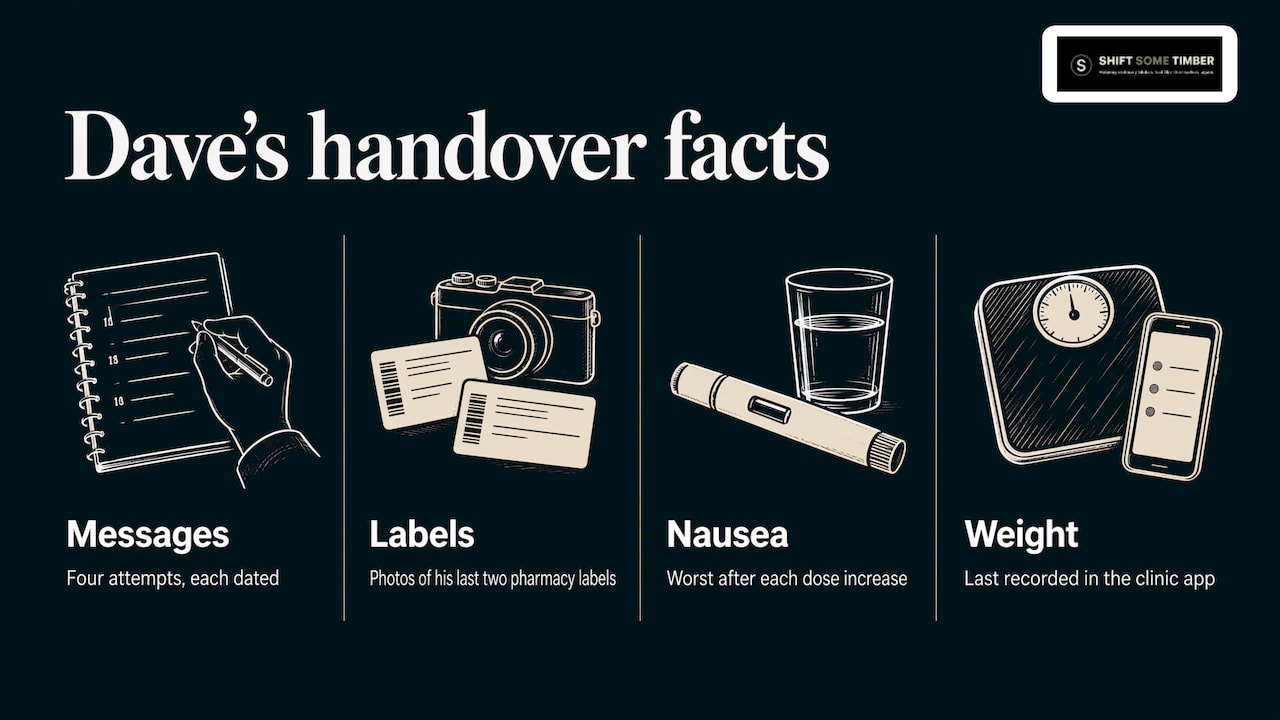
The GP can see what was supplied, when, and what he experienced. Whether Dave continues, pauses or changes treatment is a prescriber decision made in that appointment. Dave's job was only to arrive with the facts.
Who is responsible for what
The split is simple.
- Your prescriber decides about starting, continuing, changing or stopping a medicine, and about doses.
- Your GP holds your wider record and can see other conditions and medicines.
- You keep the checklist current and tell each professional what is going on.
Which service prescribes depends on the medicine. NICE says tirzepatide can be prescribed in primary care or a specialist service, while semaglutide is prescribed in a specialist service. Our comparison of GP and specialist weight-management services explains the difference in plain English. Our NHS weight-loss medication guide covers access routes.
Expect reviews to be regular. One NHS area's specification describes monthly appointments during titration and structured reviews for at least the first 12 months. Another says clinicians should record injection difficulties, adverse effects, micronutrient concerns and pregnancy plans. Arrangements differ by area, so ask what applies to you.
If the transfer is delayed
- Write down the dates you have chased and keep the proof.
- Ask the previous service for your records and supply history in writing.
- Tell your GP what you have been taking and when you last had it.
- Ask your GP or new prescriber what to do about any gap. Do not adjust, stretch or restart a dose on your own.
- Be careful where you get medicine. The MHRA says GLP-1 medicines are prescription-only and that you should be warned about falsified products if they are not prescribed by a registered healthcare professional.
If you stop treatment, NICE says you should get support to keep the weight off. People stopping weight-management medicines should be offered advice and support, and the NICE news item says teams should monitor people for at least a year after treatment. Our piece on why follow-up belongs in the plan goes further.
Keep the everyday habits going
A gap in appointments does not need to be a gap in routine. NICE says all weight-management medicines should be used alongside a reduced-calorie diet and increased physical activity, and that people stopping them should be offered support to maintain weight loss.
Food
Keep meals simple and repeatable: a protein source, vegetables and a sensible carbohydrate. Our recipes are built around UK supermarkets and budgets, and the nutrition guide for men covers protein, calories and meal planning. SHIFT Grub is the food part of My Timber.

Movement
Start with walking you can repeat, then add two short strength sessions a week at home. See exercise guides and our walking, strength and mobility guide. SHIFT Fit is the movement part of My Timber.
Sleep, mood and life beyond the scales
Poor sleep and low mood make routines harder. Life Back helps you track things that matter beyond the scales, and SHIFT Health has plain-English information on sleep, energy and wellbeing.
Blood pressure, blood tests, heart and metabolic health
Bring any readings to your GP and note the dates. Our SHIFT Health pages explain blood pressure, blood tests and metabolic and heart health, so you can ask better questions. Testosterone and fertility education is there too. Individual results and decisions stay with your GP.
Where My Timber fits
My Timber is free. It gives you Today and Journey check-ins, progress tracking, SHIFT Grub, SHIFT Fit, Life Back and Ask Timber for non-clinical support. You can use it alongside your own clinic or prescriber, after treatment ends, or without treatment. You do not need to transfer a prescription or buy anything. Find out more on our weight loss support for men page.
One step for today: open a note, copy the five headings above and add the first thing you remember.
FAQ
Can SHIFT take over my treatment?
No. Clinical assessment, prescribing and dispensing through SHIFT are currently closed. Your own prescriber or GP handles individual treatment decisions. My Timber is free practical support alongside them.
What should I bring to my GP?
Bring your one-page checklist, photos of medicine labels, your dated contact attempts, recent weights and blood pressure readings, and your questions. NICE says records should be shared between providers with permission, so say you are happy for your GP to see them.
Do I need My Timber to be on treatment?
No. It works with any provider, after treatment, or if you have never had treatment. No prescription transfer or purchase is needed.
What if I have stopped treatment and feel I am slipping?
Tell your GP, and lean on routines: regular meals, walking and check-ins. NICE expects monitoring and extra support after treatment ends, so ask what is on offer locally.
Sources
- NICE NG246: Overweight and obesity management
- NICE NG246: General principles of care
- NICE CKS: Obesity management
- NICE TA1026 prescribing guide
- MHRA Drug Safety Update, 24 October 2024
- NHS medicines information
- Nottingham and Nottinghamshire ICB policy, June 2025
- Coventry and Warwickshire tirzepatide checklist
- NHS Surrey Heartlands tirzepatide specification, 2025
- Derbyshire tirzepatide guideline, September 2025
- NICE QS212 Quality statement 7
- NICE news, 5 August 2025
Recommended
- Weight Loss for Men UK: Getting Started & Support
- Weight-Loss Tablets for Men UK | Daily Pill Options
- Weight Loss Maintenance Plan: A Practical Guide for UK Men
- Weight-Loss Injections for Men UK | Mounjaro & Wegovy
SHIFT provides general UK health information and practical support. Speak to your GP or your own prescriber about symptoms, test results or medicines. My Timber is free to use alongside your own clinic, after treatment ends or without treatment.
Last updated .