Weight Loss Maintenance Plan: A Practical Guide for UK Men
A weight loss maintenance plan is a set of habits, checks and back-up options that keep the weight off once you've lost it. It has five parts: regular eating with protein, strength and general movement, sleep and stress, tracking, and a plan for wobbles. Keep the plan simple enough to run on a busy week, and keep some support in place for at least a year. That is what NICE recommends after treatment ends.
This guide is written for men who have lost weight, with or without medication, and want to hold on to it. It's also for men who are close to their goal and wondering what comes next.
TL;DR
- Maintenance is a phase with its own plan. It isn't "going back to normal". NICE says people finishing treatment should get regular feedback and monitoring for at least a year.
- Core habits: protein at meals, plenty of fibre, regular eating, strength work twice a week, enough sleep.
- Weigh yourself regularly and set a trigger point. When you hit it, act early rather than waiting.
- Plan for meals out, holidays and busy weeks using simple if-then rules.
- If you're on or coming off GLP-1 medicine, speak to your prescriber before changing anything. Research shows regain is common after stopping, so support matters.
Table of Contents
- What weight loss maintenance actually means
- Why keeping weight off is harder than losing it
- Your maintenance plan in six steps
- Planning for meals out, celebrations and busy weeks
- Tracking progress beyond the scales
- If you're on GLP-1 medicine or thinking of stopping
- Our perspective: maintenance is where most men are left on their own
- How SHIFT supports you after the weight comes off
- FAQ
- Sources
What weight loss maintenance actually means
Maintenance starts when losing weight stops being the main job and keeping it off takes over. For some men that's a goal weight. For others it's the end of a course of treatment, or the point where the scales stop moving and life gets in the way.
Nobody gets a bell and a certificate. What changes is the target. You're no longer trying to create a gap between what you eat and what you burn. You're aiming for a steady weight, with food and activity you can keep up for years.
The support should not stop either. NICE says people who stop weight-management medicines or finish a behavioural programme should receive advice and support to maintain their changes, with regular feedback and monitoring for at least one year. If nobody has offered you that, ask for it, or build it yourself using the steps below.
Why keeping weight off is harder than losing it
If you've put weight back on before, it isn't a character flaw. A major peer-reviewed review by Hall and Kahan explains that biological, behavioural and environmental factors commonly drive a pattern of weight loss, plateau and regain. Your appetite, your routine and your surroundings all pull in the same direction.
In practice, for most men it looks like this:
- The early motivation fades and the new routine starts to feel like effort.
- A busy spell at work or a family stretch pushes out the gym, the meal prep and the sleep.
- Hunger and food thoughts creep back.
- A few weeks of small slips go unnoticed because you've stopped weighing in.
The fix isn't more willpower. It's a plan that expects these things and has an answer ready.
Your maintenance plan in six steps
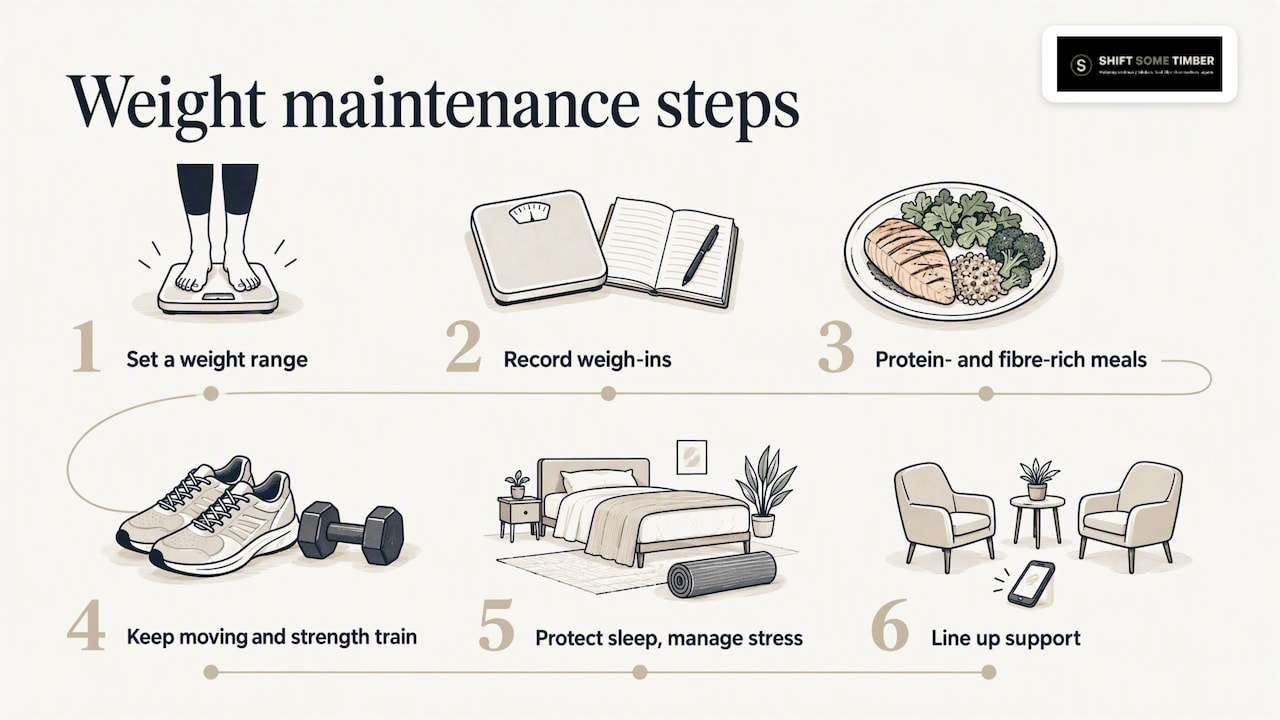
1. Set a maintenance range, not a single number
Body weight moves by a kilo or two over a week from fluid, food in the gut and salt. Pick a range, for example three kilos wide, that you're happy to live in. Your range is your goal. Your trigger point is the top of it.
2. Weigh in regularly and write it down
The Hall and Kahan review lists frequent self-monitoring and self-weighing among the behaviours linked with long-term maintenance. Pick a day and a time, for instance Saturday morning before breakfast. Record it in a note, a spreadsheet or My Timber. The number is information, not a verdict.
The same review points to using thresholds to signal when to re-engage support or use contingency strategies. So decide now: if you're above the top of your range two weeks running, you go back to the tighter routine from step 3 and book a check-in.
3. Build meals around protein and fibre
The British Dietetic Association's guidance on weight-loss medicines advises a mix of healthy foods, regular eating, protein at meals, high-fibre foods and 1.5 to 2 litres of fluid a day. That is sensible advice whether or not you take medication.
In plain terms:
- Breakfast: eggs, Greek yoghurt or porridge with something protein-rich alongside. The Hall and Kahan review lists eating breakfast among maintenance behaviours.
- Lunch and dinner: a palm-sized portion of meat, fish, eggs, beans or tofu, plus vegetables, plus a smart carbohydrate such as potatoes, wholegrain bread or rice.
- Snacks: have a default you don't have to think about, such as fruit, nuts in a measured handful, or a protein yoghurt.
- Cooking at home: the same review lists eating more meals at home and portion-controlled meals. That doesn't mean never eating out. It means home is the default.
If you want ideas that suit a working week, our Grub tools are built for exactly this.
4. Keep moving, and lift something twice a week
The UK Chief Medical Officers' guidance says adults should accumulate at least 150 minutes of moderate activity or 75 minutes of vigorous activity a week, do muscle-strengthening activity on at least two days, and minimise sedentary time. The same guidance says activity supports the prevention of weight regain.
A realistic week for a man with a job and a family could be:
- Two 30 to 40 minute strength sessions: squats, rows, presses and carries, at home or in a gym.
- A brisk 30 minute walk on three or four days, including a lunchtime or after-dinner walk.
- One longer, more enjoyable session at the weekend: football, cycling, a hike, swimming with the kids.
That adds up to roughly the 150 minutes without needing to be a gym person. If you're newer to strength work, our guide to GLP-1 and exercise: strength, movement and safety covers starting safely, and the principles apply whether or not you're on medication.
Strength work matters more than most men expect. The BDA says eating less can reduce muscle as well as body fat, which is why protein with each meal and strength activity are advised together. Muscle helps with strength, everyday function and how you feel in your body.

5. Protect your sleep and manage stress
The BDA guidance also lists getting enough sleep, managing stress and limiting recreational screen time as part of building healthy habits. These aren't extras. Short nights and a stressful week make snacking and skipping workouts far more likely.
Pick one change. A fixed bedtime that gives you a proper night's sleep, phone out of the bedroom, or a 10 minute walk to decompress after work. Small and repeatable beats ambitious and abandoned.
6. Line up your support before you need it
NICE says long-term programmes should foster independence and self-management, encourage sustainable eating and activity, discuss obstacles, encourage family-based changes and identify ongoing support. That support can be programmes, online resources, groups, local services, family or friends.
Tell one person what your range and trigger point are. Ask your partner or a mate to be the one who notices. And save the details of whoever you'd contact if the scales climb.
Planning for meals out, celebrations and busy weeks
The riskiest moments are predictable: birthdays, stag dos, holidays, away days with work, the week the kids are ill. NICE advises using a well-rehearsed if-then action plan, thinking about changes to your immediate environment, seeking social support and building manageable routines.
Here are some if-then rules you can steal and adapt:
- If I'm eating out, then I look at the menu beforehand and pick a protein-based main.
- If there's a big meal tonight, then I eat normally earlier in the day rather than skipping meals and arriving starving.
- If I miss a training session, then I walk for 20 minutes that day and do the session the next.
- If I'm travelling, then I pack protein snacks and book a hotel with a gym or plan a walk each day.
- If I'm above my trigger weight two weeks running, then I go back to weighing daily for a fortnight and book a check-in.
Environment matters too. If the biscuit tin is the problem, move it or stop buying the big packs. If the evening sofa session is the problem, put your trainers by the door and your walk before dinner.
The Hall and Kahan review says good maintenance support should anticipate difficult periods, prepare contingency plans, reduce behavioural fatigue and put lapses into perspective rather than treating them as failure. One bad weekend doesn't undo months of work. Three bad months with no checks might. So the rule is simple: get back to the plan at the next meal, not next Monday.
Tracking progress beyond the scales
Weight is useful but narrow. The BDA says longer-term goals can include strength, movement, playing with children or grandchildren, sleep and feeling calmer, so maintenance should track wider health and life improvements, not weight alone.
A monthly check-in could cover:
| What to track | How | Why it helps |
|---|---|---|
| Weight | Weekly weigh-in, same conditions | Early warning when you pass your trigger point |
| Strength | Weights lifted or reps in two or three key exercises | Shows you're keeping muscle |
| Energy and sleep | Score out of 10 | Often improves before the scales do |
| Everyday life | Stairs, playing with the kids, clothes fit | The reason you started |
| Food habits | How many days you hit protein and veg targets | Tracks the behaviour, not just the result |
My Timber is our check-in and progress-tracking tool, and our Life Back goals help you decide what you want your life to look like beyond a number. You can read how we handle your data on our Progress Centre methodology and privacy page.
If you're on GLP-1 medicine or thinking of stopping
Maintenance looks different if you take a medicine such as semaglutide or tirzepatide. The decision about dose, duration and stopping belongs to you and your prescriber. Don't change or stop a prescribed medicine on your own.
What the evidence says:
- NICE says weight-management medicines should be used alongside a reduced-calorie diet and increased physical activity. So the habits in this article are part of treatment, not an alternative to it.
- For tirzepatide, NICE's practical guide says it could be long-term if weight loss is achieved, with a review after six months on the highest tolerated dose, and continued diet and activity support if you stop.
- Stopping carries a real risk of regain. In the STEP 1 extension study, which included UK participants, people lost a mean 17.3% of body weight on semaglutide over 68 weeks, then regained 11.6 percentage points after withdrawal by week 120, leaving a net loss of 5.6%. The researchers also reported that about two-thirds of the prior loss came back within a year, and most heart and metabolic improvements moved back towards baseline.
None of that means you can never stop. It means stopping should be planned, with your prescriber, and with your food, strength work and check-ins already in place. The UK CMO guidance says strengthening activity is likely to be especially important for preserving muscle and preventing regain in people taking or recently taking GLP-1 agonists.
If you want to go deeper, these guides from us may help:
- Stopping GLP-1 treatment: weight regain and appetite
- After stopping semaglutide: research, reviews and practical support
- Preventing muscle loss on GLP-1 treatment
- What a GLP-1 weight loss plateau means
If you're weighing lifestyle on its own against medication, our comparison of lifestyle alone vs weight-loss medication sets out the differences.
Our perspective: maintenance is where most men are left on their own
We started SHIFT because the support for men tends to thin out right when it matters. The first few months get attention. Then you're on your own with the same fridge, the same job and the same stresses that were there before.
We think maintenance needs to be treated as part of the journey, not the bit after it. That's why men are welcome with us before, during and after treatment, including men who started elsewhere, who have stopped medication, or who want support without medication at all.
We also think the scales are too small a measure. The men we want to help care about energy, confidence, playing football with their kids and not dreading a photo. If you only track kilos, a flat month feels like failure. If you track your life, you see what's working.
Our advice is plain: keep the plan boring, keep checking in, and don't wait until you've regained a stone to ask for help.
— Matt O’Brien
How SHIFT supports you after the weight comes off
The Programme brings together practical food ideas (Grub), achievable movement (Fit), meaningful personal goals (Life Back) and check-ins and progress tracking (My Timber). It fits around work and family, and it's private and judgement-free. Treatment assessment, prescribing and dispensing are handled by appropriately regulated partners, with ongoing support from us whichever route you take.
If you want a structured start or a steadier finish, see our weight loss for men service and how to get started. If you prefer to read first, our lifestyle and behaviour change page and evidence-based weight management starting plan are good places to begin.
FAQ
How long should I follow a maintenance plan?
Plan on it being permanent in spirit, with the structure loosening as habits settle. NICE says people finishing treatment or a behavioural programme should get regular feedback and monitoring for at least a year. After that, keep your weekly weigh-in and trigger point, as they cost almost nothing.
How much exercise do I need to keep weight off?
The UK Chief Medical Officers advise at least 150 minutes of moderate activity or 75 minutes of vigorous activity a week, plus muscle-strengthening on at least two days. Their guidance also says activity supports preventing regain. If you're starting from a low base, build up gradually and speak to your GP if you have a health condition or concerns.
Will I put the weight back on if I stop GLP-1 medication?
Many people do regain some. In the STEP 1 extension, participants regained about two-thirds of their previous loss within a year of stopping semaglutide. That is an average, so your result may differ. Talk to your prescriber about a planned approach and keep your food, strength and check-in routines going.
What should I do if my weight starts creeping up?
Act at your trigger point, not after months of drift. Go back to weighing more often, tighten up protein and meal regularity, and get your strength sessions back in. Treat it as a lapse to learn from, not a failure, and contact your support or prescriber if it continues.
Do I need to count calories forever?
Not necessarily. The research links maintenance with behaviours such as self-monitoring, regular meals, protein, breakfast and more home cooking. Many men use tracking for a short stretch to recalibrate, then rely on habits and the scales. If you have a history of disordered eating, speak to your GP before tracking food closely.
Sources
- NICE Quality statement 7: advice and support after stopping medicines for weight management or completing a behavioural intervention
- Hall and Kahan: maintenance of lost weight and long-term management of obesity
- British Dietetic Association: medications for obesity
- UK Chief Medical Officers' physical activity guidelines
- NICE: diet, physical activity and behavioural approaches
- NICE: prescribing, reviewing and stopping tirzepatide
- STEP 1 extension: weight regain and cardiometabolic effects after withdrawal of semaglutide
Recommended
- Lose Weight With a Men’s Diet: UK 1,800 Calorie Plans That Last
- Weight Loss for Men Over 50: A Realistic UK Guide
- Men's Fat Loss Workouts: A Realistic Weekly Plan
- High Protein Meals for Weight Loss: A Practical UK Guide
Last updated .