Batch Cooking for Dads: A Sunday Plan With Three UK Meals
The simplest way to batch cook as a dad is to pick three meals that share ingredients, cook them in one Sunday session of about two hours, and portion everything the same day. Some portions go in the fridge for the first couple of days. The rest go straight in the freezer. Below is a worked example using ordinary supermarket food, one shopping list that bends to your budget, and the safe cooling, freezing and reheating rules from the Food Standards Agency.
You don't need to be a good cook. You need a plan, a few tubs and a bit of space on the hob.
TL;DR
- Cook three meals on Sunday: a beef and lentil Bolognese, a one-tray chicken thigh bake and a bean and veg chilli. Between them they cover about 12 to 15 portions.
- Use one shopping list built on shared staples, and swap items to fit your budget or your family's tastes.
- Cool food within one to two hours, keep the fridge between 0 and 5°C, eat leftovers within two days and freeze the rest straight away.
- Defrost in the fridge, use within 24 hours, and reheat until steaming hot throughout.
- Build each plate around protein and vegetables. Your GP or prescriber handles individual diet or treatment questions.
Table of Contents
- Why batch cooking suits dads
- The three meals
- One flexible shopping list
- Your Sunday session, step by step
- Portions that don't need a separate meal for everyone
- Cooling, storing, freezing and reheating safely
- What the week looks like
- Leftover ideas so it doesn't get boring
- Making it stick
- Free support that fits around your week
- Your next step
- FAQ
- Sources
Why batch cooking suits dads
Weekday evenings are the problem. You get home, the kids are hungry, and the easiest option is whatever takes ten minutes. Batch cooking moves the effort to one slot when you already have the time, so a decent meal is waiting on a Wednesday when you don't.
The British Dietetic Association says batch cooking can save time and money by making larger quantities and storing portions in the fridge or freezer. It also points out that you should choose portion sizes for the people actually eating, from toddlers to teenagers. That matters in a family kitchen: a portion for you is not a portion for a five-year-old.
Safefood describes a few ways to do it. You can double or triple a meal and freeze the extra, or you can cook slow ingredients such as potatoes, rice, lentils and beans in bulk and assemble meals later. Our plan uses the first approach, with a little of the second.
If you want the general principles first, our guide to meal prep for busy blokes covers them. This article is the specific version: three named meals, one list, one afternoon.
The three meals
We picked these because they use cheap, common ingredients, freeze well and give each plate a good amount of protein. Good Food lists stews, ragù, Bolognese and vegetable chilli among its family batch-cooking options, so none of this is unusual cooking.
Meal 1: beef and lentil Bolognese
Brown the mince with onion and garlic, add tinned tomatoes, a tin or a cup of cooked lentils, and a spoonful of tomato purée. Simmer for 30 minutes. The lentils stretch the meat and add protein and fibre.
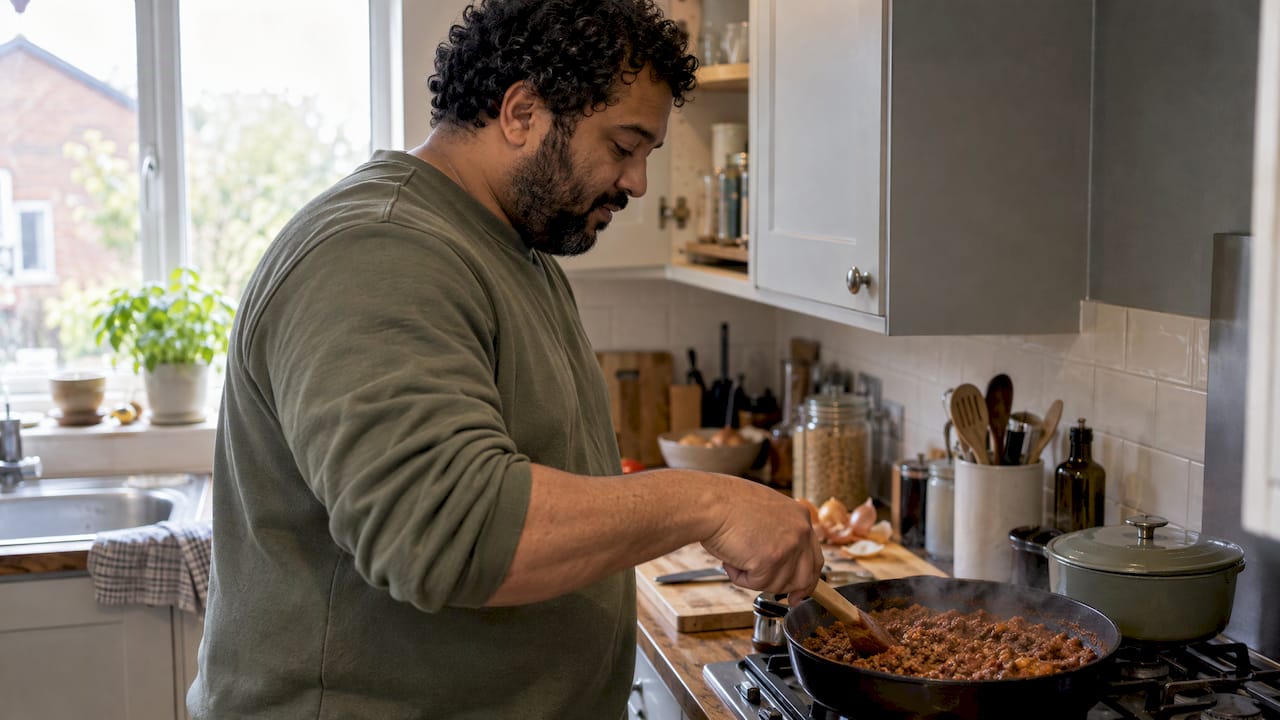
This is the workhorse. One big pan makes 6 to 8 portions and it turns into several different dinners (see the leftover ideas below). Safefood's budget advice is to buy staples that work across several dishes, with mince for Bolognese, lasagne, shepherd's pie and burgers as its example. That is exactly how this pan is used.
Meal 2: one-tray chicken thighs with sweet potato and green beans
Put skin-on or skinless chicken thighs on a large tray with cubed sweet potato, a little oil and some paprika or garlic. Roast, adding the green beans for the last 10 to 15 minutes. Check the chicken is cooked through with no pink meat and the juices run clear.
This one costs you almost no attention. It sits in the oven while you do everything else.
Meal 3: bean and veg chilli with rice
Soften onion and peppers, add chilli powder or a mild spice mix, tinned tomatoes, kidney beans, black beans and whatever veg is in the fridge. Simmer for 25 minutes. Cook the rice separately and cool it fast (more on that below).
The chilli is your meat-free meal. Beans and pulses are a recognised protein source, and this keeps the week from being all mince and chicken.
One flexible shopping list
This list makes the three meals above. Everything is available in the big UK supermarkets, and every line has a swap.
| Item | Rough amount | Used in | Easy swap |
|---|---|---|---|
| Beef mince (5% or 10% fat) | 1 kg | Bolognese | Turkey mince, or half mince and extra lentils |
| Chicken thighs | 8 to 10 | Tray bake | Chicken drumsticks or legs |
| Dried or tinned green or brown lentils | 2 tins or 250 g dried | Bolognese, chilli | Tinned chickpeas |
| Tinned chopped tomatoes | 5 tins | Bolognese, chilli | Passata |
| Kidney beans and black beans | 3 tins | Chilli | Any tinned beans |
| Sweet potatoes | 3 to 4 large | Tray bake | White potatoes |
| Green beans, frozen or fresh | 400 g | Tray bake | Broccoli |
| Onions, garlic, peppers | 4 onions, 1 bulb, 3 peppers | All three | Frozen sliced peppers and onions |
| Carrots and courgettes | 3 carrots, 2 courgettes | Grate into Bolognese and chilli | Any veg you have |
| Rice and dried pasta | 500 g each | Sides | Wholewheat versions, or potatoes |
| Spices, tomato purée, oil | Store cupboard | All three | Whatever you already own |
A few ways to keep the bill down. Own-brand tins and frozen veg are fine. Check what's in the cupboard first. Safefood also advises avoiding bulk-buying food you won't use, so if your family won't eat chilli, swap it for a second tray bake rather than buying beans that sit there for months. Our healthy meals on a budget guide has more ways to trim the shop.
Your Sunday session, step by step
Allow about two hours, including washing up. Put a podcast on. Nobody is marking you.
- Clear the decks (10 minutes). Empty the dishwasher, find your tubs and lids, and get a pen and masking tape for labels.
- Chicken tray into the oven (15 minutes). Chop the sweet potato, season the thighs and get the tray in. Set a timer.
- Start the Bolognese (25 minutes active). Brown the mince, soften the onion, add tomatoes and lentils, and leave it to simmer. Grate in a carrot and a courgette if you want extra veg that nobody will notice.
- Make the chilli (20 minutes active). Use a second pan. Once it's simmering, you have two pans bubbling and an oven working.
- Add the green beans and cook the rice. Beans go on the tray for the last 10 to 15 minutes. Cook a big pan of rice, or skip it and use microwave pouches on the night.
- Cool and portion (30 minutes). This is the step that matters for safety. Details follow.
- Label and store. Write the meal name and the date on each tub. Fridge or freezer, decided before you sit down.
The Dad Army plan splits things differently, with a 90-minute cook on Sunday and a shorter 60-minute one on Wednesday. If a two-hour block is too much, that's a fair alternative: do the Bolognese and chilli on Sunday and the tray bake midweek.
Portions that don't need a separate meal for everyone
You are cooking for a family, so aim for one meal that works for everyone. Serve it in parts. Put the Bolognese, pasta and some veg on the table and let each person build a plate. The kids might skip the lentils' look and take extra pasta. You can take extra veg.
For your own plate, the NHS Better Health guide on healthy eating when trying to lose weight gives clear markers. It recommends protein at each meal, at least two portions of vegetables in a main meal, and keeping starchy foods to no more than a third of what you eat in a day. It also suggests smaller plates, measuring cooking fat and weighing rice or pasta before you cook it.
Royal Papworth NHS guidance offers a simple plate model: half vegetables, salad and fruit, a quarter starchy carbohydrate and a quarter lean protein-rich food. It uses a palm-sized piece of meat, or a hand-sized piece of poultry or fish, as a guide. You don't need scales for this. Your hand is always with you.
So when you portion the Bolognese, put a ladle of sauce in the tub and leave room for the pasta or a side of veg on the day. Cook the carbohydrate fresh or freeze it separately. It's easier to adjust your own plate that way.
The NHS also says vegetables are generally high in fibre and low in calories and can help you feel full. That's why the grated carrot and courgette go in the pan. If you want more on protein, our guides to high protein meals for weight loss and protein for men losing weight go into it.
How much you should eat is an individual question. If you have a health condition or take medication, your GP or prescriber is the person to ask.
Cooling, storing, freezing and reheating safely
This part is worth following closely. Cooked food left warm for too long is where problems start.
Cooling
The Food Standards Agency says not to put hot or warm food straight in the fridge. Cool it at room temperature and get it into the fridge within one to two hours. To cool it faster, divide it into smaller portions in shallow containers. So the tubs aren't just for storage: shallow tubs help your Bolognese cool quicker than one deep pan.
Fridge
The FSA says your fridge should be between 0 and 5°C and that you should eat leftovers within two days, or freeze them if that won't happen. North Somerset's food safety guidance gives the same two-day limit for cooked leftovers and says rice should be kept no more than 24 hours. Cool rice quickly and either eat it within a day or freeze it.
In practice, with a Sunday cook, the fridge covers Sunday night to Tuesday. Anything for Wednesday onwards goes in the freezer on Sunday.
Freezer
The FSA says your freezer should be around -18°C. Food Standards Scotland adds that you can freeze food before its use-by date and that freezing in smaller portions means you only reheat what you need.
The BDA advises cooling food completely before freezing, labelling it with name and date, and not refreezing food that has been frozen and thawed. You don't need fancy boxes either. The BDA says washed margarine or ice-cream tubs, foil boxes, plastic bags and cling film all work, as long as containers are microwave-safe if you plan to reheat in them.
Defrosting and reheating
Thaw in the fridge overnight rather than on the worktop. The FSA says to use food within 24 hours after it's fully defrosted, and Food Standards Scotland gives one to two days. We'd keep to the shorter limit. North Somerset's guidance says to reheat only once, until steaming hot throughout. Stir halfway if you use a microwave, so there are no cold spots.
Freezing small portions makes this easy. Take out only what you'll eat, and you won't be tempted to keep reheating the same tub.
A quick safety checklist
- Cooled and in the fridge within one to two hours of cooking
- Shallow tubs, not one deep pan
- Fridge between 0 and 5°C, freezer around -18°C
- Every tub labelled with name and date
- Rice in the fridge for no more than 24 hours
- Thawed in the fridge, eaten within 24 hours, reheated once until steaming hot
If you are cooking for anyone pregnant, elderly, very young or with a weakened immune system, or you're unsure about a specific food, check the NHS or FSA pages or ask your GP or pharmacist.
What the week looks like
Here is one way to spread twelve or so portions across the week. Adjust it to your own routine.
| Day | Dinner | Where it came from |
|---|---|---|
| Sunday | Chicken tray bake, fresh from the oven | Cooked today |
| Monday | Bolognese with pasta and a side of veg | Fridge |
| Tuesday | Chilli with rice | Fridge |
| Wednesday | Bolognese baked potato | Freezer, thawed overnight |
| Thursday | Chicken thighs with salad and wraps | Freezer, thawed overnight |
| Friday | Chilli-stuffed peppers or chilli on toast | Freezer, thawed overnight |
| Saturday | Free night: takeaway, pub or something fresh | No pressure |
Notice the free night. A plan you can break is a plan you keep. Our guide to eating out while losing weight can help with that Saturday.
Leftover ideas so it doesn't get boring
The same pan of Bolognese can become several things:
- Baked potato topper. Spoon it over a jacket potato with a handful of salad.
- Lasagne-style bake. Layer with pasta sheets and a simple white sauce, or just cheese on top.
- Cottage pie. Top with mash or sweet potato mash and bake.
- Stuffed peppers. Halve peppers, fill and bake.
The chilli works as:
- Burrito or wrap filling. Add grated cheese and shredded lettuce.
- Nachos for the weekend. Layer on a tray with cheese, then bake.
- Chilli on toast for a fast lunch.
- Soup. Add stock and blend for a thicker, smoother bowl.
The chicken thighs can be shredded into wraps, sliced over a salad, or stirred through rice with a little leftover veg.
Remember that reheating once is the rule. Turn a thawed portion into a new dish only if you cook it through until steaming hot and eat it, not reheat it again later. If you'd like more recipe ideas to rotate in, the SHIFT Grub recipe library is free to browse.
Making it stick
Most dads who give up on batch cooking do so because they try to do too much. Five identical boxes of chicken and rice is a short road to boredom. Start smaller.
- Week one: Double one meal you already cook and freeze half.
- Week two: Cook two meals in one session.
- Week three: Try the full three-meal Sunday.
If Sunday is chaos, pick another slot. Some dads cook while the kids are at football or swimming. The point is that the cooking happens when you're already home and the oven is already on.
If you're juggling this with a wider goal, our weight loss support for busy dads plan puts food in the context of work, family and sleep.
Free support that fits around your week
My Timber is our free practical support for men. It brings together check-ins, progress tracking, SHIFT Grub for realistic food, SHIFT Fit for walking and strength, and Ask Timber for non-clinical support. You can use it alongside your own clinic or prescriber, after treatment ends, or with no treatment at all. You don't need a prescription transfer or a purchase. Individual treatment decisions stay with your own prescriber.
See the free weight-loss support for men to find out what's included.
Your next step
Pick one thing. Write the shopping list tonight, or just choose which Sunday you'll try. If that's too much, buy a stack of tubs and double tomorrow's dinner. That counts.
FAQ
How long can I keep batch-cooked meals in the fridge?
The Food Standards Agency says to eat leftovers within two days, or freeze them if you think you won't manage that. Rice is stricter: North Somerset guidance says no more than 24 hours in the fridge. Keep your fridge between 0 and 5°C.
Can I freeze cooked meals and reheat them later?
Yes. Cool the food, portion it, label it with name and date and freeze it. Thaw it in the fridge, use it within 24 hours of defrosting and reheat it once until steaming hot throughout. Don't refreeze food that has already been frozen and thawed.
Do I need special containers?
No. The BDA says washed margarine or ice-cream tubs, foil boxes, plastic bags and cling film all work. If you reheat in the container, check it is microwave-safe. Shallow tubs help food cool faster.
How do I batch cook for the family and still eat for weight loss?
Serve one shared meal in parts so everyone can build their own plate. For yours, the NHS suggests protein at each meal and at least two portions of vegetables in a main meal. Questions about your own calorie needs or medication are best taken to your GP or prescriber.
How many meals should I cook in one session?
Start with one or two and build up to three once the routine feels easy. Two hours is a sensible limit for a first full Sunday session. A shorter second session midweek is a good alternative if you'd rather not do it all at once.
Sources
- Batch cooking and freezing food, British Dietetic Association
- How to get ahead with batch cooking, Safefood
- 20 Best Batch-Cooking Family Recipes, Good Food
- Sunday and Wednesday Meal Prep Plan for Busy Dads, Dad Army
- Healthy eating when trying to lose weight, NHS Better Health
- Healthy eating and your weight, Royal Papworth NHS
- How to chill, freeze and defrost food safely, Food Standards Agency
- Chilling, Food Standards Scotland
- Food safety and hygiene guidance 2025, North Somerset Council
Recommended
SHIFT provides general UK health information and practical support. Speak to your GP or your own prescriber about symptoms, test results or medicines. My Timber is free to use alongside your own clinic, after treatment ends or without treatment.
Last updated .