Body Fat Percentage for Men: Healthy Ranges and How to Measure
For most men, a healthy body fat percentage sits roughly between 8% and 20% in your twenties and thirties, drifting up to about 11% to 22% from 40 to 59. Above about 25% is where most sources start calling it obesity. But the number only means something if you know how it was measured. Home scales and gym machines can be several points out, and your waist often tells you more about your health risk.
This guide gives you the ranges by age, shows you how to measure properly, and explains what to do with the result.
TL;DR
- A commonly cited healthy range is 8–20% for men aged 20 to 39 and 11–22% for men aged 40 to 59. Ranges rise a little with age.
- Around 25% and above is the point where many sources class men as obese. Cut-offs differ between sources, so use them as a guide, not a verdict.
- Body fat scales are best for tracking your own trend, not for one-off readings.
- The NHS-backed advice for men is to keep your waist under 94 cm (37 inches). NICE also suggests keeping your waist to less than half your height.
- Go too low and that is a health problem too. Lean is not the same as healthy.
Table of Contents
- What is a healthy body fat percentage for men?
- Is 25% body fat a lot for a man?
- How to measure body fat percentage
- Waist size: the quick check that tells you more
- Waist-to-height ratio: one number for every man
- Which measure should you use?
- Can body fat be too low?
- What to do with your numbers
- Our view on body fat numbers
- Start with a plan that fits your life
- FAQ
- Sources
What is a healthy body fat percentage for men?
There is no single perfect figure. Different bodies and different organisations draw the lines in slightly different places. The Physiological Society points out that we do not have exact values for the right amount of body fat, though it suggests men aim for around 14 to 17%.
The ranges below come from two widely used sources. They agree more than they disagree.
| Age | Royal College of Nursing range (via Men's Health UK) | Medical News Today "good" band |
|---|---|---|
| 20 to 29 | 8–20% (ages 20 to 39) | 10.6–14.8% |
| 30 to 39 | 8–20% (ages 20 to 39) | 14.6–18.2% |
| 40 to 49 | 11–22% (ages 40 to 59) | 17.5–20.6% |
| 50 to 59 | 11–22% (ages 40 to 59) | 19.2–22.1% |
| 60 to 69 | Not given | 19.8–22.6% |
Sources: Men's Health UK and Medical News Today.
Medical News Today splits things into finer bands. For a man in his thirties, "excellent" runs from 8% to 14.5%, "fair" is 18.3% to 21.3% and "poor" is 21.4% to 24.9%. It labels anything over 25% as dangerously high for that age group.
Why the range goes up with age
Muscle tends to fall and fat tends to rise as the years go on. Harvard Health notes that body fat percentages are naturally higher in people aged 60 and over, partly because of muscle loss. It also warns that high fat with low muscle, known as sarcopenic obesity, can be more dangerous than obesity alone because it affects movement and frailty.
So if you are 45 and sitting at 21%, you are inside the usual range. If you are 25 and sitting at 21%, you are at the upper edge of it.
The fitness categories you will see online
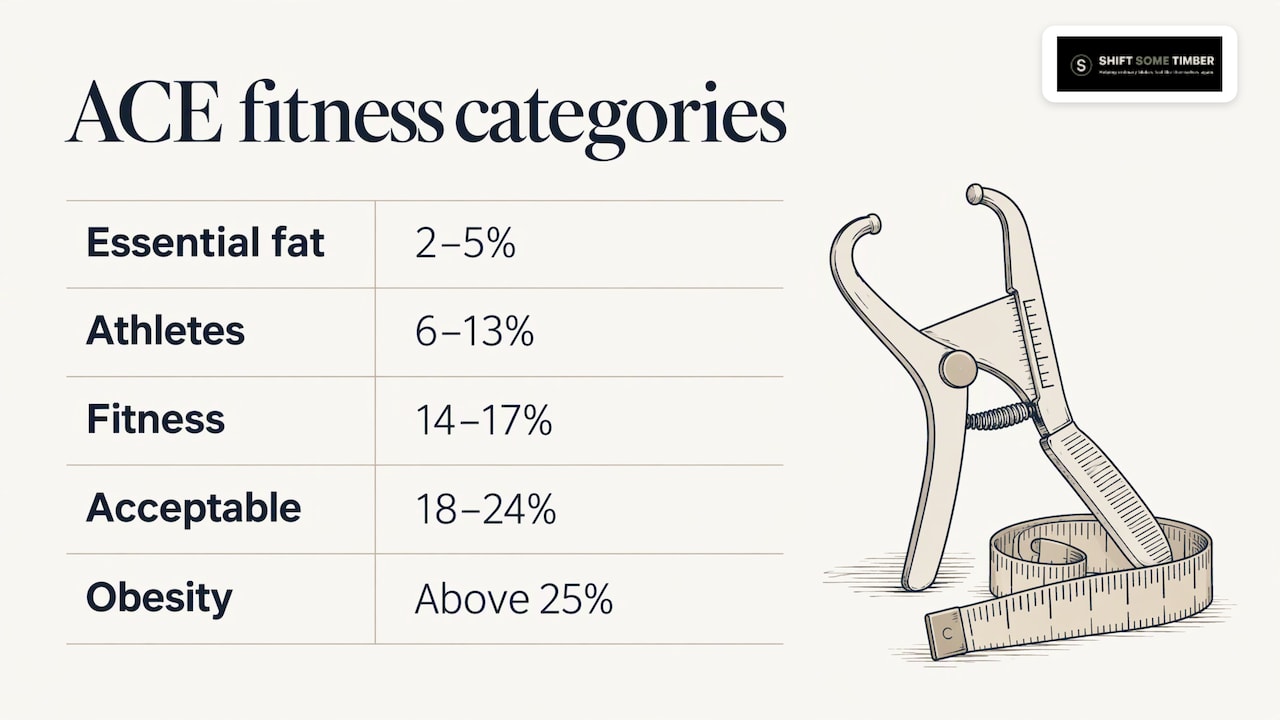
You will often come across the American Council on Exercise categories. Via Men's Health UK, these are essential fat at 2–5%, athletes at 6–13%, fitness at 14–17%, acceptable at 18–24% and obesity above 25%. They were built around fitness levels, not medical risk, so treat "athlete" as a description of a very lean, trained man rather than a goal for everyone.
Is 25% body fat a lot for a man?
It is on the high side. Men's Health UK quotes Dr Steven Heymsfield, who classes a man aged 20 to 39 as obese above 25%, with the cut-off rising to 28% for men aged 40 to 59.
Not every source agrees. A 2025 study discussed by Harvard Health used body fat rather than BMI and defined overweight as at least 25% for men and obesity as at least 30%. The cut-offs depend on who is drawing the line and what they are using it for.
What that means for you:
- Under 20%: you are in a healthy range for most ages.
- 20 to 25%: acceptable for many men over 40, but a sign to look at your waist and habits.
- 25% and above: worth taking seriously. Check your waist measurement and talk to your GP if you have other risk factors.
And remember where the fat sits. Harvard Health explains that even with a weight near the normal range, a large waist can mean an unhealthy amount of belly fat, which raises the risk of diabetes and heart disease. If that sounds familiar, our guide to visceral fat in men explains what it is and how to shift it.
How to measure body fat percentage
Here is the honest picture: every method has a margin of error, and the cheap ones have the biggest.
A 2020 study in the British Journal of Nutrition compared methods in 170 healthy adults against a five-component reference model. DXA scans and air displacement (the "Bod Pod") performed well. Bioimpedance, the technology in most smart scales and handheld devices, was good on average but showed larger errors for individuals. Equations based on tape and skinfold measurements generally performed poorly.
| Method | Where you find it | How much to trust a single reading |
|---|---|---|
| DXA scan | Clinics, some private gyms | High |
| Air displacement (Bod Pod) | University labs, some private clinics | High |
| Bioimpedance scales and handhelds | Home, gyms | Moderate on average, wider error for you personally |
| Skinfold calipers | Gyms, trainers | Depends heavily on the person measuring |
| Online calculators and photos | Anywhere | Rough estimate only |
Body fat scales: how accurate are they?
Good enough to follow a trend, not good enough to settle an argument with yourself. Scale readings shift with hydration, when you last ate, whether you have trained and even the time of day. Medical News Today notes that no single formula gives an accurate figure, and that the best measurement uses specialist equipment, usually in a doctor's office or with a trainer.
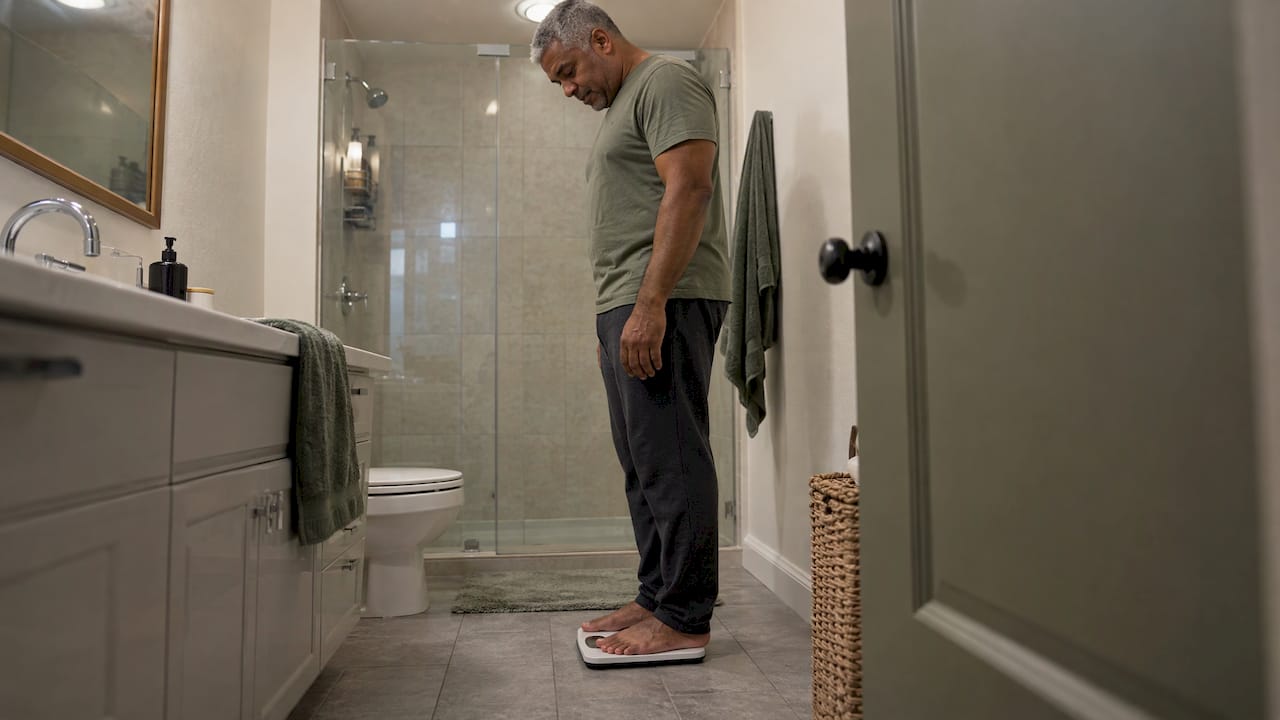
It is also worth knowing that NICE's obesity guidance says not to use bioimpedance as a substitute for BMI as a measure of general body fat in adults. Clinicians lean on BMI and waist measures for that reason.
If you do use a scale, get a consistent routine:
- Weigh yourself first thing in the morning, after the toilet, before food and drink.
- Use the same scale in the same spot every time.
- Look at the average over three to four weeks, not a single day.
- Ignore the decimal place. A move from 24.6% to 24.1% is noise.
Our guide to body composition tracking shows how weight and waist together reveal real trends.
Waist size: the quick check that tells you more
A tape measure costs a few pounds and the UK guidance for it is clear. For men, NICE guideline CG43 says a waist of 94 cm or more brings an increased risk of health problems, and 102 cm or more is a higher risk again, even at a healthy weight.
NICE's diabetes prevention guidance puts it the same way: 94 to 102 cm (37 to 40 inches) is high risk and more than 102 cm is very high risk. My Health London, an NHS programme, advises men to aim for less than 94 cm (37 inches). It advises men of Black African, African Caribbean, South Asian or Middle Eastern origin to aim for less than 90 cm (35 inches), as they are at higher risk.
| Waist (men) | What it means |
|---|---|
| Under 94 cm (37 in) | Lower risk |
| 94 to 102 cm (37 to 40 in) | Increased risk |
| Over 102 cm (40 in) | High risk |
| Under 90 cm (35 in) | Target for men of Black African, African Caribbean, South Asian or Middle Eastern origin |
How to measure your waist correctly
The method below follows NICE guidance:
- Find the bottom of your ribs and the top of your hips.
- Wrap the tape around your middle, halfway between those two points. That is usually just above the belly button.
- Breathe out naturally, then read the measurement. Do not suck in.
- Keep the tape level and snug, not digging in.
Most men are surprised because the waist is not where their trousers sit. Many wear their jeans below the belly, so the trouser size understates the true figure. More detail is in our guide to waist size for men.
One limit: NICE notes waist circumference is a valid measure of belly fat for people with a BMI under 35. Above that, BMI already carries most of the risk information, so your GP will look at the wider picture.
Waist-to-height ratio: one number for every man
Waist-to-height ratio takes away the problem of tall men and short men having different "good" waist sizes. Divide your waist by your height, using the same units for both.
Example from NICE: a 96.5 cm waist and 170 cm height gives 0.57. In inches, 38 divided by 67 gives the same.
NICE NG246 reads the result like this:
| Ratio | What it indicates |
|---|---|
| 0.4 to 0.49 | Healthy, no increased risk |
| 0.5 to 0.59 | Increased risk |
| 0.6 or more | High risk, further increased |
The categories apply to adults of both sexes and all ethnicities with a BMI under 35, including people with a lot of muscle. The risks listed are type 2 diabetes, high blood pressure and cardiovascular disease. The simple rule from NICE: keep your waist to less than half your height.
The British Heart Foundation also describes waist-to-hip ratio. Divide your waist by your hips at the widest point of your buttocks. For men, above 0.90 is high risk.
Want it done for you? Use our waist-to-height ratio calculator for men.
Which measure should you use?
They answer slightly different questions.
| Measure | Tells you | Best for |
|---|---|---|
| Body fat percentage | How much of your weight is fat | Tracking changes in body composition over time |
| Waist circumference | How much fat is around your middle | A quick, cheap health-risk check |
| Waist-to-height ratio | Belly fat relative to your size | A risk check that works across heights |
| BMI | Weight relative to height | A starting screen, less useful for very muscular men |
The BHF explains that you can have a healthy BMI and still be at risk if more of your weight is fat, and that an "apple" shape, with more fat on the belly, comes with higher risk.
In practice, a sensible routine is simple. Measure your waist and weight every two weeks. Check body fat on your scale once a month if you like, and only watch the trend. Take photos if they help you see what the numbers miss. Our healthy weight range calculator can give you a starting point for weight.
Can body fat be too low?
Yes. Chasing the lowest number is not a health goal. The Physiological Society says men should not go below the essential fat level of 2 to 5%, as very low levels are linked with metabolic problems and affect fertility and immune responses. Dr Heymsfield, quoted in Men's Health UK, warns that going below 5% is very risky.
The same Physiological Society piece notes that people with lipodystrophy, a genetic condition with almost no fat tissue, develop many of the metabolic problems seen in obesity. Both extremes cause trouble.
For most men reading this, being too lean is not the issue. But if you are training hard, eating very little and noticing low energy, low mood or a drop in sex drive, see your GP. Long periods of sitting also matter for men's health beyond the scale, as this piece on how a sedentary lifestyle contributes to erectile dysfunction shows. Our guides on low testosterone symptoms and low energy in men over 40 cover what to check.
What to do with your numbers
If your numbers are in a healthy range, keep doing what you are doing and keep measuring. If they are not, you have a clear starting point.
- Waist 94 cm or over, or ratio of 0.5 or more: start with the basics. Food you can stick to, movement you will actually do, and sleep. Our guide on how to lose belly fat as a man and the explainer on why belly fat happens in men are good next reads.
- Waist 102 cm or over, or a ratio of 0.6 or more: speak to your GP. They can check blood pressure, blood sugar and cholesterol. Our guide to five metabolic health markers explains what the results mean.
- Weight is hard to shift despite real effort: there are medical treatment options, including GLP-1 medicines, which need a proper clinical assessment first. Our GLP-1 Knowledge Centre explains how they work.
Set small targets. Taking 2 to 3 cm off your waist is a real change, and it often shows before the scales move much.
Our view on body fat numbers
Most men we speak to have either never measured anything or have fixated on one number. Neither helps.
Our view is simple. Use a tape measure for your waist, use a scale for your trend, and use both to ask a better question than "what is my percentage?" The better question is "is this getting better, and do I feel better?"
That is why SHIFT is built around more than the scales. Grub gives you practical food ideas, Fit gives you movement you can manage around work and family, and My Timber tracks your check-ins so you can see progress that a single reading would miss. Life Back keeps the focus on what you actually want to get back to doing.
You are welcome whether you are thinking about treatment, already on it, have stopped, or want support without medication. No judgement, just plain English and honest guidance.
Matt O’Brien
Start with a plan that fits your life
If your measurements have told you it is time to do something, we can help you work out the next step. SHIFT brings together treatment information, clinical pathways through regulated partners, and practical day-to-day support for men, before, during and after treatment. That includes men who started elsewhere.
See how it works on our weight loss for men page, or map out your route with My Weight-Loss Roadmap.
FAQ
How accurate are body fat scales?
They are usable for tracking your own trend but unreliable for a single reading. Research shows bioimpedance performs reasonably on average but with larger errors for individuals. Weigh under the same conditions every time and watch the average over several weeks.
Is 25% body fat a lot for a man?
It is high. Several sources, including Men's Health UK, class over 25% as obese for men under 40, with the cut-off a little higher for men aged 40 to 59. Check your waist as well, and speak to your GP if it is 102 cm or more.
What waist size is healthy for a man?
Under 94 cm (37 inches) is the guide for most men. NHS-backed advice says men of Black African, African Caribbean, South Asian or Middle Eastern origin should aim for under 90 cm (35 inches). Measure halfway between your lowest rib and the top of your hips.
What is a good waist-to-height ratio for a man?
A ratio between 0.4 and 0.49 is classed as healthy by NICE. From 0.5 you are at increased risk, and at 0.6 or more the risk is higher still. The rule of thumb is to keep your waist below half your height.
Sources
- What Is a Healthy Body Fat Percentage? (Men's Health UK)
- Body fat: our own Janus (The Physiological Society)
- Body fat percentage charts (Medical News Today)
- What is considered a healthy body fat percentage as you age (Harvard Health)
- Five-component model validation of reference, laboratory and field methods (British Journal of Nutrition)
- NICE CG43 Obesity: full guideline, identification and classification
- NICE PH35 Type 2 diabetes prevention recommendations
- Measurements matter (My Health London, NHS)
- NICE NG246 Identifying and assessing overweight, obesity and central adiposity
- How to measure and calculate body fat percentage (British Heart Foundation)
Recommended
- Belly Fat in Men: Why It Happens and What Helps
- Body Composition Tracking: Why Weight and Waist Reveal Trends
- How to Lose Belly Fat for Men: What Works in the UK
- Visceral fat in men: what it is and how to shift it
Last updated .