
How to Lose Belly Fat for Men: What Works in the UK
You lose belly fat by losing fat overall. You can't pick the stomach, and sit-ups won't do it alone. For most men the plan is a steady calorie deficit, protein and vegetables at each meal, less alcohol, strength training twice a week, plenty of walking and decent sleep. Belly fat is often among the first places to shrink once the deficit is consistent. Here's how to do it around work and family, and how to tell whether you need more support.
TL;DR
- You can't spot-reduce fat. Belly fat falls when your whole body loses fat through a sustained calorie deficit.
- Food does most of the work. Sit-ups and crunches build muscle under the fat but don't remove it.
- Aim for 150 minutes of moderate activity a week plus strength work on two days. Short sessions count.
- Measure your waist, not just the scales. The NHS advises keeping it below half your height.
- If you've tried properly and the weight won't move, talk to a clinician about medication. Support matters either way.
Table of Contents
- Why belly fat matters more than other fat
- Check where you stand: the waist test
- You can't spot-reduce: what that means for sit-ups
- Food: where most of the progress comes from
- Exercise: what helps, and how much
- Diet plus exercise beats either alone
- Sleep, stress and the things that undermine you
- Perspective: what we see
- Tracking progress and keeping it off
- When medication might be worth discussing
- Where SHIFT fits in
- FAQ
- Sources
Why belly fat matters more than other fat
Not all fat is the same. The soft fat you can pinch is subcutaneous fat. It sits under the skin. Visceral fat sits deeper, around organs such as the liver and gut. Dr Caroline Apovian of Harvard-affiliated Brigham and Women's Hospital says the bigger concern is visceral fat that builds around vital organs when extra calories aren't burned.
Men are more prone to it. Research suggests men take up more dietary fat into abdominal visceral fat than pre-menopausal women, which helps explain why so many of us end up apple-shaped rather than pear-shaped.
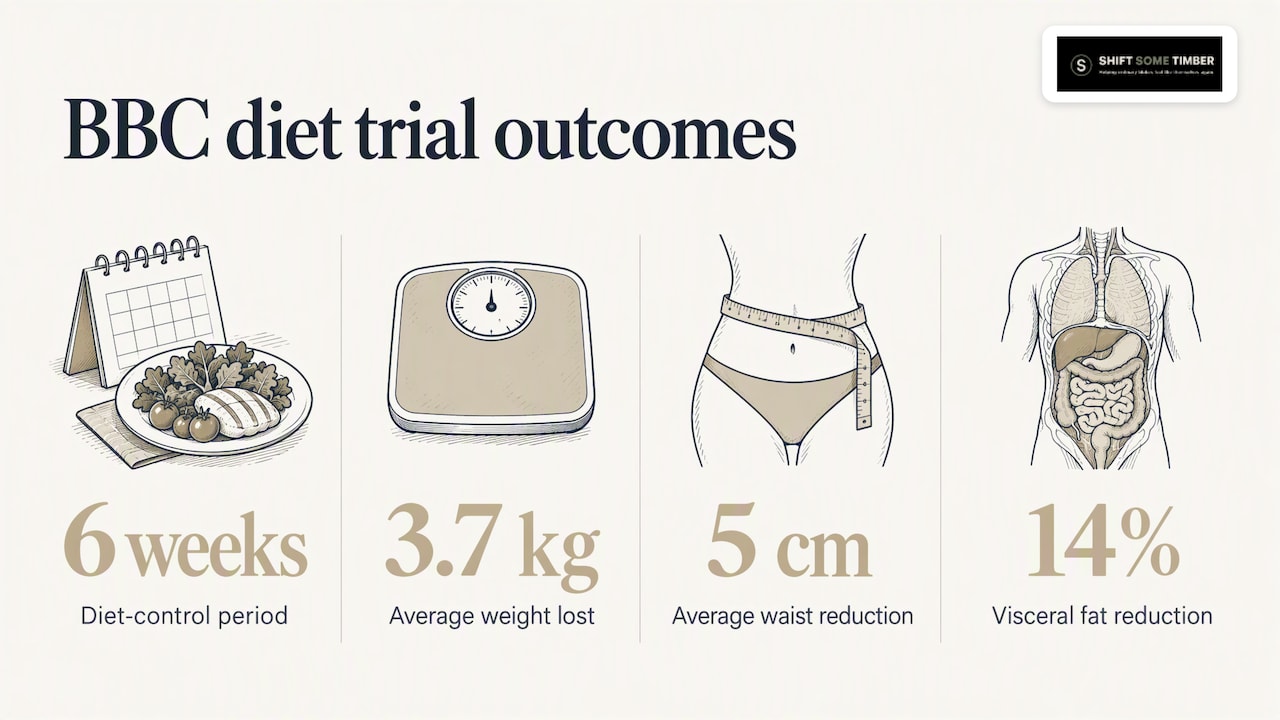
That's the bad news. The good news is that visceral fat responds well to the basics. In a BBC experiment, the group that controlled its diet for six weeks lost an average 3.7 kg, cut waist size by 5 cm on average, and recorded a 14% reduction in visceral abdominal fat. It was a small trial, but it shows what a few weeks of consistent eating changes can do.
Check where you stand: the waist test
The scales don't tell you where your weight sits. A tape measure does. The NHS advises adults to keep their waist to less than half their height. So if you're 178 cm tall, aim for under 89 cm.
How to measure:
- Stand up straight and breathe out normally.
- Find the midpoint between the bottom of your ribs and the top of your hip bones.
- Wrap the tape around your bare stomach there. Snug, not squeezing.
- Note the number and divide it by your height in the same units.
If you'd rather not do the maths, use our waist-to-height ratio calculator for men. Measure every two to four weeks, not daily. Waist size moves slowly and the number is a trend, not a verdict.
You can't spot-reduce: what that means for sit-ups
This is the biggest myth in the field. The British Heart Foundation is clear that crunches and sit-ups can strengthen the abdominal muscles but won't significantly reduce the fat over them. Fat comes off through overall fat loss, driven by a sustained calorie deficit with activity and diet behind it.
The BBC experiment tested this too. A six-week sit-up programme didn't reduce body weight or improve measured health markers. Waistlines did shrink by about 2 cm, but the report put that down to stronger abdominal muscles holding the existing fat more firmly, not to losing it.
So do core work if you like it. It helps posture and your back. Just don't expect it to melt the middle.
Food: where most of the progress comes from
You can't out-train a diet that quietly adds a few hundred calories a day. The NHS advice is to choose an eating pattern that cuts calories, stays healthy and fits your life. That last part is the one most plans ignore. If you can't keep it up on a Tuesday night after work, it isn't the right plan.
A simple plate
- Vegetables: at least two portions with your main meal.
- Protein: at every meal. Eggs, chicken, fish, lean mince, beans, Greek yoghurt.
- Wholegrain starch: wholemeal bread, brown rice, oats, in sensible portions.
- Less of: sugary foods and drinks, and added oils.
Protein helps you feel fuller and, when you're in a deficit, supports the muscle you want to keep. If you want numbers, our 1,800 calorie men's diet plans show how that can look across a week of normal UK food.
Alcohol: the quiet one
A few pints a week add up fast. The NHS notes that alcohol is high in calories, can increase hunger and lead to unplanned food choices, so cutting down supports weight loss. The British Nutrition Foundation says UK men should have no more than 14 units a week, spread out with several alcohol-free days. Start there. Swapping two midweek pints for something alcohol-free is often the easiest calorie cut a man can make.
Drinks and portions
The NHS suggests limiting fruit juice and smoothies to a combined 150 ml a day. Liquid calories don't fill you up, so they're easy to over-do.
The British Nutrition Foundation also advises men who average more than 90 g of cooked red and processed meat a day to cut down to 70 g, and to reduce saturated fat. Fish twice a week, with one portion oily, is on the same list. Fibre-rich foods and at least five portions of fruit and veg a day round it out.
What a realistic day looks like
Take a van driver or a dad doing the school run. Breakfast is eggs on wholemeal toast or porridge with yoghurt. Lunch is a chicken wrap with salad rather than a meal deal with crisps and a fizzy drink. Tea is a normal home-cooked meal with half the plate vegetables and a palm-sized portion of protein, not a second helping of rice. One snack, planned, not grazed. It's not exciting. It works because you can repeat it.
Exercise: what helps, and how much
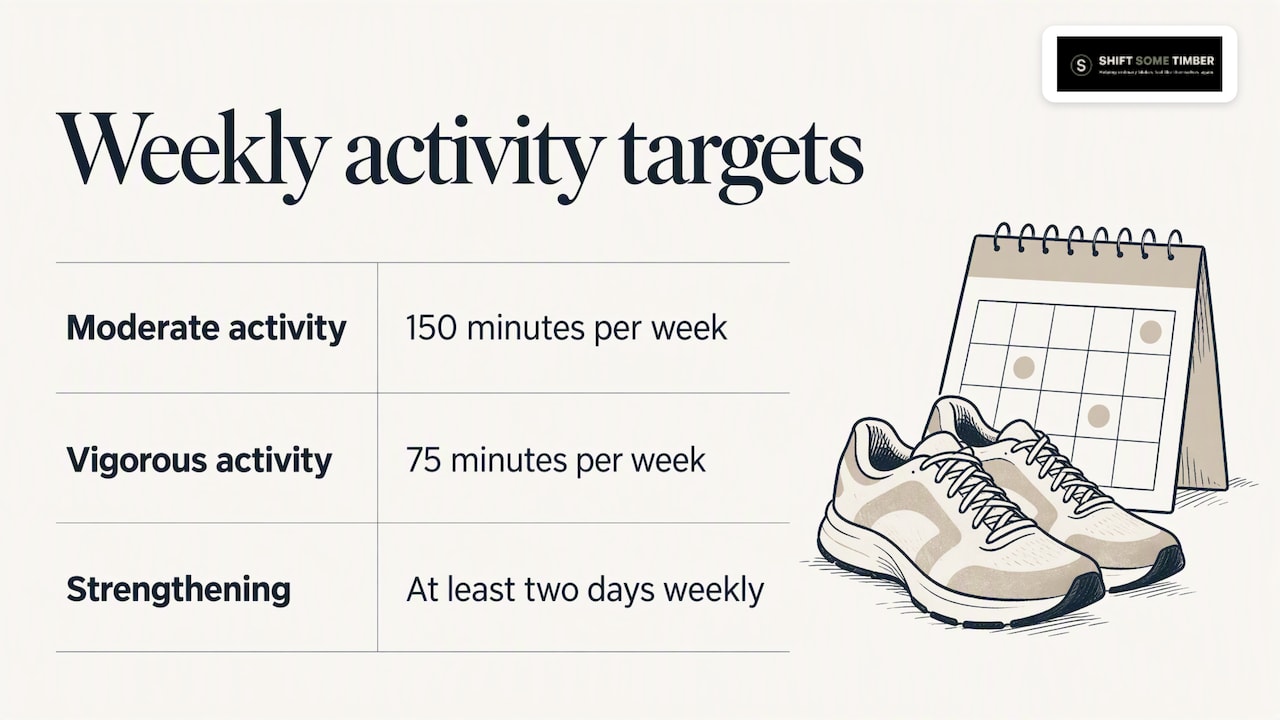
The UK Chief Medical Officers recommend adults do 150 minutes of moderate activity or 75 minutes of vigorous activity a week, plus muscle-strengthening exercise on at least two days. Sessions can be broken up through the day. Active travel and daily tasks count.
BHF guidance says aerobic exercise is the most effective type for overall fat loss, including around the middle, while strength training builds muscle and supports weight loss. You need both.
Research also finds that exercise can improve body composition, insulin sensitivity and fitness even when body weight doesn't fall. So a quiet scale after a good fortnight of training isn't failure.
A week that fits around work
| Day | What | Time |
|---|---|---|
| Mon | Brisk walk at lunch or after tea | 20 to 30 min |
| Tue | Strength: squats, press-ups, rows, carries | 30 min |
| Wed | Walk or cycle part of the commute | 20 to 30 min |
| Thu | Strength: lunges, deadlift or hinge, shoulder press | 30 min |
| Fri | Rest or easy walk | 15 min |
| Sat | Longer walk, swim, bike or football with the kids | 45 to 60 min |
| Sun | Rest | Any |
That's about 150 minutes of aerobic activity plus two strength sessions. If that's too much now, start with half and build. Ten minutes three times a day counts the same as thirty minutes in one go.
Strength work is not optional
When you lose weight, some of it can be muscle. Lifting twice a week helps protect it, which keeps your metabolism and strength up. It matters even more if you're on weight-loss medication. See our guides on GLP-1 and exercise and muscle loss on GLP-1 treatment if that's you.
Diet plus exercise beats either alone
The Men's Health Forum's work on weight-loss services found that men do better in programmes that include both a diet and an exercise component than in programmes with just one. It also notes that men seem to respond well to personalised programmes. That matches what we hear from men: generic advice gets dropped, plans that fit your week stick.
Sleep, stress and the things that undermine you
There's less hard evidence for these than for food and movement, so treat them as supporting actors rather than magic fixes. But most men who stall will recognise the pattern. Poor sleep makes you hungrier and less likely to train. Stress makes the takeaway and the extra beer more tempting. Fixing the basics helps the plan hold:
- Keep a regular bedtime and aim for a consistent wake time.
- Keep screens out of the last half hour before bed.
- Pick one thing that helps you switch off: a walk, a gym session, a call with a mate.
- If low mood or constant stress is driving your eating, speak to your GP. Our guide to starting antidepressants can help you prepare for that conversation.
Perspective: what we see
Most men don't fail because they don't know what to do. They fail because the plan was built for someone with more time, fewer commitments and no off days. We started SHIFT because ordinary men told us the same story: a strict diet for three weeks, a gym burst, then a bad week and a feeling of having blown it.
Our view is simple. Belly fat comes down when the basics are repeated for long enough, and the basics are food, movement, sleep and support. The scales are one measure. Waist, energy, how your clothes fit and how you feel playing with your kids tell you more. And if you've been on medication, or stopped it, the habits you build matter even more, because they're what you keep.
We also think there's no shame in asking for help. Needing structure, accountability or medical input isn't weakness. It's picking the right tool.
— Matt O’Brien
Tracking progress and keeping it off
The NHS recommends weighing yourself regularly and setting realistic goals. Pick what you'll track and stick to it:
- Waist: every two to four weeks, same spot, same time of day.
- Weight: once a week, same conditions, and look at the trend rather than a single day.
- Other signs: energy, sleep, how far you can walk, how your belt fits.
NICE guidance says no single food, drink or activity maintains a healthy weight. A combination of dietary and activity changes is needed, and even small, gradual improvements are likely to help. That's good news if you've been thinking you need a dramatic overhaul. You don't.
Plateaus are normal. If nothing has moved for three or four weeks, check portions, drinks and weekend eating before changing everything. Small, honest adjustments beat starting again.
When medication might be worth discussing
Sometimes lifestyle changes alone aren't enough, particularly with a high BMI or weight-related health conditions. Medicines such as GLP-1 treatments are prescribed by clinicians after an assessment, and they work alongside food and movement, not instead of them.
NHS access varies by area. As one example, a local NHS policy in Suffolk and North East Essex requires a BMI of at least 35 kg/m², a qualifying complication and participation in diet, activity and behavioural support for Mounjaro through its specialist service. The same policy says Wegovy should be stopped if less than 5% weight loss is reached after six months. Other areas set their own rules. Lower BMI thresholds, usually 2.5 kg/m² lower, apply to people from South Asian, Chinese, other Asian, Middle Eastern, Black African or African-Caribbean backgrounds.
Don't start or stop any prescribed medication without speaking to your GP or prescriber. If you want to know what to ask, read our questions for your prescriber and the comparison of lifestyle alone vs weight-loss medication. The NHS also says people who stop weight-loss medicines should be offered support to stay at a healthy weight, which is why ongoing habits matter.
Where SHIFT fits in
If you want structure that fits around work and family, that's what we built. The Programme brings together Grub for practical food ideas, Fit for achievable movement, Life Back for personal goals and My Timber for check-ins and progress tracking. Treatment options, including GLP-1 medicines, are part of the picture, with clinical assessment, prescribing and dispensing handled by appropriately regulated partners. You're welcome before, during or after treatment, including if you started elsewhere or want support without medication.
See how it works on our men's weight management page, or look through The Programme first.
FAQ
How can I get rid of belly fat quickly as a man?
There's no safe way to target the stomach, and fast fixes tend to rebound. The quickest sustainable route is a steady calorie deficit, cutting alcohol and sugary drinks, protein at each meal and daily walking. In the BBC experiment, six weeks of diet control cut waist size by 5 cm on average.
Do sit-ups help with belly fat?
Not much. They strengthen your abdominal muscles, but the British Heart Foundation says they won't significantly reduce the fat over them. Fat loss comes from your overall calorie deficit and activity, so put your effort into food, walking and full-body strength work.
What is the difference between visceral and subcutaneous fat?
Subcutaneous fat sits under the skin and is the part you can pinch. Visceral fat sits deeper around organs such as the liver and gut. Visceral fat is the one doctors worry about most, and men tend to store more of it around the middle.
How big a waist is too big?
The NHS advises keeping your waist to less than half your height. Measure halfway between your lowest rib and hip bone, and divide by your height. If you're above that line, or you have other health concerns, speak to your GP.
Sources
- An inside look at body fat, Harvard Health
- Why Do Men Accumulate Abdominal Visceral Fat?, PMC
- Belly fat: What's the best way to get rid of it?, BBC News
- Overweight and obesity in adults, NHS
- What's the best exercise to lose fat around your belly?, British Heart Foundation
- Healthy eating when trying to lose weight, NHS Better Health
- Nutrition for men, British Nutrition Foundation
- UK Chief Medical Officers' physical activity guidelines, GOV.UK
- Effect of Exercise Training on Fat Loss, PMC
- How to make weight-loss services work for men, Men's Health Forum
- Preventing overweight, obesity and central adiposity, NICE
- Tier 3 Weight Management policy, Suffolk and North East Essex
- Tirzepatide for managing overweight and obesity, Cheshire and Merseyside formulary
Recommended
- Lose Weight With a Men’s Diet: UK 1,800 Calorie Plans That Last
- Men's Fat Loss Workouts: A Realistic Weekly Plan
- Healthy Meals on a Budget: A UK Guide for Men
- Belly Fat in Men: Why It Happens and What Helps
Last updated .