Digital Weight Loss Support for Men: What Works and How to Choose
Digital weight loss support is coaching, tracking and community delivered through an app, website or video call instead of a weekly room above a pub or church hall. For many men it works because it fits around shifts, commutes and family, and it keeps things private. The evidence says the versions with a real person involved tend to do best, and that the support matters whether you are using medication or not.
This guide explains what digital support involves, what the NHS offers, how accountability groups fit in, how to spot a credible service, and how to build routines that survive a busy week.
TL;DR
- Digital support means tracking, goal-setting, education, coaching and peer contact, delivered online. You choose the mix that suits your week.
- A 2023 systematic review found that programmes with human contact work better than fully automated ones.
- The NHS Digital Weight Management Programme is free, runs for 12 weeks and is aimed at adults living with obesity who also have diabetes, high blood pressure or both.
- Credible support is healthcare-endorsed, gives access to qualified people and explains its approach plainly.
- Online support works before, during and after treatment, including GLP-1 medicines and including when you stop.
Table of Contents
- What digital weight loss support actually involves
- What the evidence says about online support
- The NHS Digital Weight Management Programme
- Men's accountability groups: what to expect
- How to tell whether a service is credible
- Digital support alongside GLP-1 and other treatments
- Keeping weight off when you stop medication, or never start it
- Building routines around work and family
- Our view: support should outlast the first month
- Support that fits around your week
- FAQ
- Sources
What digital weight loss support actually involves
The phrase covers a lot of ground, so it helps to break it into parts. The US Community Preventive Services Task Force describes technology-supported coaching or counselling as interventions that combine components such as tracking, social interaction, counselling or education. Its review (covering research up to 2008) found these approaches can help people lose weight and keep it off. It also points to practical advantages: access for people with unusual work schedules or who cannot travel easily, and anonymity for those who prefer it.
In plain terms, most digital support is built from the same handful of pieces:
- Self-monitoring. Logging weight, food, steps or mood so you can see what is happening rather than guess.
- Goal-setting. Small, specific targets for the week, not a vague plan to "do better".
- Education. Short guides on food, activity, sleep and how treatments work.
- Coaching. A named person or group who checks in, adjusts the plan and keeps you honest.
- Peer support. Other people in the same position, which many men find easier online than face to face.
A 2023 review of eHealth interventions for weight loss listed self-monitoring, goal-setting, social support and feedback as common components. That is a useful checklist when you look at any service: if it has none of these, it is a content library rather than support.
What the evidence says about online support
Three findings are worth knowing.
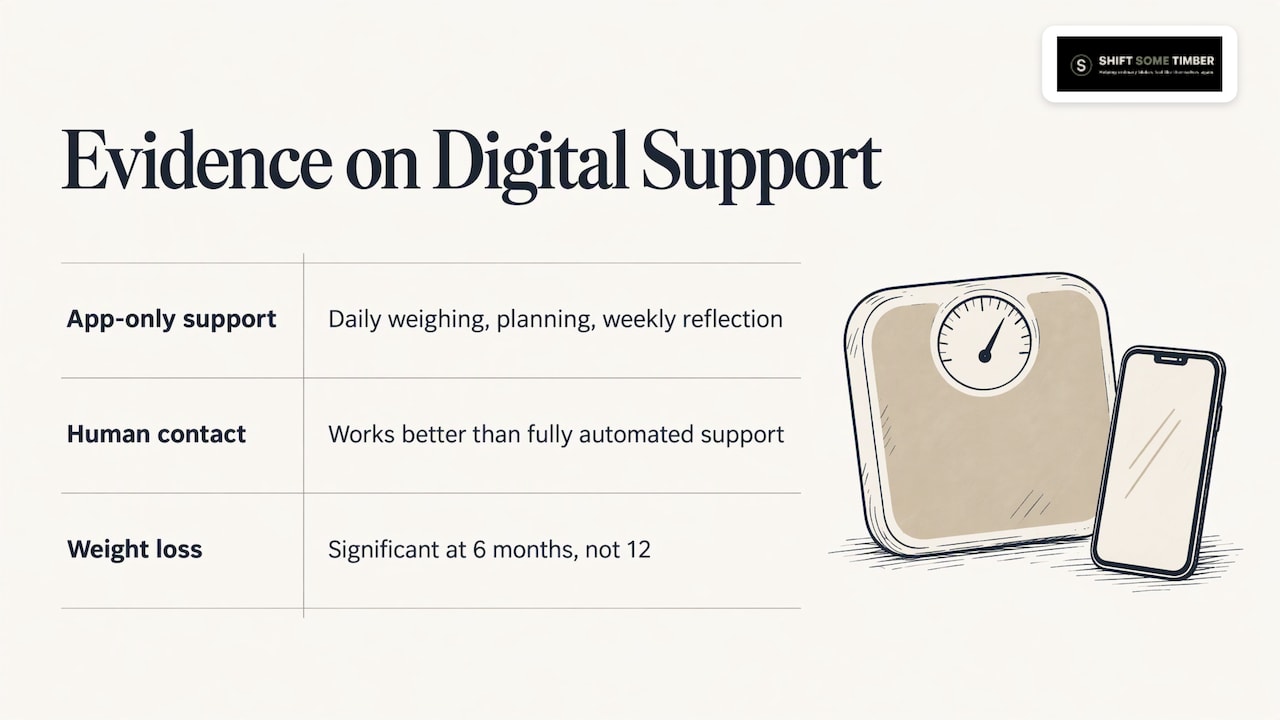
Apps can work on their own for some people. A large 2025 UK randomised trial tested an app built around daily self-weighing, action planning and weekly reflection, with no human contact. It led to significant weight loss and fewer disordered eating symptoms in adults. If you like data and routine, a simple tool can carry you a long way.
Human contact adds something. The same 2023 review found that interventions including a real person work better than fully automated ones. Someone noticing that you went quiet for ten days is hard to automate.
Early results do not always last. A 2025 systematic review looked at combinations of information, specialist contact and incentives. It found significant weight loss at 6 months but not at 12 months. The sensible reading is that you want support that carries on past the first few weeks, not a short burst of motivation.
For a wider look at what a sensible starting point looks like, our evidence-based weight management plan walks through it step by step.
The NHS Digital Weight Management Programme
If you are in England and have a diagnosis of diabetes, high blood pressure or both alongside obesity, the NHS offers a free option. The Digital Weight Management Programme provides 12 weeks of online support through apps and websites, helping people improve their diet and get more active. Your GP or another healthcare professional usually makes the referral.
There are three levels of support. All include digital content. Levels 2 and 3 add up to 50 or 100 minutes of human coaching respectively, and the NHS toolkit says this is aimed at groups, men among them, who may need more personal support to finish.
It is a good option if you qualify. Two things are worth knowing in advance:
- It is a 12-week programme, so you will want a plan for what happens in week 13.
- If you do not have the qualifying conditions, you will need a different route.
If you are weighing up what the NHS does and does not provide for medication, our guide to NHS weight loss drugs and why it depends on your postcode and the comparison of NHS and private weight-loss medication cover the detail.
Stress is one thing that regularly derails the best plans, particularly for men juggling work and home. This piece on stress and weight gain explains how the two connect and why steady activity and group coaching can help.
Men's accountability groups: what to expect
Many men searching for support are really asking for accountability: someone who will notice if they drift. A good men's accountability group offers a few things:
- Peers with similar schedules and pressures, so advice is realistic rather than aimed at someone with unlimited time.
- A place to share setbacks without being judged, and to mark milestones that are not only about the scales.
- Structure, such as weekly check-ins, so progress does not rely on willpower alone.
This lines up with national guidance. NICE's overweight and obesity guideline recommends that clinicians identify behavioural interventions tailored to groups such as men and explain the benefits of peer support. In other words, wanting a men-focused setting is not a quirk. It is recognised as a sensible preference.
Where men can find support groups in the UK
NICE says people should be told about community-based options such as health coaches, social prescribers, online networks and local groups. In practice that means:
- NHS-referred digital programmes, through your GP.
- Local council weight management services, which vary by area. Your council's public health pages are the place to look.
- Social prescribers, usually reached through your GP surgery, who can point you to walking, gardening or fitness groups nearby.
- Online communities and coached programmes, which suit you if travel or shift patterns make regular meetings hard.
Availability differs across the UK, so check with your surgery or council for what runs near you.
How to tell whether a service is credible
Anyone can launch an app and call it support. Use these checks before you hand over money or personal details.
- Is it healthcare-endorsed? NHS-approved or run with regulated clinical partners is a strong sign.
- Can you reach qualified people? Look for named clinicians, dietitians or trained coaches, not just a chatbot.
- Does it explain its approach? NICE's guidance points to services that openly set out their evidence-based approach to diet and lifestyle change.
- Does it respect your choice? NICE highlights patient choice between digital, group or individual in-person support, because different men need different things.
- Is it clear about who handles medical decisions? Prescribing and assessment belong with regulated professionals.
- Does it keep going? Remember the 12-month finding above. Look for support that covers maintenance, not only the first weeks.
Our Decision Centre methodology shows how we weigh evidence, and our weight-management review questions give you a list to take to an appointment.
Digital support alongside GLP-1 and other treatments
Medication and support are not rivals. NICE has assessed digital technologies for weight management and identified seven suitable for prescribing and monitoring weight-management medicine in the NHS, and nine for delivering multidisciplinary services without prescribing. Its guidance also says healthcare professionals should carry out a full clinical assessment before referring someone, to make sure the service suits them.
So the pattern is consistent: assessment first, then treatment where appropriate, with digital support wrapped around it. For men on or considering a GLP-1 medicine, that support covers the everyday stuff the injection or tablet cannot do for you: what to eat when your appetite changes, how to stay active, how to handle food noise, and how to keep track of how you feel. Our GLP-1 Knowledge Centre explains the medicines, and the piece on lifestyle alone versus medication helps you think through the options. If you have questions about your own treatment, your prescriber or pharmacist is the person to ask.
Keeping weight off when you stop medication, or never start it
Some men stop treatment. Some never want it. Either way, the same principle applies: you need a support set-up that matches your situation. NICE's emphasis on choice between digital, group and individual support acknowledges that maintenance looks different for different people.
If you are coming off medication, speak to the clinician who prescribed it about a plan before you stop. Then build the habits that carry the load: regular meals with enough protein and fibre, a movement routine you can actually keep, a weekly weigh-in or check-in, and someone who knows your goal. The Game of Stones two-year results are worth a read if you want to see how long-term follow-up in men has been looked at, and the MPs' call for long-term weight-loss support shows that this gap is now on the national agenda.
Building routines around work and family
The best plan is the one that survives a Tuesday with a late meeting and a child with a temperature. A few principles tend to help:
- Start with two or three anchors. For example, a protein-led breakfast, a 20-minute walk after dinner and a Sunday check-in. Add more only when those feel automatic.
- Plan for the bad day. Decide in advance what your fallback meal is and what a short workout looks like when you only have ten minutes.
- Make check-ins fixed and short. Five minutes at the same time each week beats an ambitious review you skip.
- Track more than weight. Energy, sleep, how your clothes fit and how you feel at the end of the day tell you things the scales miss.
- Involve the household. If the family eats the same meals, you are not cooking twice.
That is the thinking behind The Programme: Grub for practical food ideas, Fit for achievable movement, Life Back for personal goals and My Timber for check-ins and progress tracking.
Our view: support should outlast the first month
We started SHIFT because ordinary men told us the same thing: the information was everywhere, but nobody stayed around once the first few weeks were done.
We think digital support should feel like a mate who knows what he is talking about. Plain English, no lectures, and no judgement if you slip. That is why we pair treatment information with practical help for food, movement and goals, and why we welcome men before, during and after treatment, including those who started elsewhere.
Weight is one measure. Energy, confidence and getting your life back are the ones men tell us matter most. Good support keeps all of them in view, and it keeps going.
Matt O’Brien
Support that fits around your week
SHIFT brings treatment information and pathways together with The Programme, so you get practical food ideas, achievable movement, personal goals and progress tracking in one place. Clinical assessment, prescribing and dispensing are handled by appropriately regulated partners, and you are welcome whether you want medication or support without it.
If you are ready to take the first step, start with Weight Loss for Men UK: Getting Started and Support or explore the Weight-Loss Decision Centre. For safety information, see our medical disclaimer.
FAQ
Does online weight loss support really work?
It can. Reviews of technology-supported coaching find it can help people lose weight and maintain weight loss. Results tend to be better when a real person is involved, so look for coaching or peer contact rather than an app alone.
Can I use digital support if I am not on medication?
Yes. Digital support is built on tracking, goal-setting, education and social contact, none of which needs a prescription. The NHS programme, for instance, is based on online diet and activity support. If you later consider medication, a clinical assessment comes first.
How do I find a men's weight loss support group in the UK?
Ask your GP surgery about NHS-referred digital programmes and social prescribers, and check your local council's weight management service. NICE also lists online networks and local community groups as options. Choose one that is healthcare-endorsed and explains its approach clearly.
What happens after the 12-week NHS programme ends?
The programme itself is 12 weeks, so plan your next step before it finishes. That might be a local group, a coached online service or a maintenance routine with weekly check-ins. Speak to your GP about what is available in your area.
Sources
- Obesity: technology-supported multicomponent coaching or counselling interventions (The Community Guide)
- Effectiveness and safety of a mobile application-based intervention (2025 UK trial)
- The Effectiveness of eHealth Interventions for Weight Loss (2023 systematic review)
- Evaluation of the Aspects of Digital Interventions That Support Weight Loss (2025 systematic review)
- NHS Digital Weight Management Programme: Healthcare Professional Toolkit
- NICE: Overweight and obesity management (NG246)
- NICE: Digital technologies for delivering weight management services, recommendations
- Stress and weight gain: UK steps, 150 minutes and group coaching
Recommended
- Lose Weight With a Men’s Diet: UK 1,800 Calorie Plans That Last
- Weight Loss for Men Over 50: A Realistic UK Guide
- Men's Fat Loss Workouts: A Realistic Weekly Plan
- Protein for Men Losing Weight: Practical Food, Not Gym Theatre
Last updated .