Non-Scale Victories for Men: What to Notice Beyond the Scales
A non-scale victory is any sign of progress that a set of bathroom scales cannot show. For men, the common ones are easier stairs, better sleep, steadier energy, looser belts, calmer moods and more confidence in everyday life. Notice them, write them down and use them to choose one small step for next week. That's it. You don't need a target weight to do it.
We're the SHIFT Team. This guide is for the bloke who is doing the right things and wondering why the number isn't telling the whole story. It's also for the one who has lost weight and still doesn't feel like himself.
TL;DR
- Non-scale victories are changes in how you move, sleep, feel and cope with daily tasks. They often show up before the scales do.
- The number on the scales swings with water, time of day, sleep and hormones, so it is a noisy way to judge a week.
- Body confidence can lag behind weight loss. That is common and not a failure.
- A five-minute weekly check-in, plus one choice for next week, is enough to track progress.
- Your own GP or prescriber handles individual health and treatment decisions. Free My Timber support sits alongside them.
Table of Contents
- What counts as a non-scale victory for a man?
- Why the scales can miss real progress
- What the research says about men and motivation
- Body confidence after weight loss
- A one-week example: noticing the small stuff
- Food wins that don't involve the scales
- Movement wins: walking and strength
- Sleep, mood and Life Back
- Blood pressure, blood tests and metabolic health
- Testosterone, fertility and energy
- When to talk to a GP
- Keeping wins going: the pace question
- How free My Timber helps you notice progress
- FAQ
- Sources
What counts as a non-scale victory for a man?
It is anything that shows your health, fitness or everyday life moving the right way, without a weight figure attached. Think of it as evidence that your habits are working.
The NHS notes that living with obesity can cause day-to-day problems such as breathlessness, difficulty moving around, tiredness, joint and back pain, snoring and low mood. Turn that list around and you have a ready-made list of wins: less puffing on the stairs, an easier time getting out of the car, fewer aches, quieter nights, a lighter mood.
Here are the groups we find most useful.
- Movement: carrying the shopping in one trip, walking the dog further, getting up off the floor with the kids without a grunt.
- Sleep: falling asleep faster, waking less often, your partner mentioning you snore less.
- Energy: no slump at 3pm, enough left in the tank after work to do something you enjoy.
- Clothes: a belt notch, a shirt collar that closes without a fight.
- Mood and confidence: feeling less on edge, saying yes to a pub quiz or a swim, being in photos again.
- Habits: cooking twice in a week, taking the stairs, going for a walk at lunch, having a glass of water before the second coffee.
- Health markers: blood pressure or cholesterol readings your GP or pharmacist has checked.
None of these need a gym or a diet plan. They're things you already notice, if you stop to look.
Why the scales can miss real progress
Your weight moves around for reasons that have nothing to do with fat. Water intake, hormones and sleep all change the number across a day, so the scales can go up or down even when your habits stay the same, as Allina Health explains. The same source points out that the scales may not move when you are building muscle while losing fat.
There is some UK research behind that last point. A 12-week pilot trial found that home-based resistance training during weight loss made no difference to body composition measures compared with weight loss alone. It did improve grip strength, leg strength and sit-to-stand performance. It was a small pilot, so treat it as a hint rather than a promise. But it shows that strength can improve in ways the scales never record.
If you want a steadier picture than one daily number, our guide to body composition tracking explains why weight and waist together show trends better than either alone.
What the research says about men and motivation
Men often come to weight loss with a different mindset from the one most programmes assume. A 2026 PLOS One study from UK researchers found that men saw diets in a negative light and felt weight loss programmes were aimed at women. It also found that men's reasons for change leaned towards looks rather than health, and that dieting on impulse was common.
The same study, with 24 men in focus groups, pointed to a support system of a buddy, a mentor or a partner as fundamental to early and lasting success. It also found that quick wins were a key motivator. That is the case for non-scale victories in one line: they are quick wins you can actually see.
Support matters as much as the wins. Research from the University of Essex on male-only football-based programmes found that the sense of togetherness mattered more to men than weight loss itself. It also improved their mental health. If a mate, brother, neighbour or your partner can be your "buddy" for the weekly check-in below, use them.
Body confidence after weight loss
Many men expect to feel different the day the weight comes off. Often it doesn't happen that way, and that can be confusing.
A 2014 systematic review found that all 14 studies looking at body image after weight loss interventions saw improvements. The effect was more consistent than for self-esteem or depression. So, on average, body image does tend to improve. But averages hide individuals. Some men feel it quickly, others take much longer.
Why might confidence lag?
- Your mental picture of yourself can take time to catch up with your body.
- Loose skin, a different shape or a smaller frame can feel unfamiliar.
- Old habits of avoiding mirrors, beaches or changing rooms stay in place until you test them.
- Worry about regaining can sit alongside pride.
A study of 13 men interviewed five to seven years after bariatric surgery found that weight loss meant getting back the freedom to live and act independently in daily life. But some restrictions and insecurity about health persisted despite successful weight loss. In other words, confidence is built from doing things, not only from a lower number.
If body image is weighing on you, that is worth saying out loud. A Mental Health Foundation survey of 2,103 men in Britain, cited in the Irish Examiner, found that 28% felt anxious because of body image issues. You aren't the only one. If low mood or worrying thoughts about how you look are getting in the way, speak to your GP. You can also call Samaritans free on 116 123 at any time.
One gentle note: we don't treat any body shape, waist size or measurement as a target that every man should hit. Use measurements, if you use them at all, as private information for you, and take them to your GP if you want to talk them through.
A one-week example: noticing the small stuff
This is a worked example, not a prescription. Pick five areas, give each a quick note at the end of the week, then make one choice. Here is how Dave, a made-up 46-year-old who works shifts and has two kids, might do it. He is an illustration, not a real person.
| Area | What Dave noticed this week | Score out of 5 |
|---|---|---|
| Walking | Walked to the shop instead of driving, twice. Didn't need a sit-down halfway up the hill. | 3 |
| Sleep | Slept through on four nights. Partner said the snoring was quieter. | 3 |
| Energy | Still tired Monday, better by Thursday. No biscuit run at 3pm on two days. | 3 |
| Confidence | Said yes to five-a-side after weeks of excuses. | 2 |
| Everyday tasks | Did the bins, the stairs and the kids' bikes without feeling wrecked. | 4 |
Notice what is missing: there is no weigh-in. The scores aren't a test. They are simply a record that makes next week's choice easy.
The one choice for next week
Look at the lowest score and pick one small, specific action. For Dave that might be "another five-a-side session on Thursday" for confidence. Not a new plan. Not a overhaul. One thing.
Here is the check-in in full, so you can copy it:
- Once a week, same day, sit down for five minutes.
- Score five areas from 1 to 5: walking, sleep, energy, confidence, everyday tasks.
- Write one line on anything that surprised you, good or bad.
- Pick one choice for next week, small enough that you'll do it on a bad day.
- Share it with your buddy if you have one.
A dip is data, not failure. Poor sleep, a stressful fortnight or an illness will pull scores down. The point is spotting patterns over weeks.
Food wins that don't involve the scales
Everyday food gives you plenty of quick wins. Look for these:
- You cooked from scratch more than you did last week.
- You had a proper breakfast or lunch instead of grabbing something on the go.
- You stopped at "comfortably full" at least once.
- You made a double batch and had a ready meal in the freezer for a rough night.
- You ate a vegetable you used to skip.
The VA guide to measuring progress without the scale is a US source, but its checklist is handy anywhere. It suggests tracking hunger and fullness cues, mood and sleep, mindful eating, variety in what you eat, body movement, and social life and quality of life.
SHIFT Grub, part of free My Timber, brings together realistic UK food ideas and recipes for busy weeks. If you want ideas on structure, our men's 1,800 calorie diet guide walks through plans built around normal UK shopping.
Movement wins: walking and strength
The NHS suggests getting active for 45 to 60 minutes a day and mentions free programmes such as Couch to 5K. That can sound like a lot if you are starting from a low base. So count the small wins first:
- A ten-minute walk after dinner, three times this week.
- Getting off the bus one stop early.
- Doing the stairs at work.
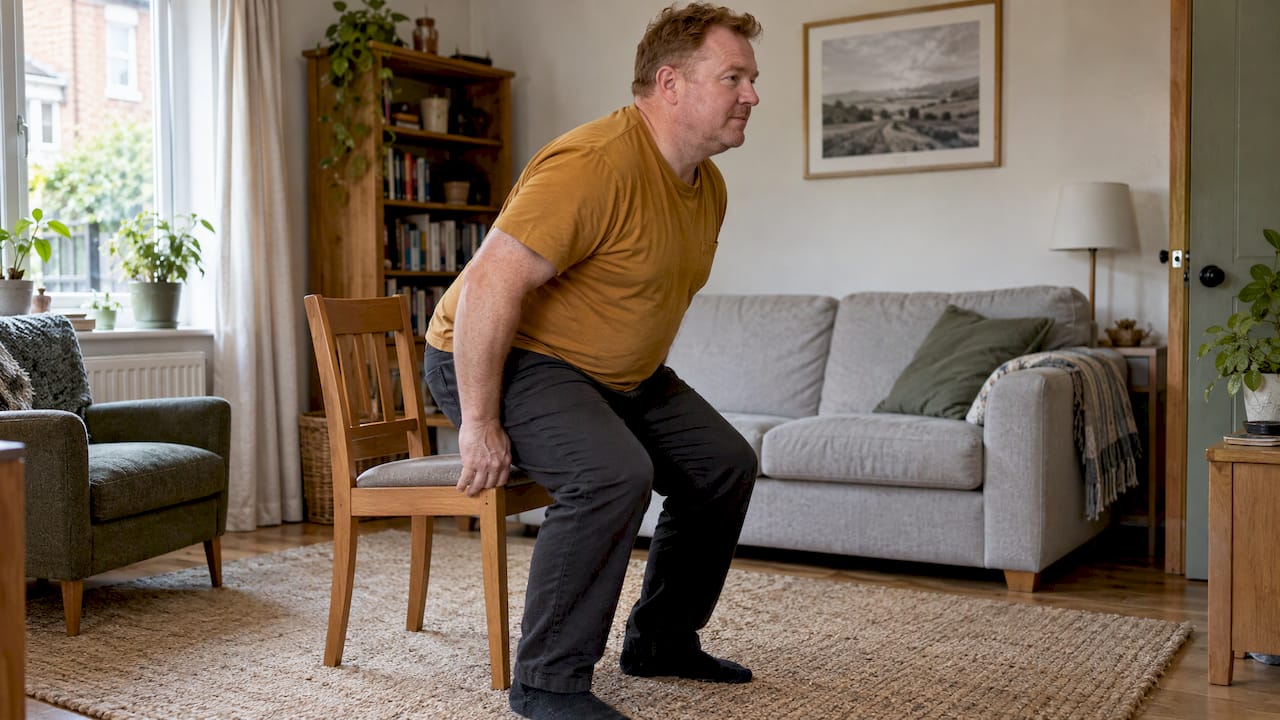
- Getting up from a chair without pushing off with your hands.
- Lifting something that felt heavy a month ago.
SHIFT Fit covers approachable walking and strength, and our men's fat loss workouts guide lays out a realistic weekly plan. Strength changes such as grip, leg power and getting up from a chair are good things to notice, because they often improve before body shape changes.
A word on safety: if you have a heart condition, high blood pressure, joint pain or you haven't exercised in years, check with your GP before stepping up the intensity. The NHS lists these among the reasons to see a GP about your weight.
Sleep, mood and Life Back
Sleep and mood are the wins men most often overlook, and they affect everything else. Snoring, waking tired and low mood are among the day-to-day problems the NHS links with obesity, so improvements here are worth writing down.
Life Back is the part of free My Timber for the things that matter beyond the scales. Use it to notice what you can do again: playing with the kids, a weekend walk, a night out without dreading the photos. Those are the things that make a change feel real.
If you snore loudly, stop breathing in your sleep, or feel exhausted all day, tell your GP. Sleep apnoea is one of the conditions the NHS says to see a GP about.
Blood pressure, blood tests and metabolic health
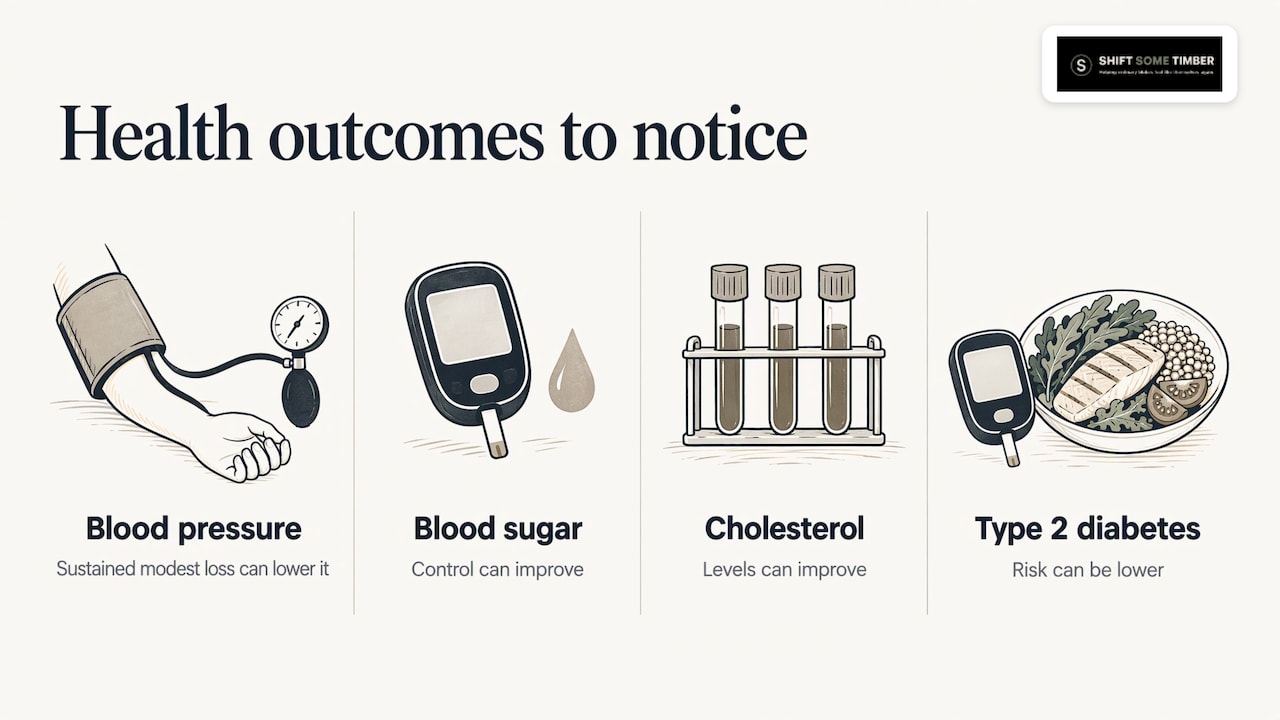
Some of the best wins are numbers, just not the number on the scales. The NHS says that losing 5 to 10% of your body weight can improve health. Scottish guidance on managing obesity, published in 2010, says sustained modest weight loss can bring lower blood pressure, better blood sugar control, improved cholesterol levels and a lower risk of type 2 diabetes. It also says people with a BMI of 25 to 35 may need a 5 to 10% loss for heart and metabolic risk reduction, and those above 35 may need more. Those are group-level findings. What they mean for you is a conversation for your GP.
If you already have a blood pressure or cholesterol reading, your GP, practice nurse or pharmacist can repeat it over time. Write down the date and the result. A better reading is a win that no mirror will show you.
Our SHIFT Health MOT is a free tool that helps you organise your health picture and think about what to ask. It is not a diagnosis. SHIFT Health also offers plain-English education on blood pressure, blood tests, metabolic and heart health, testosterone and fertility. We cover these topics to help you ask better questions, not to replace your GP.
Testosterone, fertility and energy
Many men wonder whether low energy, low drive or fertility worries are tied to weight. It is a fair question, and there is no one-size answer. Changes in energy, mood and sex drive are worth tracking in your weekly notes, and worth raising with your GP if they persist or worry you. Don't try to self-diagnose from a symptom list or buy tests online without advice. SHIFT Health education pages explain the basics so you can go to the appointment with better questions.
When to talk to a GP
Non-scale victories are encouraging, but some changes need a professional. Speak to your GP if:
- You want help losing weight, your waist is more than half your height, or you have pre-diabetes, diabetes, high blood pressure, high cholesterol, joint pain, sleep apnoea or heart disease. These are all NHS reasons to see a GP.
- You have, or think you may have, an eating disorder such as binge eating.
- Your weight is dropping without you trying. The NHS says unintentional weight loss of 5 to 10% in 3 to 6 months can be a sign of malnutrition, and clothes getting looser over time is one of the signs.
- You notice something new, unusual or persistent in your body. Cancer Research UK says in most cases it won't be cancer, but catching it early makes a real difference.
That last point matters here. Looser clothes are a win only when you have been trying to lose weight. If you haven't, get it checked.
If you take weight loss medication, or are thinking about it, your own prescriber makes the individual treatment decisions. Take questions about suitability, side effects or stopping to them. SHIFT doesn't currently provide clinical assessment, prescribing or dispensing.
Keeping wins going: the pace question
Quick wins feel good, but steady pace helps them last. The NHS suggests aiming to lose 1 to 2 lbs (0.5 to 1 kg) a week, and the idea of losing 0.5 to 1 kg weekly and keeping it off lines up with that. Some weeks you won't hit it. That is normal, and it is exactly why a wider set of markers helps.
When the scales stall, go back to your check-in. If walking, sleep and energy are improving, your habits are working. Our weight loss maintenance plan is a good next read if you have reached a point where holding steady matters more than losing more.
How free My Timber helps you notice progress
My Timber is free to use. It brings together Today and Journey check-ins, progress tracking, SHIFT Grub, SHIFT Fit, Life Back and Ask Timber for non-clinical support. You can use it alongside your own clinic or prescriber, after treatment ends, or without treatment. You don't need a prescription transfer or a purchase.
The check-ins are a good home for the weekly routine above. Log the five areas, add a line, pick your one choice. Over a few weeks the pattern is much clearer than any single weigh-in. You can start from the SHIFT homepage and find My Timber, recipes, exercise guides, calculators and the Health MOT from there.
FAQ
Are non-scale victories just a consolation prize when the scales won't move?
No. They are real information. Weight shifts with water, hormones and sleep, and strength or fitness can improve without the number changing. Many non-scale wins, such as lower blood pressure or less joint pain, are changes your GP can track.
How long does it take for body confidence to improve after weight loss?
There is no set time. Research suggests body image tends to improve after weight loss, but individual experiences differ and some insecurity can linger. Doing things you used to avoid often helps. If low mood or anxiety about your body persists, speak to your GP.
How often should I check in on non-scale progress?
Once a week is enough for most men. Pick the same day, score a few areas, write one line and choose one small action. Checking daily can bring back the same pressure you get from the scales.
Should I still weigh myself?
That is your call. Some men like the occasional weigh-in as one data point among many, while others find it stressful. If it knocks your mood, leave it and use the other markers. Talk to your GP or prescriber about what monitoring suits you.
Is My Timber only for men on weight loss medication?
No. It is free practical support that you can use alongside your own clinic or prescriber, after treatment ends, or without treatment at all. Decisions about any medication stay with your own prescriber.
Sources
- Overweight and obesity in adults, NHS
- Malnutrition symptoms, NHS
- Management of Obesity, SIGN
- Male perceptions and experiences of weight loss, PLOS One
- Camaraderie is the secret to men losing weight, University of Essex
- Psychological benefits of weight loss following behavioural interventions, Lasikiewicz et al.
- Translating weight loss into agency: men's experiences, PubMed
- Sex File on male body image, Irish Examiner
- Non-Scale Victories: Track Real Progress, Allina Health
- Home-based resistance training during weight loss, pilot trial
- How to Measure Progress without Stepping on the Scale, VA Nutrition
- Talking to your doctor, Cancer Research UK
- Lose 0.5 to 1 kg a week and keep it off
Recommended
- Weight Loss Plateau in Men: Why It Happens and What to Do
- Men's Mental Health and Weight: Confidence Without Blame
- Waist Size for Men: How to Measure It and What It Means
- Weight Loss for Men Over 40: A Realistic UK Guide
SHIFT provides general UK health information and practical support. Speak to your GP or your own prescriber about symptoms, test results or medicines. My Timber is free to use alongside your own clinic, after treatment ends or without treatment.
Last updated .