
Weight Loss Plateau in Men: Why It Happens and What to Do
If the scales have stopped moving, you are not broken and you have not failed. A plateau is a normal stage of losing weight, and for most men it can be worked through with a short list of checks and a few sensible changes. The trick is to know whether you are really stuck, then change one or two things rather than everything at once. If you are on weight loss medication, there are also set points where your prescriber should review how it is going, and we cover those below.
TL;DR
- A plateau usually means no change on the scales for around three to four weeks despite sticking to your plan. A few days of flat or up weight is normally just fluid.
- Your body adapts as you lose weight. You burn fewer calories, you can lose some muscle, and appetite pushes back.
- Check the basics first: portions, drinks, weekend eating, sleep, stress and how you are measuring progress.
- Strength training, enough protein, more daily steps and a steady routine are the most practical levers.
- On medication, there are formal review points (for example 5% weight loss thresholds). Speak to your prescriber rather than guessing or changing your dose yourself.
Table of Contents
- What counts as a weight loss plateau?
- Why weight loss stalls in men
- Check these before you change anything
- What to change when the checks come back clean
- A simple two-week reset
- If you are taking weight loss medication
- Stopping treatment or keeping the weight off
- When to see your GP
- Our perspective
- Getting support that fits your week
- FAQ
- Sources
What counts as a weight loss plateau?
A plateau is when your weight stays the same even though you are keeping to your diet and activity. Doctors typically call it a plateau after three to four weeks without change, not after three or four days.
That gap matters. Body weight moves around day to day. Salty meals, a big night out, a lot of sugary food or carbs, a hard training session and even a bad night's sleep can all shift water on the scales. Water retention from high-salt or high-sugar foods can hide real fat loss for a while.
A simple way to tell the difference
| What you see | What it probably is | What to do |
|---|---|---|
| Up 1 to 2 lb after a takeaway or a salty weekend | Fluid | Carry on, weigh again in a few days |
| Flat for a week | Normal fluctuation | Look at the weekly average, not single weigh-ins |
| Flat for three to four weeks with a consistent routine | A plateau | Run the checks below, then adjust |
| Flat or rising for weeks and you have slipped on habits | Habit drift, not a plateau | Reset the basics, no guilt |
| Flat on medication for 12 weeks or more | A review point | Speak to your prescriber |
Weigh at the same time of day, ideally first thing after the loo and before food, and compare weekly averages. Add a waist measurement every two weeks. If your trousers are looser while the scales are flat, you are still making progress.
Why weight loss stalls in men
Plateaus are not a sign that your willpower has run out. They come from how the body responds to losing weight.
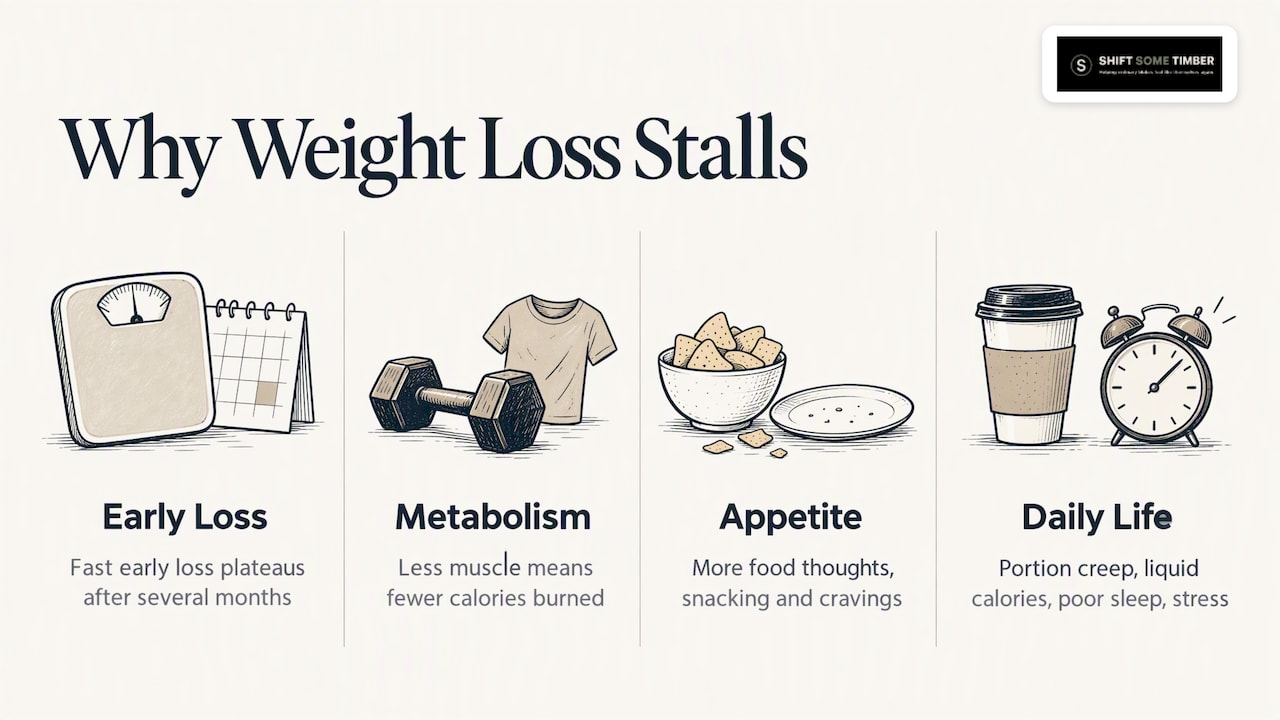
Early losses slow down. The first weeks often bring fast results, partly from water and partly from fat. NHS guidance on weight loss medicines notes that rapid early loss is often followed by a plateau after several months, as the body's biological responses oppose further loss.
Your metabolism drops a little. When you lose weight you lose some muscle as well as fat. Because muscle helps keep your calorie burn up, your metabolism declines and you burn fewer calories. A smaller body also simply needs less energy to move around. The plan that worked at 20 stone may maintain you at 17.
Appetite gets louder. Many men describe more thoughts about food, snacking and cravings as weight comes off. That is the body pushing back, and it is one reason a plateau can feel like a motivation problem when it is partly biology.
Life gets in the way. For busy dads and working men, the common culprits are quieter: portion creep, liquid calories, meals eaten on the move, evening snacking, weekends that undo the week, poor sleep and stress. None of that is a moral failing. It is what happens when a plan has to survive real life.
We look at the medication side of this in more detail in our guides on a GLP-1 weight loss plateau and an Ozempic plateau and safe next steps.
Check these before you change anything
A plateau is normal and can happen despite your best efforts. The sensible first move is to check your habits, and only then consider adjusting calories or exercise. Work through this list honestly for one week.
- Are you measuring properly? Use weekly averages and a tape measure, not one daily number.
- Have portions crept up? After a few months, "a handful of nuts" or "a bit of pasta" tends to grow.
- What are you drinking? Beer, juice, sweetened coffee and energy drinks add up without feeling like food.
- What happens at weekends? Five good days and two loose ones can cancel a deficit.
- How are you sleeping? Short or broken sleep makes hunger harder to manage.
- How stressed are you? Long work days and family pressure often show up as snacking.
- Has your activity slipped? Fewer steps usually creep in unnoticed once the novelty fades.
- Is the plan still realistic? If it only works when everything goes right, it is too strict.
If you want a structured way to do this, our weight-management review questions are designed to help you spot where your routine has drifted and what to raise with a clinician.
What to change when the checks come back clean
Pick one or two changes, give them two to three weeks, then reassess. Changing everything at once makes it impossible to know what worked, and it is hard to keep up.
Recalculate what you need
Your calorie needs are lower than when you started. A modest trim in portions, or swapping a few higher-calorie items for filling lower-calorie ones, is usually enough. Avoid crash cuts: they are hard to keep up and tend to cost you muscle. For ideas on realistic eating, our men's diet guide with 1,800 calorie plans shows how to build meals that keep you full.
Protect your muscle
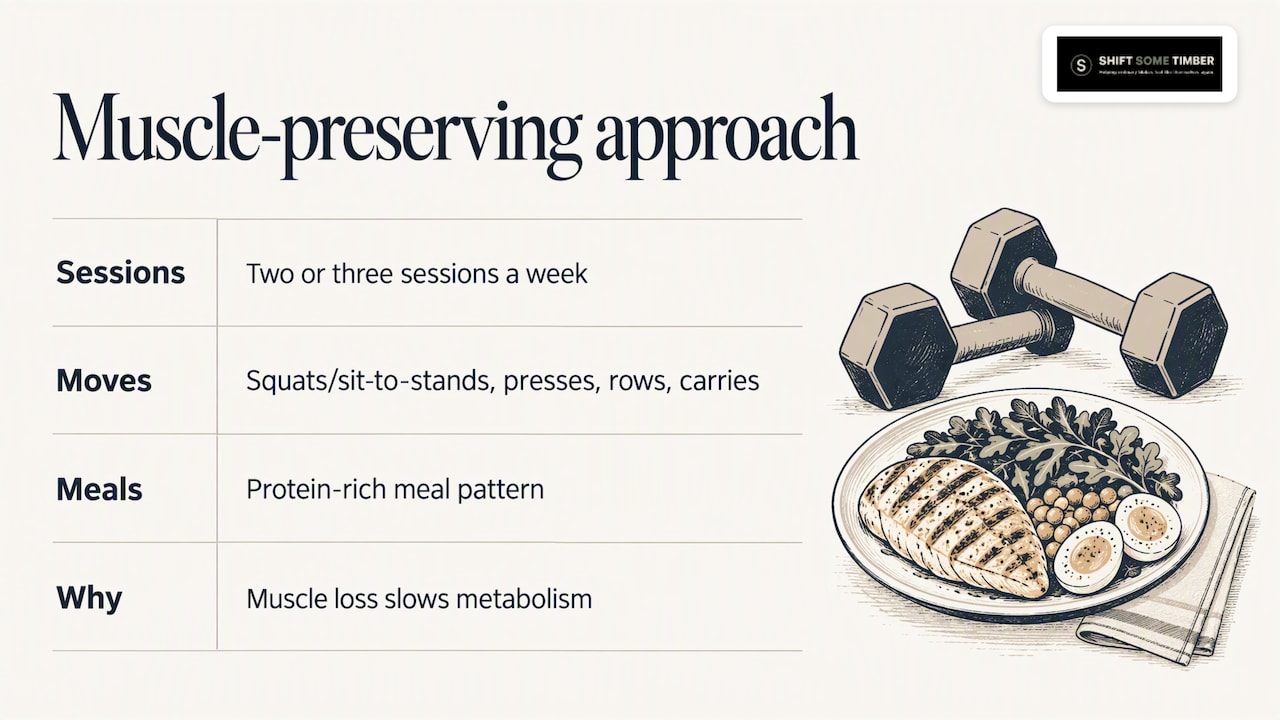
Because muscle loss slows metabolism, strength training is one of the most useful things you can add. Two or three sessions a week of simple compound moves (squats or sit-to-stands, presses, rows, carries) are plenty to begin with. Pair them with a protein-rich meal pattern so you are feeding the muscle you want to keep. Our Fit approach to movement is built around what is achievable, not what looks impressive. If you are over 50, our realistic guide to weight loss for men over 50 covers why muscle matters even more.
Move more in ordinary ways
You do not need to double your gym time. Small, repeatable targets work better. The BDA's behaviour-change resource gives the example of walking 5,000 steps on selected days or planning meals as achievable long-term goals. A 20-minute walk after dinner, parking further away, or a call taken on foot all count.
Sort sleep and stress
The BDA lists small, manageable goals, meal planning, tackling stress and sleep, tracking and consistency over perfection as the backbone of sustainable change. If your mood has dipped or motivation is low, start smaller still with our tiny goals, and see how movement can help your mood too.
A simple two-week reset
If you have run the checklist and want a clear plan, try this for two weeks.
Week one: tighten the basics
- Write down everything you eat and drink on most days. You are looking for patterns, not perfection.
- Plan your main meals for the week, including one "easy" backup for busy nights.
- Hit a daily step target that is a little above your current average.
- Aim for a regular bedtime on at least five nights.
Week two: add one lever
- Add two short strength sessions.
- Build protein into each meal.
- Trim one habitual extra, such as the daily sugary drink or the late-night snack.
- Weigh in the same way as before and take a waist measurement.
At the end, compare weekly averages. If the trend is down, even slightly, keep going. If nothing has moved after a further couple of weeks of consistent effort, it is time to look at medical support rather than pushing harder.
If you are taking weight loss medication
Plateaus are common on treatment too, and medicines work best alongside a reduced-calorie diet and more activity. The national prescribing guide says to use them with a reduced-calorie diet and increased activity. It also sets out review points. For tirzepatide, you and your prescriber should decide whether to continue if weight loss is under 5% after 6 months on the highest tolerated dose, and liraglutide and orlistat have 12-week thresholds.
For orlistat, UK prescribing guidance says treatment should be stopped if at least 5% weight loss is not reached after 12 weeks, or if weight is regained. The Endocrine Society's guideline takes a similar line, recommending stopping if loss is under 5% at 3 months or if safety or tolerability is a problem, and considering another medicine or referral.
What this means in practice:
- Do not raise, skip or stretch doses on your own to get past a plateau. Dose changes are for your prescriber.
- Tell your prescriber if your loss has stalled, along with what your eating, activity and side effects have been like.
- If you take orlistat, report symptoms of liver problems such as yellowing of the skin or eyes or dark urine. UK guidance lists jaundice and dark urine as symptoms to report. Our practical orlistat guide and the Wegovy and orlistat comparison explain more.
- If you started treatment somewhere that has gone quiet on follow-up, our page on when the clinic goes quiet explains how to get continuity.
For wider background on treatments, see our medication overview and the GLP-1 Knowledge Centre.
Stopping treatment or keeping the weight off
Many men worry that a plateau, or coming off medication, means the weight will creep back. The BDA is clear that regain after stopping obesity medication is not down to a lack of willpower or doing something wrong. It happens because of how our bodies work.
That is a reason to build habits while you are still losing, not after. The BDA also provides a resource with advice on longer-term lifestyle changes to help prevent regain after treatment ends. A few things help in practice:
- Keep a regular weigh-in and a waist check so small gains are caught early.
- Keep strength training and your daily steps, as they protect your muscle and your calorie burn.
- Keep meals planned, especially on work days.
- Have a plan for what you do if weight rises by a few pounds, so it is a nudge, not a spiral.
- Look beyond the scales: energy, sleep, fitness, clothes and confidence all count. Our Life Back page is about tracking exactly that.
When to see your GP
A plateau on its own is rarely a medical problem. But speak to your GP or prescriber if:
- you are tired all the time, low in mood or struggling with sleep, in a way that is new for you;
- your weight is rising despite no change in habits;
- you are on medication and have reached a review point without meeting the thresholds above;
- you are on orlistat and notice jaundice or dark urine;
- you have symptoms you cannot explain.
Blood tests can help rule out things that affect energy and weight. Our Baseline, Complete and Advanced health checks are options to discuss with a clinician, and our Men's Health hub covers energy, sleep and wellbeing more widely.
Our perspective
Most men who write to us about a plateau are not lacking effort. They are tired of doing everything right and watching the scales sit still, and they have often been quietly blaming themselves.
We think that is the wrong starting point. A plateau is information. It tells you the plan needs a small adjustment, or that it is time for a conversation with a clinician. It does not tell you anything about your character.
That is why SHIFT is built around support before, during and after treatment, including for men who started elsewhere or have stopped medication. Our approach is designed to keep the practical bits in view: Grub for food ideas that fit a working week, Fit for movement you can actually keep up, My Timber for check-ins and tracking, and Life Back for the goals that matter beyond the scales.
Where medication is appropriate, clinical assessment, prescribing and dispensing are handled by appropriately regulated partners, and we keep helping you with the day-to-day habits that make any treatment work better. You should never have to do this on your own, or in silence.
Matt O’Brien
Getting support that fits your week
If you have run the checks and want help working out what comes next, we can walk you through it. SHIFT brings together treatment information, practical food and movement support, and regular check-ins, with privacy and no judgement. You can start with our Weight Loss for Men UK page or build a plan with My Weight-Loss Roadmap.

If you want to read more first, the Men's Health Knowledge Hub and our evidence-based starting plan are good places to begin.
FAQ
How long does a weight loss plateau last in men?
There is no fixed length. Doctors typically treat it as a plateau once your weight has not changed for three to four weeks despite consistent effort. Many plateaus ease once you adjust portions, add strength training or improve sleep. If nothing changes after a few more weeks of steady effort, speak to your GP or prescriber.
Should I eat less or exercise more to break a plateau?
Check your habits first, then consider adjusting calories or exercise. For most men, adding strength sessions and daily steps is easier to sustain than cutting food hard. Avoid large cuts, as they are tough to keep up and can cost muscle.
What should I do if my weight loss medication stops working?
Do not change your dose yourself. Tell your prescriber, who can review your progress against the set thresholds, such as under 5% loss after 6 months on the highest tolerated tirzepatide dose. They can then decide whether to continue, change or stop. Keep your food, activity and sleep habits steady in the meantime.
Will I regain weight if I stop treatment?
Some people do, and it is not a willpower failing: the BDA says it happens because of how our bodies work. Building habits such as meal planning, regular steps and strength training while you are on treatment gives you a better base to maintain from.
Is a plateau a sign something is wrong with my health?
Usually not. It is a common stage of weight loss. See your GP if you have new tiredness, low mood, unexplained symptoms, rising weight despite no change in habits, or if you are on orlistat and notice jaundice or dark urine.
Sources
- What to Do if You Are Stuck on a Weight Loss Plateau (WebMD)
- Lifestyle advice for people taking weight loss medicines (Guy's and St Thomas' NHS)
- Getting past a weight-loss plateau (Mayo Clinic)
- Lesson 22: Plateaus (Northwestern EVO study)
- Healthy habits to support your obesity treatment (British Dietetic Association)
- A practical guide to using medicines to manage overweight and obesity (NICE)
- Pharmacological Management of Obesity guideline (Endocrine Society)
- British Dietetic Association medications for obesity resource (NICE)
Recommended
- Weight-Loss Plateau: What Men Should Check Before Panicking
- GLP-1 Weight Loss Plateau: What 4 Flat Weeks Mean in the UK
- Ozempic Weight Loss Plateau: UK Six Month Review and Safe Next Steps
- Weight Loss for Men Over 40: A Realistic UK Guide
Last updated .