
Blood Test Results Explained: A Plain Guide for UK Men
A blood test result is a set of numbers, each measured against a reference range printed beside it. A flag means a number sits outside that range. It does not mean you are ill. What the number means for you depends on your symptoms, your history and often a repeat test, and that conversation belongs with the GP, nurse or specialist who requested it. This guide shows you how to read the report so you walk into that conversation with better questions. It includes testosterone, which many men search for after a result lands.
We are the SHIFT Team. We write plain-English health information for UK men. We don't interpret individual results, and nothing here replaces your own GP or prescriber.
TL;DR
- Every line on a report has a test name, your result, a unit and a reference range. Read the range printed on your own report, because labs use different ranges.
- A high or low flag means "outside the range", not "diagnosis". Ask the person who requested the test to explain it.
- Testosterone is best measured on a morning sample, and a low first result is usually repeated before anyone draws conclusions.
- Free and total testosterone are not rivals: a doctor may look at both, plus a protein called SHBG, when a total result is borderline.
- Keep every report in one place. Trends over time tell you more than a single number.
Table of Contents
- How to read a blood test report
- What "normal" and "abnormal" really mean
- A worked example
- Other markers you may see
- Testosterone blood tests: what is measured
- Why the morning matters
- Reading a testosterone result
- Free vs total testosterone
- Home testosterone tests
- Making results useful in everyday life
- Free support alongside your own clinic
- One next step
- FAQ
- Sources
How to read a blood test report
Every line has the same four parts.
- Test name. For example haemoglobin, ferritin, HbA1c or testosterone.
- Your result. The number measured in your sample.
- The unit. Such as g/L, mmol/L, mmol/mol or nmol/L. Units matter because the same marker can be reported in different ones.
- The reference range. The span of values the lab expects in most healthy people of your age and sex, often with an H or L flag when you fall outside it.
Start with the unit and range, not the number. A testosterone of 9 means nothing until you know it is in nmol/L and that the lab's range for men starts at, say, 8.
The NHS says a blood test is usually done at a GP surgery or hospital and takes about 10 minutes, with results arriving after a few days and usually within a few weeks. If you hear nothing after a few weeks, it advises contacting the GP surgery or specialist. It also says to ask a healthcare professional to explain anything you don't understand.
What "normal" and "abnormal" really mean
A reference range is a statistical span, not a pass mark. Most people sitting just outside it feel fine, and some people inside it still have symptoms. That is why doctors read results alongside how you feel.
Ranges also differ between hospitals because labs use different equipment and methods. Here is total testosterone for adult men as printed by four UK NHS or lab sources:
| Lab | Printed range for men | Date or version |
|---|---|---|
| Oxford University Hospitals | 8.0 to 32.0 nmol/L (19+) | August 2026 |
| Newcastle Hospitals | 8.6 to 29 nmol/L (18 to 49); 6.7 to 25.7 nmol/L (50+) | Current test directory |
| Leeds Teaching Hospitals | 8 to 27 nmol/L | Version 3.21, October 2026 |
| Synlab | 8.3 to 30.2 nmol/L (under 50); 7.7 to 24.8 nmol/L (50+) | Version 6, July 2026 |
The numbers are close but not identical. A joint UK position statement from the Society for Endocrinology and the Association of Clinical Biochemistry and Laboratory Medicine says a single reference range or cut-off is not appropriate in the UK because the tests and their ranges vary. These tables are published by the labs and are revised from time to time, so your own report is always the one to trust.
A worked example
Say your report shows:
- Testosterone (total): 9.4 nmol/L. Range printed: 8.0 to 32.0 nmol/L. No flag.
- HbA1c: 44 mmol/mol. Range printed: 20 to 41 mmol/mol. Flagged H.
The testosterone is inside the range, but near the bottom. Whether that matters depends on symptoms and on a repeat sample, so it is a question for your GP rather than a conclusion.
The HbA1c sits above the non-diabetic band. Oxford's published ranges list 20 to 41 mmol/mol as non-diabetic, 42 to 47 as high risk of diabetes and 48 or above as diagnostic of diabetes. A flag here is a prompt for a conversation about food, movement and follow-up testing, not a verdict. Our guide to HbA1c and your three-month blood sugar number goes through it in more detail.
Write down two or three questions before you ring or book: "Is anything outside the range that I should act on?", "Do we need to repeat it, and when?", "Does this change anything about my weight or treatment plan?"
Other markers you may see
Most men get a general panel rather than a testosterone test. Typical lines include haemoglobin (oxygen-carrying protein in red cells), ferritin (iron stores), thyroid markers, cholesterol, liver function and HbA1c. Leeds prints haemoglobin for males over 16 as 130 to 180 g/L, which shows how a range is written with its unit.
Some lines look alarming but are rarely meaningful alone. MPV, the average size of your platelets, is a good example. Cleveland Clinic gives a normal MPV as roughly 7 to 9 fL in non-pregnant adults and notes that a high or low MPV on its own does not mean disease. The same logic applies to most single flagged numbers: a clinician looks at the pattern.
For a wider tour, see our guides to blood tests for men and what they check, blood tests for tiredness and the numbers, ranges and context behind results.
Testosterone blood tests: what is measured
A testosterone test usually measures total testosterone, the hormone circulating in your blood, most of it attached to proteins. Low testosterone in men is called hypogonadism. Newcastle's laboratory notes that low results may point to hypogonadism and that LH and FSH are needed to tell whether the cause lies in the testes or the brain's signalling. Those are two other hormones the lab may add.
Testing is aimed at men with symptoms. Derbyshire's NHS pathology guideline says general population screening is not recommended but that biochemical testing should happen where signs or symptoms are present. Symptoms such as low mood, poor sleep, low drive or tiredness have many causes, which is why a GP usually looks at the whole picture first.
See our testosterone blood test preparation and results guide for the education side.
Why the morning matters
Testosterone rises and falls across the day. Derbyshire's guideline says samples should be taken around 9am (between 8 and 10am) after sleep. The joint UK statement recommends morning fasting samples when you are not acutely ill, while a review in Diagnostics notes a non-fasting early morning sample is considered acceptable so fasting does not become a barrier. The same review says shift workers should be tested within three hours of waking, because the rhythm follows sleep.
Practical points for a busy man:
- Book the earliest slot you can get.
- Tell the surgery if you work nights, so they can time it from when you woke.
- Don't test while you have an infection or are very unwell, as illness can affect the result.
- Follow the instructions you are given on fasting rather than guessing.
Our testosterone blood test timing guide covers preparation step by step.
Reading a testosterone result
UK guidance does not offer one magic number, but the joint position statement gives a framework for a man with symptoms:
- Two consecutive morning fasting levels below 8 nmol/L are likely to mean hypogonadism.
- A level of 8 to 12 nmol/L needs careful clinical correlation, meaning a doctor weighs it against symptoms and other tests.
- Above 12 nmol/L is not usually consistent with hypogonadism.
Derbyshire's flowchart is similar: it treats a 9am result of 12 to 28 nmol/L as adequate function, and the lab adds LH and FSH when a result is under 12 nmol/L. Note that the guideline revision shown carries an expiry date of 31 March 2026, so your own NHS area's current version is what your GP follows.
Two things follow. First, one low result is a reason to repeat, not to panic. Second, treatment decisions, if any, sit with your GP or specialist. We can't say whether a number is right for you.
Free vs total testosterone
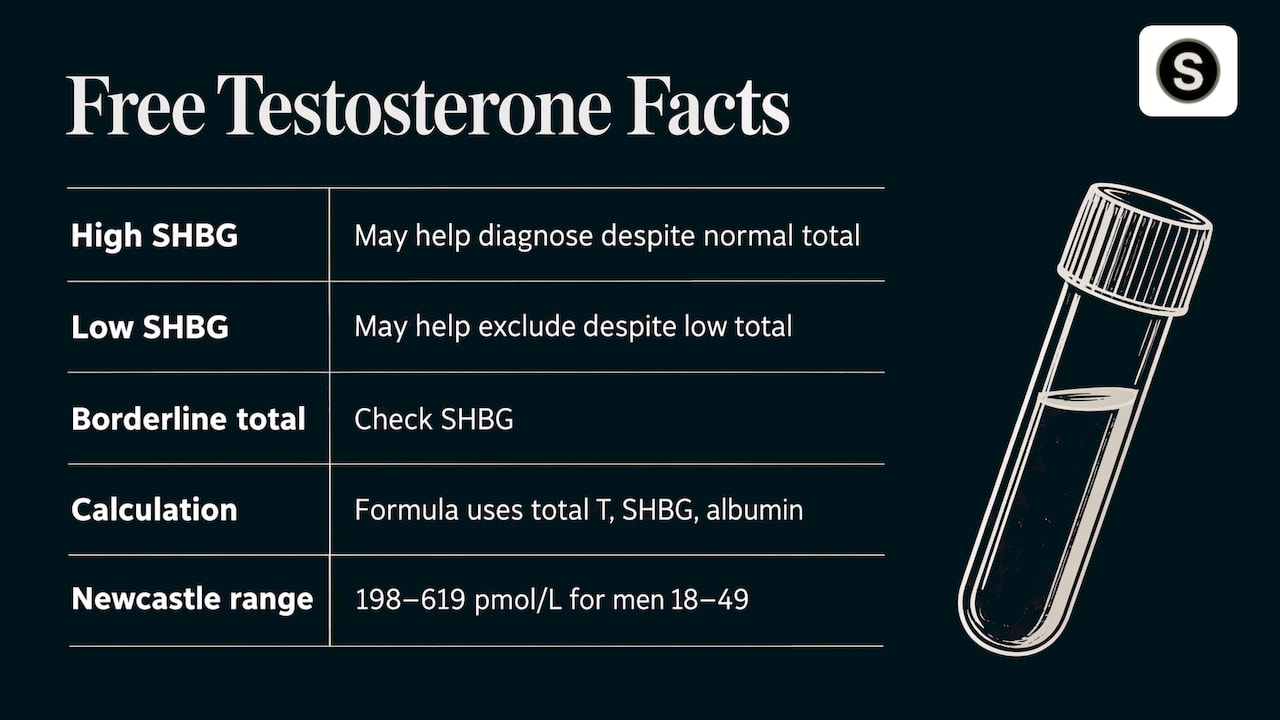
Most testosterone in the blood is bound to a protein called SHBG (sex hormone binding globulin). Free testosterone is the small share not bound. The joint UK statement explains why the split matters: when SHBG is high, calculated free testosterone may help diagnose hypogonadism despite a normal total, and when SHBG is low it may help exclude it despite a low total. So SHBG should be checked when total testosterone is borderline.
You may notice a free testosterone figure on a report, such as Newcastle's printed range of 198 to 619 pmol/L for men aged 18 to 49. Note the unit is pmol/L, not nmol/L. In UK labs this figure is normally worked out by formula from total testosterone, SHBG and albumin, because the review in Diagnostics reports that no UK clinical laboratories offered direct free testosterone measurement in a national audit. If your report says "calculated", that is normal.
Excess weight can influence SHBG and testosterone, which is one reason men on a weight loss journey are sometimes tested. Our guide to weight loss blood tests for UK men explains the common checks.
Home testosterone tests
Home kits usually involve a finger-prick or a sample you post to a lab. Whatever the route, a few points apply:
- Ranges vary between labs, so a result only makes sense against the range printed with it.
- Timing matters for testosterone, so take the sample in the morning as instructed.
- A single result, however it was collected, is rarely the end of the story. Doctors usually repeat a low morning result.
- Take the report to your GP and ask them how to read it, especially if you have symptoms.
If you are on weight loss treatment, tell your own prescriber about any results you get, so they sit in one record.
Making results useful in everyday life
A result is a snapshot. What you do next is mostly ordinary and achievable.
Food. If your HbA1c or cholesterol is flagged, realistic meals help more than a dramatic overhaul. Our recipes include simple, UK-friendly breakfasts you can batch cook, such as a paprika turkey potato hash.
Movement. Walking and light strength work fit around work and family. Our walking vs structured exercise comparison helps you pick a starting point.
Sleep and mood. Poor sleep and stress can sit behind tiredness that gets blamed on hormones. Life Back is where we cover progress beyond the scales.
Tracking. Keep each report, with its date and printed ranges, in one folder or note. Comparing like with like over months is more useful than any single reading. We explain how in keeping track of your health results over time.
Free support alongside your own clinic
My Timber is our free practical support. It brings together check-ins, progress tracking, food and recipes with SHIFT Grub, walking and strength with SHIFT Fit, Life Back and Ask Timber for non-clinical support. You can use it alongside your own clinic or prescriber, after treatment ends, or with no treatment at all. No prescription transfer or purchase is needed. Clinical assessment, prescribing and dispensing through SHIFT are currently closed, so your own prescriber handles individual treatment decisions. You can start from the Shift Some Timber home page.
One next step
Pick the report you already have. Find the unit and the reference range on each flagged line, write down your three questions, and book the GP conversation. That is enough for today.
FAQ
What does a high or low flag on a blood test mean?
It means your number is outside the reference range printed on that report. Ranges are statistical spans and differ between labs, so a flag is a prompt to ask your GP or nurse what it means for you, not a diagnosis.
When should a testosterone blood test be taken?
In the morning, ideally around 9am. Derbyshire's NHS guideline gives 8 to 10am after sleep as the window. If you work shifts, the Diagnostics review suggests testing within three hours of waking.
Is free or total testosterone more important?
Neither is "better". Total testosterone is the usual first test. When it is borderline, doctors may check SHBG and calculate free testosterone to get a clearer picture, as the UK position statement describes.
How long do blood test results take?
The NHS says results may arrive after a few days and usually within a few weeks. If you hear nothing after a few weeks, contact the GP surgery or specialist who requested the test.
Can I use My Timber if I'm on weight loss medication?
Yes. My Timber is free and designed to be used alongside your own clinic or prescriber, after treatment ends, or without treatment. Questions about your medication go to your own prescriber.
Sources
- Blood tests, NHS
- Biochemistry reference ranges, Oxford University Hospitals
- Testosterone, serum, Newcastle Hospitals Laboratories
- Blood Sciences Reference Range Database, Leeds Teaching Hospitals
- Chemistry Reference Intervals, Synlab
- Standardising the biochemical confirmation of adult male hypogonadism, Clinical Endocrinology
- Derbyshire shared care pathology guideline on testosterone
- Adult Male Hypogonadism: A Laboratory Medicine Perspective, Diagnostics
- MPV blood test, Cleveland Clinic
Recommended
- Testosterone blood tests: preparation and results explained
- Fasting Before a Blood Test: What UK Men Need to Know
- Keeping Track of Your Health Results Over Time: A UK Guide for Men
- Understanding blood-test results and follow-up
SHIFT provides general UK health information and practical support. Speak to your GP or your own prescriber about symptoms, test results or medicines. My Timber is free to use alongside your own clinic, after treatment ends or without treatment.
Last updated .